Species · Fishes
Sonora Chub Gila ditaenia
The scientific name of the Sonora Chub is Gila ditaenia. It is a species of fish in the family Cyprinidae (carps), order Cypriniformes. The name dates from 1945.
- Scientific name
- Gila ditaenia Miller, 1945
- Common name
- Sonora Chub
- Genus
- Gila
- Family
- Cyprinidae (Carps)
- Order
- Cypriniformes
- Class
- Teleostei
- Red List category
- VU Vulnerable
- Environment
- freshwater
- Recorded in
- 2 countries
- Name status
- accepted in the Catalogue of Life

Overview
Gila ditaenia occurs in the Rio de la Concepcion drainage in the United States and Mexico. It is usually very dark, with two black stripes parallel to its lateral line and a very light underside.
Written 27 November 2026 from the sources listed below. Each statement was checked against the passage it cites; statements that could not be supported were removed.
Appearance
The Sonora Chub typically has a stout body, although some individuals have fusiform or cylindrical body shapes. It has 63 to 75 scales along its lateral line.[1][2]
Its dorsal, anal, and pelvic fins typically have eight fin rays, with variation between seven and nine. It has strongly developed scale radii on all scale fields and a horizontal to oblique mouth.[3][4]
The Sonora Chub is usually very dark, with two black stripes running parallel above and below its lateral line. Its underside is very light in color, forming a counter-shading pattern.[5][6]
During mating seasons, the paired and anal fins develop red markings and the belly develops orange areas. A round spot at the base of the tail is a distinguishing feature during these seasons.[7][8]
Habitat
The Sonora Chub is a stream-dwelling minnow. It concentrates in the deepest and largest pools, which provide more permanent and stable environments for juveniles.[9][10]
The species uses sandy pool bottoms to bury its eggs and protect them from predators. Drought can force Sonora chubs from deeper streams into shallower pools.[11][12]
California Gulch is a small intermittent or ephemeral tributary of Sycamore Canyon that joins it in Mexico.[13]
Diet
The Sonora Chub feeds on aquatic insects and terrestrial insects. It also consumes large floating algae pads in larger pools.[14][15]
Reproduction and life cycle
Sonora Chub spawning usually occurs during the early spring, although spawning is not restricted to spring.[16][17]
Larvae and juveniles have been recorded in Sycamore Creek and the Rio Altar during November.[18]
Male Sonora chubs commonly display strongly exaggerated coloration patterns. Breeding males develop bright red and orange fin patterns associated with mating success.[19][20]
The species' coloration patterns have been suggested to develop after spring and summer rains.[21]
Similar species
Gila ditaenia closely resembles Gila pandora but can be distinguished by its smaller lateral scales.[22]
Conservation
The Sonora Chub was placed on the endangered species list in 1988. Sycamore Creek and Penasco Creek habitats have been designated as critical areas where interference and fishing are prohibited.[23][24]
A 12-meter riparian boundary zone further restricts access to the species' streams.[25]
Mining, grazing, recreation, and introduced foreign taxa have contributed to habitat modification in Sycamore Creek. Non-native green sunfish are identified as a potential predator of the Sonora Chub.[26][27]
Decreasing watershed conditions and increasing drought conditions are additional threats to the species.[28]
The Sonora Chub was identified in California Gulch in 1995. A one-time search there in 2022 did not locate any individuals.[29][30]
A section of border wall was built over the California Gulch bed between 2023 and 2024 and may obstruct upstream migration.[31]
Classification of the Sonora Chub
| Kingdom | Animalia |
|---|---|
| Phylum | Chordata |
| Subphylum | Vertebrata |
| Infraphylum | Gnathostomata |
| Parvphylum | Osteichthyes |
| Gigaclass | Actinopterygii |
| Superclass | Actinopteri |
| Class | Teleostei (Teleost) |
| Order | Cypriniformes |
| Family | Cyprinidae (Carps) |
| Subfamily | Leuciscinae |
| Genus | Gila (Western Chubs) |
| Species | Gila ditaenia Miller, 1945 |
Where the Sonora Chub is found
Checklists and occurrence records place Gila ditaenia in 2 countries. GBIF holds 236 georeferenced records of it.
Countries
Regions and cities with the most records
- Sonora, Mexico 95
- Arizona, United States 91
- Rio Rico, United States 43
- Magdalena de Kino, Mexico 29
- Nogales, United States 11
- Zacatecas, Mexico 6
- Nogales, Mexico 4
A number beside a place is its count of GBIF occurrence records. A place without a number comes from a checklist alone. Records show where a species has been observed or collected, which can include escapes and vagrants.
Common names
English
- Sonora Chub
Names in 6 other languages
- Chinese
- 索諾骨尾魚
- Czech
- gila sonorská
- Latvian
- Sonoras gila
- Mandarin Chinese
- 索诺骨尾鱼
- Russian
- Сонорская гила
- Spanish
- Charalito Sonorense, carpa sonorense
Related species
-
 Humpback ChubGila cypha
-
 Bonytail ChubGila elegans
-
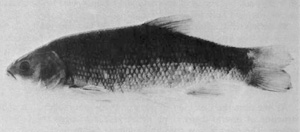 Thicktail ChubGila crassicauda
-
 Utah ChubGila atraria
-
 Roundtail ChubGila robusta
-
 Arroyo ChubGila orcuttii
-
 Rio Grande ChubGila pandora
- Virgin ChubGila seminuda
Compare
Questions and answers
What is the scientific name of the Sonora Chub?
The scientific name of the Sonora Chub is Gila ditaenia. Written with its author, the full name is Gila ditaenia Miller, 1945.
Which family does the Sonora Chub belong to?
Gila ditaenia belongs to the family Cyprinidae, in the order Cypriniformes and the class Teleostei.
Where is the Sonora Chub found?
Checklists and occurrence records place Gila ditaenia in 2 countries: Mexico and United States.
What is the conservation status of the Sonora Chub?
The IUCN Red List category recorded for Gila ditaenia is Vulnerable (VU).
How large does the Sonora Chub grow?
It rarely exceeds 200 millimeters in length. Most individuals recorded in the United States are no longer than 125 millimeters.[32][33]
What does the Sonora Chub eat?
It feeds on aquatic insects and terrestrial insects and consumes large floating algae pads in larger pools.[14][15]
When does the Sonora Chub spawn?
Spawning usually occurs during the early spring, but is not restricted to spring.[16][17]
What distinguishes the Sonora Chub from Gila pandora?
The Sonora Chub has smaller lateral scales than Gila pandora.[22]
Sources
Passages the profile rests on
- The Sonora chub has a typically stout body, although some individuals have fusiform or cylindrical body shapes. Source passage: “The Sonora chub's body is typically very chubby, hence its name, with fusiform and terete implications in some individuals.” — English Wikipedia
- The Sonora chub has 63 to 75 scales along its lateral line. Source passage: “There are 63 to 75 scales in a lateral line.” — English Wikipedia
- Its dorsal, anal, and pelvic fins typically have eight fin rays, with variation between seven and nine. Source passage: “They have eight fin rays on their dorsal, anal, and pelvic fins with some variation between seven or nine.” — English Wikipedia
- The Sonora chub has strongly developed scale radii on all scale fields and a horizontal to oblique mouth. Source passage: “The Yaqui chub GILA PURPUREA and the Sonora chub GILA DITAENIA have radii strongly developed on all fields of scales the mouth is horizontal to oblique and” — fieldguide.mt.gov
- The Sonora chub is usually very dark, with two black stripes running parallel above and below its lateral line. Source passage: “They are usually very dark in color with two noticeable black stripes running parallel above and below the lateral line.” — English Wikipedia
- Its underside is very light in color, forming a counter-shading pattern. Source passage: “They also have counter-shading patterns with very light underbellies for camouflage.” — English Wikipedia
- During mating seasons, the paired and anal fins develop red markings and the belly develops orange areas. Source passage: “During mating seasons, they will have red markings on their paired and anal fins, with orange areas on their bellies.” — English Wikipedia
- A round spot at the base of the tail is a distinguishing feature during mating seasons. Source passage: “A round spot at the base of their tails can easily identify them during their mating seasons.” — English Wikipedia
- The Sonora chub is a stream-dwelling minnow. Source passage: “The Sonora chub is a small (5-7 inches), stream-dwelling minnow” — ecos.fws.gov
- The Sonora chub concentrates in the deepest and largest pools because they provide more permanent and stable environments for juveniles. Source passage: “Sonora chubs concentrate themselves in the deepest and largest pools because they are more permanent, allowing a stable environment for their juveniles.” — English Wikipedia
- The species uses sandy pool bottoms to bury its eggs and protect them from predators. Source passage: “They use the sandy bottoms of these larger pools to burrow their eggs and protect them from predators.” — English Wikipedia
- Drought can force Sonora chubs from deeper streams into shallower pools. Source passage: “Periods of drought can however force them out of the deeper streams into shallower pools.” — English Wikipedia
- California Gulch is a small intermittent or ephemeral tributary of Sycamore Canyon that joins it in Mexico. Source passage: “a small intermittent or ephemeral tributary of the Sycamore Canyon that joins it in Mexico.” — English Wikipedia
- The Sonora chub feeds on aquatic insects and terrestrial insects. Source passage: “They feed on aquatic and terrestrial insects” — English Wikipedia
- The Sonora chub consumes large floating algae pads in larger pools. Source passage: “as well as the large floating pads of algae in the larger pools.” — English Wikipedia
- Sonora chub spawning usually occurs during the early spring. Source passage: “Spawning usually occurs in the early spring months of the year” — English Wikipedia
- The species' spawning is not restricted to spring. Source passage: “indicating that Sonora chubs do not restrict their spawning to the spring months.” — English Wikipedia
- Sonora chub larvae and juveniles have been recorded in Sycamore Creek and the Rio Altar during November. Source passage: “Larvae and juveniles have been found in Sycamore Creek and the Rio Altar in November” — English Wikipedia
- Male Sonora chubs commonly display strongly exaggerated coloration patterns. Source passage: “most males depict highly exaggerated coloration patterns.” — English Wikipedia
- Breeding males develop bright red and orange fin patterns associated with mating success. Source passage: “The more desirable breeding males have evolved bright red and orange patterns on their fins to ensure their mating success.” — English Wikipedia
- The species' coloration patterns have been suggested to develop after spring and summer rains. Source passage: “It has also been suggested that coloration patterns arise after spring and summer rains.” — English Wikipedia
- Gila ditaenia closely resembles Gila pandora but can be distinguished by its smaller lateral scales. Source passage: “Gila ditaenia is nearly identifical to Gila pandora but can be distinguished by smaller (63-75 lateral) scales” — fishbase.org
- The Sonora chub was placed on the endangered species list in 1988. Source passage: “This species was placed on the endangered species list in 1988” — English Wikipedia
- Sycamore Creek and Penasco Creek habitats have been designated as critical areas where interference and fishing are prohibited. Source passage: “The habitat areas of Sycamore and Penasco Creek have been placed on critical status, meaning that these areas have strictly prohibited any interference or fishing.” — English Wikipedia
- A 12-meter riparian boundary zone further restricts access to the species' streams. Source passage: “There is also a 12-metre (39 ft) riparian boundary zone, which further restricts access to these streams.” — English Wikipedia
- Mining, grazing, recreation, and introduced foreign taxa have contributed to habitat modification in Sycamore Creek. Source passage: “Sycamore Creek has been highly modified by human activities such as mining, grazing, and recreation, as well as the introduction of foreign taxa.” — English Wikipedia
- Non-native green sunfish are identified as a potential predator of the Sonora chub. Source passage: “There is also a concern for predation by non-native green sunfish” — English Wikipedia
- Decreasing watershed conditions and increasing drought conditions are identified as additional threats to the species. Source passage: “These various human perturbations are being made worse by decreased watershed conditions and increasing drought conditions” — English Wikipedia
- The Sonora chub was identified in California Gulch in 1995. Source passage: “In 1995, G. ditaenia was identified in the California Gulch” — English Wikipedia
- A one-time search for Sonora chubs in California Gulch in 2022 did not locate any individuals. Source passage: “A one-time search for specimens in 2022 in this area did not locate any individuals” — English Wikipedia
- A section of border wall was built over the California Gulch bed between 2023 and 2024 and may obstruct upstream migration. Source passage: “a border wall section was built over the California Gulch bed between 2023 and 2024 that may prevent upstream migration of Sonora chub during favorable hydrological periods.” — English Wikipedia
- The Sonora chub rarely exceeds 200 millimeters in length. Source passage: “rarely exceeding 200 millimeters in length.” — English Wikipedia
- Most Sonora chubs recorded in the United States are no longer than 125 millimeters. Source passage: “Most specimens in the United States never even exceed 125 millimeters.” — English Wikipedia
Data
- Catalogue of Life, 2026-10-16 XR cc by
- Global Biodiversity Information Facility CC BY 4.0
- Wikidata CC0
- GeoNames CC BY 4.0
- Wikimedia Commons per image; credit shown with each image
- Within the Catalogue of Life, this name comes from World Register of Marine Species cc by
References
- Miller, R. R. (1945). A new cyprinid fish from southern Arizona, and Sonora, Mexico, with the description of a new subgenus of Gila and a review of related species. Copeia, 2. https://doi.org/10.2307/1437513 Link where the name was published
This species in other databases
- Catalogue of Life 3G2G7
- Wikidata Q307274
- iNaturalist 101436
- WoRMS urn:lsid:marinespecies.org:taxname:1014404
- ITIS 163552
Page built on 27 November 2026. See how the catalog is made and all sources and licences.
Cite this page
ScientificNames.org. (2026). Gila ditaenia (Sonora Chub). Retrieved November 27, 2026, from https://scientificnames.org/species/gila-ditaenia
“Gila ditaenia (Sonora Chub).” ScientificNames.org, 2026, scientificnames.org/species/gila-ditaenia. Accessed 27 Nov. 2026.
ScientificNames.org. “Gila ditaenia (Sonora Chub).” Accessed November 27, 2026. https://scientificnames.org/species/gila-ditaenia.
@misc{scientificnames_gila_ditaenia_sonora_chub,
  author = {{ScientificNames.org}},
  title = {Gila ditaenia (Sonora Chub)},
  year = {2026},
  url = {https://scientificnames.org/species/gila-ditaenia},
  note = {Accessed 2026-11-27}
}