Comparison

Southern Grasshopper Mouse vs Muskrat

Southern Grasshopper Mouse (Onychomys torridus) and Muskrat (Ondatra zibethicus) both belong to the family Cricetidae (new world mice and rats) and part ways below it. Both are recorded in 2 countries.
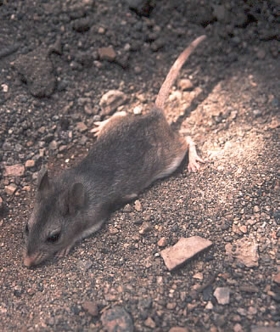
Southern Grasshopper Mouse

Southern Grasshopper Mouse

Onychomys torridus

National Park Service, Public domain, via Wikimedia Commons

Muskrat

Muskrat

Ondatra zibethicus

David Menke, Public domain, via Wikimedia Commons

Side by side

Southern Grasshopper MouseMuskrat
Scientific nameOnychomys torridus (Coues, 1874)Ondatra zibethicus (Linnaeus, 1766)
English nameSouthern Grasshopper MouseMuskrat
GroupMammalsMammals
ClassMammalia MammalMammalia Mammal
OrderRodentia RodentRodentia Rodent
FamilyCricetidae New World Mice and RatsCricetidae New World Mice and Rats
GenusOnychomys Grasshopper MouseOndatra Muskrat
Named in18741766
Red List categoryLeast ConcernLeast Concern
EnvironmentNot recordedfreshwater, terrestrial
Countries on record2 countries51 countries
GBIF occurrence records7,481 records1,181,297 records

Rows where the two agree are shown in grey.

Where each is found

Both recorded in 2 countries

Only Muskrat (49)

From Catalogue of Life checklists and GBIF occurrence records. A country missing from a list means no record is held, which is not proof of absence.

Checked facts

Southern Grasshopper MouseMuskrat
Appearance
  • The muskrat has a long, scaly tail that is laterally compressed and adapted for swimming. English Wikipedia
  • The muskrat has partially webbed hind feet that provide its main means of propulsion in water. English Wikipedia
  • The muskrat's fur has two layers that protect it from cold water. English Wikipedia
  • The muskrat has a large head, nearly concealed ears, medium-sized whiskers, and short legs. animaldiversity.org
  • The muskrat's coat includes dense underfur and longer, coarse, shining guard hairs. adfg.alaska.gov
Size
  • Its total body length, including the tail, ranges from 120 to 163 mm. English Wikipedia
  • Its head-and-body length averages 9–13 cm, and its tail measures 3–6 cm. animaldiversity.org
  • The tail accounts for an average of 33.9% of the animal's body length. English Wikipedia
  • Females have an average tail length of 4.58 cm, compared with 4.50 cm in males. English Wikipedia
  • Adult muskrats weigh approximately 0.6–2 kg. English Wikipedia
  • The muskrat's total adult body length is approximately 40–70 cm, including its tail. English Wikipedia
  • The muskrat's tail measures approximately 20–28 cm in length. adfg.alaska.gov
Habitat
  • Muskrats inhabit freshwater and saline wetlands, rivers, lakes, and ponds. English Wikipedia
  • Muskrats favor marshes with relatively stable water levels and abundant vegetation. animaldiversity.org
  • In marshes, muskrats construct dome-shaped huts using emergent vegetation. dec.ny.gov
  • Muskrats construct vegetation houses approximately two to three feet above the water and five to six feet in diameter. adfg.alaska.gov
Diet
  • Arthropods constitute almost the entire diet of the southern grasshopper mouse. English Wikipedia
  • Its prey includes little pocket mice and western harvest mice. English Wikipedia
  • Arizona bark scorpions are among its prey, and the mouse can consume them despite repeated stings. English Wikipedia
  • Seeds, plants, and vegetables account for approximately 10–25% of its diet. animaldiversity.org
  • Its animal prey also includes rodents belonging to the genera Peromyscus, Perognathus, and Microtus. animaldiversity.org
  • Cattails and other aquatic vegetation constitute the principal foods of muskrats. English Wikipedia
  • Plant material accounts for approximately 95% of the muskrat's diet. English Wikipedia
  • Muskrats also consume freshwater mussels, frogs, crayfish, fish, and small turtles. English Wikipedia
  • Muskrats primarily consume aquatic plant roots and stems, including cattails, lilies, sedges, and grasses. adfg.alaska.gov
  • Muskrats may occasionally eat mussels, shrimp, and small fish. adfg.alaska.gov
  • Muskrats consume approximately one-third of their body weight in food each day. animaldiversity.org
Behaviour
  • The species is predominantly nocturnal. English Wikipedia
  • Southern grasshopper mice are highly aggressive predators. English Wikipedia
  • They stalk prey before rushing forward and killing it with a bite to the head. animaldiversity.org
  • They are capable of climbing well and remain active throughout the year. animaldiversity.org
  • Individuals are generally solitary and defend their territories aggressively against intruders. animaldiversity.org
  • They sometimes live in male-female pairs throughout the year. animaldiversity.org
  • They produce a loud, piercing vocalization lasting between 0.7 and 1.2 seconds. animaldiversity.org
  • Their characteristic vocalization can be heard by humans at distances of up to 100 metres. animaldiversity.org
  • They give their characteristic call when confronting adversaries or before killing prey. animaldiversity.org
  • They sometimes kill and eat other members of their species when threatened or food is scarce. animaldiversity.org
  • Live crickets are preferred over dead crickets. English Wikipedia
  • The species can temporarily become insensitive to pain after receiving Arizona bark scorpion venom. English Wikipedia
  • Muskrats can remain underwater for approximately 12–17 minutes. English Wikipedia
  • Muskrats generally live in family groups consisting of a male, a female, and their offspring. English Wikipedia
  • Muskrats are most active at night and around dawn and dusk. English Wikipedia
  • Muskrats remain active throughout the year and do not hibernate. dec.ny.gov
Reproduction
  • Female muskrats can produce two or three litters annually, with six to eight offspring per litter. English Wikipedia
  • The gestation period of muskrats is approximately 29–30 days. animaldiversity.org
  • Newborn muskrats weigh approximately 22 grams. animaldiversity.org
  • Newborn muskrats are nearly hairless and remain blind for approximately two weeks. dec.ny.gov
  • Young muskrats can swim at approximately ten days of age. animaldiversity.org
  • Young muskrats are fully weaned at approximately three to four weeks of age. animaldiversity.org
  • Muskrats reach sexual maturity at approximately nine to ten months of age. adfg.alaska.gov
Distribution
  • The species occurs in Mexico and the United States states of Arizona, California, Nevada, New Mexico, and Utah. English Wikipedia
  • The muskrat is native to North America and has been introduced into parts of Eurasia and South America. English Wikipedia
  • Muskrats occur across most of Canada, the United States, and a small part of northern Mexico. English Wikipedia
Conservation
  • The muskrat is classified as an invasive alien species of Union concern in the European Union. English Wikipedia
  • Muskrats are prohibited from importation into New Zealand under its Hazardous Substances and New Organisms Act 1996. English Wikipedia
Uses
  • The species benefits farmers by consuming insects and rodents that could otherwise damage crops. animaldiversity.org
Similar speciesNo checked fact yet
  • The round-tailed muskrat (Neofiber alleni) is the closest living relative of the common muskrat. English Wikipedia
Name originNo checked fact yet

In brief

Southern Grasshopper Mouse

Onychomys torridus inhabits hot, arid valleys, scrub deserts, shortgrass prairies, and desert scrub. It is a predominantly nocturnal predator that feeds mainly on arthropods and can consume Arizona bark scorpions despite repeated stings. Full profile

Muskrat

Ondatra zibethicus occurs across most of Canada, the United States, and a small part of northern Mexico, and has been introduced into parts of Eurasia and South America. It is distinguished by a long, laterally compressed, scaly tail adapted for swimming and partially webbed hind feet. Full profile

Compare something else

Page built on 28 November 2026 from the data on the two species pages, where every source is listed.

Cite this page

ScientificNames.org. (2026). Southern Grasshopper Mouse vs Muskrat. Retrieved November 28, 2026, from https://scientificnames.org/compare/southern-grasshopper-mouse-vs-muskrat