Species · Mammals
Southern Grasshopper Mouse Onychomys torridus
The scientific name of the Southern Grasshopper Mouse is Onychomys torridus. It is a species of mammal in the family Cricetidae (new world mice and rats), order Rodentia. The name dates from 1874.
- Scientific name
- Onychomys torridus (Coues, 1874)
- Common name
- Southern Grasshopper Mouse
- Genus
- Onychomys
- Family
- Cricetidae (New World Mice and Rats)
- Order
- Rodentia
- Class
- Mammalia
- Red List category
- LC Least Concern
- Recorded in
- 2 countries
- Name status
- accepted in the Catalogue of Life
Overview
Onychomys torridus inhabits hot, arid valleys, scrub deserts, shortgrass prairies, and desert scrub. It is a predominantly nocturnal predator that feeds mainly on arthropods and can consume Arizona bark scorpions despite repeated stings.
Written 26 November 2026 from the sources listed below. Each statement was checked against the passage it cites; statements that could not be supported were removed.
Appearance
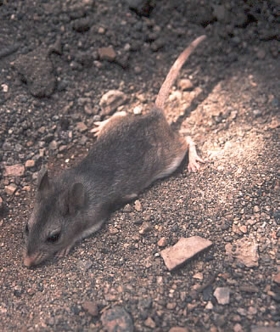
Its tail is short, broad, club-shaped, and white at the tip. Total body length, including the tail, ranges from 120 to 163 mm.[1][2]
Its head-and-body length averages 9–13 cm, and its tail measures 3–6 cm. The tail accounts for an average of 33.9% of the animal's body length.[3][4]
Females have an average tail length of 4.58 cm, compared with 4.50 cm in males.[5]
Habitat
The Southern Grasshopper Mouse inhabits hot, arid valleys and scrub deserts. It occurs in shortgrass prairies and desert scrub, with most individuals preferring dry habitats at low elevations.[6][7][8]
Individuals nest in small underground burrows, frequently using burrows abandoned by other rodents.[9]
Diet
Arthropods constitute almost the entire diet of the Southern Grasshopper Mouse. Its animal prey includes rodents belonging to the genera Peromyscus, Perognathus, and Microtus, as well as little pocket mice and western harvest mice.[10][11][12]
Behaviour
The Southern Grasshopper Mouse is predominantly nocturnal and is a highly aggressive predator. It stalks prey before rushing forward and killing it with a bite to the head.[13][14][15]
It can climb well and remains active throughout the year. Individuals are generally solitary and defend their territories aggressively against intruders, although they sometimes live in male-female pairs throughout the year.[16][17][18]
The species produces a loud, piercing vocalization lasting between 0.7 and 1.2 seconds. Its characteristic vocalization can be heard by humans at distances of up to 100 metres.[19][20]
Individuals give their characteristic call when confronting adversaries or before killing prey. They sometimes kill and eat other members of their species when threatened or food is scarce.[21][22]
Live crickets are preferred over dead crickets. The species can temporarily become insensitive to pain after receiving Arizona bark scorpion venom.[23][24]
Reproduction and life cycle
Females can breed throughout the year, although most reproductive activity occurs in late spring and summer. The gestation period ranges from 26 to 35 days, with an average of approximately 29 days.[25][26][27]
Litter sizes range from one to six offspring, and the average litter contains approximately 2.6 offspring. Young are weaned at approximately three weeks of age.[28][29][30]
Females generally give birth to their first litter at four or five months of age. Female offspring born in April may produce two or three litters before the end of that year.[31][32]
Females seldom reproduce after two years of sexual maturity.[33]
Conservation
No major conservation issues are currently known for the Southern Grasshopper Mouse.[34]
Uses
The Southern Grasshopper Mouse benefits farmers by consuming insects and rodents that could otherwise damage crops.[35]
Classification of the Southern Grasshopper Mouse
| Kingdom | Animalia |
|---|---|
| Phylum | Chordata |
| Subphylum | Vertebrata |
| Infraphylum | Gnathostomata |
| Parvphylum | Osteichthyes |
| Megaclass | Tetrapoda |
| Class | Mammalia (Mammal) |
| Subclass | Theria |
| Infraclass | Eutheria |
| Order | Rodentia (Rodent) |
| Suborder | Myomorpha (Mice) |
| Superfamily | Muroidea |
| Family | Cricetidae (New World Mice and Rats) |
| Subfamily | Neotominae |
| Genus | Onychomys (Grasshopper Mouse) |
| Species | Onychomys torridus (Coues, 1874) |
Where the Southern Grasshopper Mouse is found
Checklists and occurrence records place Onychomys torridus in 2 countries across North America. GBIF holds 7,481 georeferenced records of it.
Countries
Regions and cities with the most records
- Arizona, United States 2,161
- California, United States 1,501
- Green Valley, United States 825
- Sahuarita, United States 782
- Nevada, United States 617
- Sonora, Mexico 350
- New Mexico, United States 235
- Baja California, Mexico 191
- Chihuahua, Mexico 189
- Texas, United States 174
- Sinaloa, Mexico 150
- Desert Hot Springs, United States 98
- Utah, United States 98
- Apple Valley, United States 93
- Flowing Wells, United States 85
- Tucson, United States 85
- Hesperia, United States 83
- Victorville, United States 83
- Durango, Mexico 76
- Drexel Heights, United States 74
- Adelanto, United States 72
- Casas Adobes, United States 72
- Catalina Foothills, United States 69
- Kingman, United States 67
- Ridgecrest, United States 63
- Sierra Vista, United States 63
- Oro Valley, United States 62
- Palm Springs, United States 58
- Yucca Valley, United States 57
- Washington, United States 56
- Fountain Hills, United States 55
- Tanque Verde, United States 52
- Rio Rico, United States 51
- Nogales, Mexico 47
- Nogales, United States 47
- Chihuahua, Mexico 46
Range as the checklists state it
Middle America
North America
A number beside a place is its count of GBIF occurrence records. A place without a number comes from a checklist alone. Records show where a species has been observed or collected, which can include escapes and vagrants.
Common names
English
- Southern Grasshopper Mouse
Names in 8 other languages
- Czech
- křeček prériový
- Dutch
- Zuidelijke Sprinkhaanmuis
- Finnish
- skorpionihiiru
- Japanese
- ミナミバッタマウス
- Norwegian Bokmål
- Sørlig Gresshoppemus
- Polish
- pasikoniszka preriowa
- Russian
- Южный кузнечиковый хомячок
- Spanish
- Ratón chapulinero sureño, Ratón-saltamontes sureño
Synonyms
10 other scientific names have been used for this species and are now treated as synonyms of Onychomys torridus.
- Hesperomys toridus Coues, 1874
- Onychomys longicaudus Merriam, 1889
- Onychomys macrotis Elliot, 1903
- Onychomys pulcher Elliot, 1904
- Onychomys ramona Rhoads, 1893
- Onychomys torridus clarus Hollister, 1913
- Onychomys torridus perpallidus Mearns, 1896
- Onychomys torridus ramona Rhoads, 1893
- Onychomys torridus tularensis Merriam, 1904
- Onychomys torridus yakiensis Merriam, 1904
Related species
-
 Northern Grasshopper MouseOnychomys leucogaster
- Mearns's Grasshopper MouseOnychomys arenicola
-
 MuskratOndatra zibethicus
-
 European HamsterCricetus cricetus
-
 Golden HamsterMesocricetus auratus
-
 Winter White Dwarf HamsterPhodopus sungorus
-
 European Water VoleArvicola amphibius
- Indefatigable Galapagos MouseNesoryzomys indefessus
Compare
Questions and answers
What is the scientific name of the Southern Grasshopper Mouse?
The scientific name of the Southern Grasshopper Mouse is Onychomys torridus. Written with its author, the full name is Onychomys torridus (Coues, 1874).
Which family does the Southern Grasshopper Mouse belong to?
Onychomys torridus belongs to the family Cricetidae, in the order Rodentia and the class Mammalia.
Where is the Southern Grasshopper Mouse found?
Checklists and occurrence records place Onychomys torridus in 2 countries: United States and Mexico.
What is the conservation status of the Southern Grasshopper Mouse?
The IUCN Red List category recorded for Onychomys torridus is Least Concern (LC).
Are grasshopper mice aggressive?
Yes. Southern Grasshopper Mice are highly aggressive predators that stalk and kill prey with a bite to the head. They also defend their territories aggressively against intruders.[14][15][17]
Sources
Passages the profile rests on
- Its tail is short, broad, club-shaped, and white at the tip. Source passage: “The tail is club-shaped, short and broad, the anterior part being the same color as the body and the tip being white.” — English Wikipedia
- Its total body length, including the tail, ranges from 120 to 163 mm. Source passage: “It has a short tail, growing to a total length of 120 to 163 mm (4.7 to 6.4 in).” — English Wikipedia
- Its head-and-body length averages 9–13 cm, and its tail measures 3–6 cm. Source passage: “Body size averages between 9-13 cm for the head and body, and 3-6 cm for the tail.” — animaldiversity.org
- The tail accounts for an average of 33.9% of the animal's body length. Source passage: “Moreover, the tail length of southern grasshopper mice made up an average of 33.9% of its body length.” — English Wikipedia
- Females have an average tail length of 4.58 cm, compared with 4.50 cm in males. Source passage: “Their tail length measures an average of 4.58 ± 0.36 cm (1.80 ± 0.14 in) in females, and 4.50 ± 0.39 cm (1.77 ± 0.15 in) in males.” — English Wikipedia
- The species inhabits hot, arid valleys and scrub deserts. Source passage: “The natural habitat of southern grasshopper mice include hot, arid valleys, and scrub deserts.” — English Wikipedia
- It occurs in shortgrass prairies and desert scrub. Source passage: “Grasshopper mice are found in shortgrass prairies, and desert scrub.” — animaldiversity.org
- Most individuals prefer dry habitats at low elevations. Source passage: “Most prefer xeric areas at low elevations.” — animaldiversity.org
- Individuals nest in small underground burrows, frequently using burrows abandoned by other rodents. Source passage: “Onychomys torridus nest in small burrows dug into the ground. Often these burrows have been deserted by other rodents” — animaldiversity.org
- Arthropods constitute almost the entire diet of the southern grasshopper mouse. Source passage: “The southern grasshopper mouse feeds almost entirely on arthropods, such as beetles, grasshoppers and scorpions.” — English Wikipedia
- Its prey includes little pocket mice and western harvest mice. Source passage: “In addition to arthropods, it is known to prey upon the little pocket mouse (Perognathus longimembris) and the western harvest mouse (Reithrodontomys megalotis).” — English Wikipedia
- Its animal prey also includes rodents belonging to the genera Peromyscus, Perognathus, and Microtus. Source passage: “The remainder includes mainly scorpions, but also grasshoppers, beetles, and small vertebrates, including other rodents, such as Peromyscus, Perognathus, and Microtus.” — animaldiversity.org
- The species is predominantly nocturnal. Source passage: “The southern grasshopper mouse is a robust, small, nocturnal species” — English Wikipedia
- Southern grasshopper mice are highly aggressive predators. Source passage: “Southern grasshopper mice are a predatory and very aggressive rodent species.” — English Wikipedia
- They stalk prey before rushing forward and killing it with a bite to the head. Source passage: “After stalking their potential kill, they seize the animal with a rush, killing with a bite to the head.” — animaldiversity.org
- They are capable of climbing well and remain active throughout the year. Source passage: “They are largely nocturnal, good climbers, and active year round.” — animaldiversity.org
- Individuals are generally solitary and defend their territories aggressively against intruders. Source passage: “Grasshopper mice are solitary animals, guarding their large territory fiercely against all intruders.” — animaldiversity.org
- They sometimes live in male-female pairs throughout the year. Source passage: “They may, however, live in male-female pairs year round” — animaldiversity.org
- They produce a loud, piercing vocalization lasting between 0.7 and 1.2 seconds. Source passage: “Onychomys can produce a loud, piercing, pure tone, which lasts between 0.7 and 1.2 seconds” — animaldiversity.org
- Their characteristic vocalization can be heard by humans at distances of up to 100 metres. Source passage: “and is audible to the human ear up to100 meters away.” — animaldiversity.org
- They give their characteristic call when confronting adversaries or before killing prey. Source passage: “they give this call when faced with an adversary, including other grasshopper mice, or prior to making a kill.” — animaldiversity.org
- They sometimes kill and eat other members of their species when threatened or food is scarce. Source passage: “Grasshopper mice often commit acts of cannibalism, killing and eating other members of their species if they are threatened or in need of food.” — animaldiversity.org
- Live crickets are preferred over dead crickets. Source passage: “Live crickets were preferred to deceased specimens” — English Wikipedia
- The species can temporarily become insensitive to pain after receiving Arizona bark scorpion venom. Source passage: “This mouse can normally feel pain from other sources, but can be temporarily insensitive to these stimuli after a dose of venom from a bark scorpion.” — English Wikipedia
- Females can breed throughout the year, although most reproductive activity occurs in late spring and summer. Source passage: “Grasshopper mice are capable of breeding year-round, but most reproductive activity occurs during the late spring and the summer.” — animaldiversity.org
- The gestation period ranges from 26 to 35 days. Source passage: “Gestation lasts 26-35 days.” — animaldiversity.org
- The average gestation period is approximately 29 days. Source passage: “The average litter size is 2.6 (range 1 to 5), produced after an average gestation period of 29 days.” — English Wikipedia
- Litter sizes range from one to six offspring. Source passage: “Litter size ranges from one to six young.” — animaldiversity.org
- The average litter contains approximately 2.6 offspring. Source passage: “The average litter size is 2.6 (range 1 to 5)” — English Wikipedia
- Young are weaned at approximately three weeks of age. Source passage: “They open their eyes at two weeks of age, immediately begin nursing from their mother, and are weaned at three weeks of age.” — animaldiversity.org
- Female offspring born in April may produce two or three litters before the end of that year. Source passage: “Females born as early as April may produce two or three litters before year's end.” — animaldiversity.org
- Females generally give birth to their first litter at four or five months of age. Source passage: “The females give birth to their first litter when four or five months old.” — English Wikipedia
- Females seldom reproduce after two years of sexual maturity. Source passage: “Females seldom breed after two years of sexual maturity.” — animaldiversity.org
- No major conservation issues are currently known for this species. Source passage: “There are no currently known conservation issues associated with southern grasshopper mice” — English Wikipedia
- The species benefits farmers by consuming insects and rodents that could otherwise damage crops. Source passage: “Largely due to their ferocity and appetite, grasshopper mice help farmers by eating a large number of insects and rodents that would otherwise destroy crops.” — animaldiversity.org
- The species occurs in Mexico and the United States states of Arizona, California, Nevada, New Mexico, and Utah. Source passage: “native to Mexico and the states of Arizona, California, Nevada, New Mexico, and Utah in the United States.” — English Wikipedia
- Seeds, plants, and vegetables account for approximately 10–25% of its diet. Source passage: “10-25% of the diet of O. torridus consists of seeds, plants, and vegetables.” — animaldiversity.org
Data
- Catalogue of Life, 2026-10-16 XR cc by
- Global Biodiversity Information Facility CC BY 4.0
- Wikidata CC0
- GeoNames CC BY 4.0
- Wikimedia Commons per image; credit shown with each image
- Within the Catalogue of Life, this name comes from The Integrated Taxonomic Information System cc0
References
- Proc. Acad. Nat. Sci. Philadelphia vol.26 p.183 where the name was published
- Hall, & Raymond, E. (1981). The Mammals of North America, 2nd Ed., Vol. 2.
- Banks, R. C., R. W. McDiarmid, and A. L. Gardner. (1987). Checklist of Vertebrates of the United States, the U.S. Territories, and Canada. Resource Publication, No. 166.
- Wilson, Don E., and DeeAnn M. Reeder, eds. (1993). Mammal Species of the World: A Taxonomic and Geographic Reference, 2nd Ed., 3rd Printing.
- Wilson, Don E., and F. Russell Cole. (2000). Common Names of Mammals of the World.
- Musser, Guy G., and Michael D. Carleton / Wilson, Don E., and DeeAnn M. Reeder, eds. (2005). Superfamily Muroidea. Mammal Species of the World: A Taxonomic and Geographic Reference, 3rd Ed., Vol. 2.
This species in other databases
Page built on 26 November 2026. See how the catalog is made and all sources and licences.
Cite this page
ScientificNames.org. (2026). Onychomys torridus (Southern Grasshopper Mouse). Retrieved November 26, 2026, from https://scientificnames.org/species/onychomys-torridus
“Onychomys torridus (Southern Grasshopper Mouse).” ScientificNames.org, 2026, scientificnames.org/species/onychomys-torridus. Accessed 26 Nov. 2026.
ScientificNames.org. “Onychomys torridus (Southern Grasshopper Mouse).” Accessed November 26, 2026. https://scientificnames.org/species/onychomys-torridus.
@misc{scientificnames_onychomys_torridus_southern_grasshopper_mouse,
  author = {{ScientificNames.org}},
  title = {Onychomys torridus (Southern Grasshopper Mouse)},
  year = {2026},
  url = {https://scientificnames.org/species/onychomys-torridus},
  note = {Accessed 2026-11-26}
}