Comparison

Bush Dog vs Coyote

Bush Dog (Speothos venaticus) and Coyote (Canis latrans) both belong to the family Canidae (dogs) and part ways below it. Both are recorded in 2 countries.

Bush Dog

Bush Dog

Speothos venaticus

Bonne1978, CC BY-SA 3.0, via Wikimedia Commons

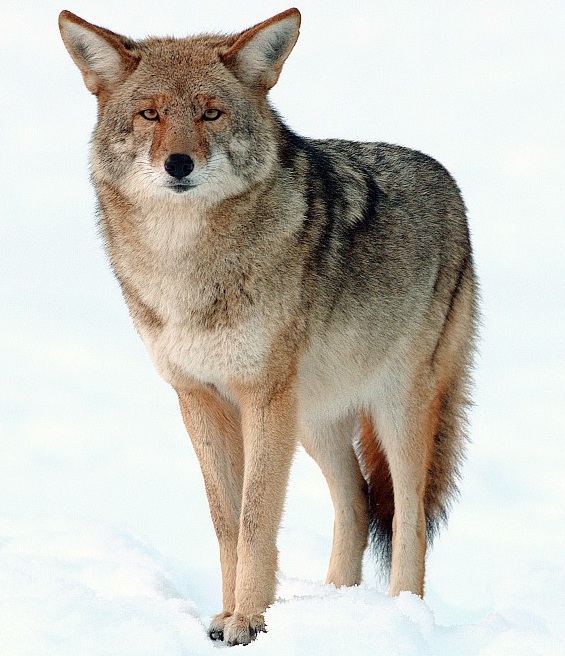
Coyote

Coyote

Canis latrans

Yathin S Krishnappa, CC BY-SA 3.0, via Wikimedia Commons

Side by side

Bush DogCoyote
Scientific nameSpeothos venaticus (Lund, 1842)Canis latrans Say, 1823
English nameBush DogCoyote
GroupMammalsMammals
ClassMammalia MammalMammalia Mammal
OrderCarnivora CarnivoresCarnivora Carnivores
FamilyCanidae DogsCanidae Dogs
GenusSpeothos Bush DogsCanis Dogs
Named in18421823
Red List categoryNear ThreatenedLeast Concern
EnvironmentNot recordedterrestrial
Countries on record13 countries10 countries
GBIF occurrence records754 records120,320 records

Rows where the two agree are shown in grey.

Where each is found

Both recorded in 2 countries

Only Bush Dog (11)

Only Coyote (8)

From Catalogue of Life checklists and GBIF occurrence records. A country missing from a list means no record is held, which is not proof of absence.

Checked facts

Bush DogCoyote
Appearance
  • Adult bush dogs have soft, long brownish-tan fur with lighter reddish coloration on the head, neck, and back, and a dark underside. English Wikipedia
  • Young bush dogs have black fur covering their entire bodies. English Wikipedia
  • Bush dogs have relatively short legs, short snouts, and small ears. English Wikipedia
  • Bush dogs have partially webbed toes that facilitate swimming. English Wikipedia
  • Bush dogs have large scent glands on both sides of the anus. English Wikipedia
  • Bush dogs have a wide head and a short rostrum. animaldiversity.org
  • The coyote typically has a coat combining light gray, reddish or fulvous, black, and white coloration. English Wikipedia
  • Coyotes have pointed ears, a narrow muzzle, and a bushy tail with a black tip. nps.gov
  • Coyotes generally have a grey-brown coat with black-tipped hairs along their backs. nps.gov
  • The coyote has longer ears and a relatively larger braincase than the gray wolf. English Wikipedia
  • Coyotes carry their tails downward when walking or running. English Wikipedia
Size
  • Male coyotes typically weigh between 8 and 20 kg. English Wikipedia
  • Female coyotes typically weigh between 7 and 18 kg. English Wikipedia
  • Adult coyotes have an average total body length, including the tail, of 1.0 to 1.35 m. English Wikipedia
  • The coyote's tail measures approximately 40 cm in length. English Wikipedia
  • The average shoulder height of coyotes ranges from 18 to 23 inches. nps.gov
  • Coyotes average approximately 20 to 35 pounds in weight according to the Jewel Cave National Monument account. nps.gov
  • Northern coyote subspecies average approximately 18 kg, compared with 11.5 kg for southern Mexican subspecies. English Wikipedia
Habitat
Diet
  • Coyotes preferentially prey on Dall's sheep, white-tailed deer, eastern cottontail rabbits, and California voles. pmc.ncbi.nlm.nih.gov
  • Coyotes avoid preying on small mammals, including carnivorans and arboreal species. pmc.ncbi.nlm.nih.gov
  • Coyotes consume deer, rabbits, hares, rodents, birds, reptiles, amphibians, fish, and invertebrates. English Wikipedia
  • Coyotes occasionally consume fruits and vegetables. English Wikipedia
  • Coyotes in the southern United States may consume more frogs than coyotes in other regions. nps.gov
  • Coyotes in the Yukon may consume more berries. nps.gov
  • Vegetation consumption by coyotes is greatest during summer and autumn. research.fs.usda.gov
Behaviour
  • Coyotes can live either in family units or in loosely organized packs of unrelated individuals. English Wikipedia
  • Coyotes can hunt either individually or in groups. pmc.ncbi.nlm.nih.gov
  • Coyotes may form groups of five to six adults under favorable conditions. nps.gov
  • Coyote packs containing more than ten animals have been observed. nps.gov
  • Coyotes may establish and defend territories or survive as nonterritorial transient individuals. pmc.ncbi.nlm.nih.gov
  • Coyotes characteristically produce howls that rapidly change in tone and pitch. English Wikipedia
Reproduction
Distribution
  • Bush dogs occur from Costa Rica through much of South America east of the Andes, reaching central Bolivia, Paraguay, and southern Brazil. English Wikipedia
  • Coyotes are native to North America. English Wikipedia
  • Coyotes occur throughout North and Central America. animaldiversity.org
  • Coyotes have expanded their geographic range by approximately 40 percent over the past 120 years. research.fs.usda.gov
  • Coyotes currently occur in every US state except Hawaii and extend as far north as the Arctic. nps.gov
  • Coyotes were first sighted in eastern Panama in 2013. English Wikipedia
Conservation
  • The bush dog is classified as Near Threatened by the IUCN in document 1. English Wikipedia
  • Bush dog populations declined by approximately 20–25% over the preceding twelve years, according to document 1. English Wikipedia
  • Habitat loss caused by deforestation for timber, cattle farming, and palm oil production is a major threat to bush dogs. English Wikipedia
  • Disease transmission from domestic dogs is one of the identified threats to bush dogs. English Wikipedia
  • Bush dogs are listed in Appendix I of CITES. animaldiversity.org
  • The coyote is classified as Least Concern by the International Union for Conservation of Nature. English Wikipedia
  • Human persecution is a major cause of coyote mortality. nps.gov
  • Trapping for their pelts is one of the major causes of coyote mortality throughout their range. nps.gov
  • Coyotes have expanded their range despite substantial persecution related to actual or perceived livestock predation. pmc.ncbi.nlm.nih.gov
UsesNo checked fact yet
Similar species
  • The maned wolf or African wild dog is identified as a possible closest living relative of the bush dog. English Wikipedia
No checked fact yet
Name originNo checked fact yet

In brief

Bush Dog

Speothos venaticus occurs from Costa Rica through much of South America east of the Andes, reaching central Bolivia, Paraguay, and southern Brazil. It has partially webbed toes that facilitate swimming and can dive and swim underwater. Full profile

Coyote

Coyotes are native to North America and inhabit environments ranging from dry tropical deciduous forests and prairies to woodlands, mountains, and urban areas. The Coyote has pointed ears, a narrow muzzle, a bushy black-tipped tail, and a coat combining gray, reddish, black, and white coloration. Full profile

Compare something else

Page built on 27 November 2026 from the data on the two species pages, where every source is listed.

Cite this page

ScientificNames.org. (2026). Bush Dog vs Coyote. Retrieved November 27, 2026, from https://scientificnames.org/compare/bush-dog-vs-coyote