Comparison
Samurai Chocolate Gourami vs Giant Gourami
Samurai Chocolate Gourami (Sphaerichthys vaillanti) and Giant Gourami (Osphronemus goramy) both belong to the family Osphronemidae (gourami) and part ways below it. Both are recorded in 1 country.


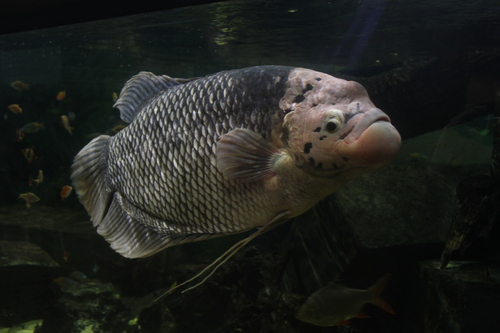
Giant Gourami
Osphronemus goramy
(c) Tim Sheerman-Chase, some rights reserved (CC BY), CC BY 4.0, via iNaturalist
Side by side
| Samurai Chocolate Gourami | Giant Gourami | |
|---|---|---|
| Scientific name | Sphaerichthys vaillanti Pellegrin, 1930 | Osphronemus goramy Lacepède, 1801 |
| English name | Samurai Chocolate Gourami | Giant Gourami |
| Group | Fishes | Fishes |
| Class | Teleostei Teleost | Teleostei Teleost |
| Order | Anabantiformes | Anabantiformes |
| Family | Osphronemidae Gourami | Osphronemidae Gourami |
| Genus | Sphaerichthys Chocolate Gouramis | Osphronemus Kaloi Fishes |
| Named in | 1930 | 1801 |
| Red List category | Endangered | Least Concern |
| Environment | freshwater | brackish, freshwater |
| Countries on record | 1 country | 13 countries |
| GBIF occurrence records | 25 records | 406 records |
Rows where the two agree are shown in grey.
Where each is found
Both recorded in 1 country
Only Giant Gourami (12)
- Cambodia
- India
- Madagascar
- Malaysia
- Mauritius
- Philippines
- Reunion
- Seychelles
- Singapore
- Sri Lanka
- Thailand
- Vietnam
From Catalogue of Life checklists and GBIF occurrence records. A country missing from a list means no record is held, which is not proof of absence.
Checked facts
| Samurai Chocolate Gourami | Giant Gourami | |
|---|---|---|
| Appearance |
|
|
| Size |
|
|
| Habitat |
| No checked fact yet |
| Diet |
|
|
| Behaviour |
|
|
| Reproduction |
|
|
| Distribution |
|
|
| Conservation |
| No checked fact yet |
| Uses |
|
|
| Other |
|
|
In brief
Samurai Chocolate Gourami
The species is native to Asia and occurs mainly in the Kapuas River region of West Kalimantan, Borneo, Indonesia. The species mimics dead leaves as a camouflage strategy. Full profile
Giant Gourami
Osphronemus goramy is substantially larger than most other gouramis and can reach a maximum standard length of 80 cm. Full profile
Compare something else
Page built on 29 November 2026 from the data on the two species pages, where every source is listed.
Cite this page
ScientificNames.org. (2026). Samurai Chocolate Gourami vs Giant Gourami. Retrieved November 29, 2026, from https://scientificnames.org/compare/samurai-chocolate-gourami-vs-giant-gourami
“Samurai Chocolate Gourami vs Giant Gourami.” ScientificNames.org, 2026, scientificnames.org/compare/samurai-chocolate-gourami-vs-giant-gourami. Accessed 29 Nov. 2026.
ScientificNames.org. “Samurai Chocolate Gourami vs Giant Gourami.” Accessed November 29, 2026. https://scientificnames.org/compare/samurai-chocolate-gourami-vs-giant-gourami.
@misc{scientificnames_samurai_chocolate_gourami_vs_giant_gourami,
  author = {{ScientificNames.org}},
  title = {Samurai Chocolate Gourami vs Giant Gourami},
  year = {2026},
  url = {https://scientificnames.org/compare/samurai-chocolate-gourami-vs-giant-gourami},
  note = {Accessed 2026-11-29}
}