Comparison
Longspine Porgy vs Sheepshead
Longspine Porgy (Stenotomus caprinus) and Sheepshead (Archosargus probatocephalus) both belong to the family Sparidae (porgies) and part ways below it. Both are recorded in 2 countries.

Longspine Porgy
Stenotomus caprinus
SEFSC Pascagoula Laboratory; Collection of Brandi Noble, NOAA/NMFS/SEFSC., Public domain, via Wikimedia Commons


Side by side
| Longspine Porgy | Sheepshead | |
|---|---|---|
| Scientific name | Stenotomus caprinus Jordan & Gilbert, 1882 | Archosargus probatocephalus (Walbaum, 1792) |
| English name | Longspine Porgy | Sheepshead |
| Group | Fishes | Fishes |
| Class | Teleostei Teleost | Teleostei Teleost |
| Order | Perciformes | Perciformes |
| Family | Sparidae Porgies | Sparidae Porgies |
| Genus | Stenotomus | Archosargus Sheepshead Porgies |
| Named in | 1882 | 1792 |
| Red List category | Least Concern | Least Concern |
| Environment | marine | brackish, marine |
| Countries on record | 2 countries | 6 countries |
| GBIF occurrence records | 1,048 records | 17,635 records |
Rows where the two agree are shown in grey.
Where each is found
Both recorded in 2 countries
Only Sheepshead (4)
From Catalogue of Life checklists and GBIF occurrence records. A country missing from a list means no record is held, which is not proof of absence.
Checked facts
| Longspine Porgy | Sheepshead | |
|---|---|---|
| Appearance | No checked fact yet |
|
| Size | No checked fact yet |
|
| Habitat | No checked fact yet |
|
| Diet | No checked fact yet |
|
| Behaviour | No checked fact yet |
|
| Reproduction | No checked fact yet |
|
| Distribution | No checked fact yet |
|
| Conservation | No checked fact yet |
|
| Uses | No checked fact yet |
|
| Name origin | No checked fact yet |
|
In brief
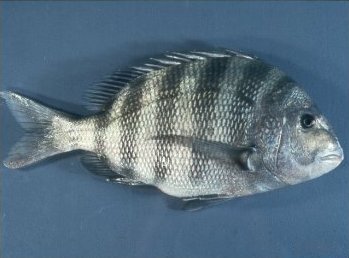
Sheepshead
Archosargus probatocephalus occurs in the Western Atlantic Ocean from Nova Scotia to Rio Grande do Sul in Brazil, including the Gulf of Mexico and Caribbean Sea. It is distinguished by broad, flattened front teeth, molar-like side teeth and five or six dark vertical bars along its flanks. Full profile
Compare something else
Page built on 27 November 2026 from the data on the two species pages, where every source is listed.
Cite this page
ScientificNames.org. (2026). Longspine Porgy vs Sheepshead. Retrieved November 27, 2026, from https://scientificnames.org/compare/longspine-porgy-vs-sheepshead
“Longspine Porgy vs Sheepshead.” ScientificNames.org, 2026, scientificnames.org/compare/longspine-porgy-vs-sheepshead. Accessed 27 Nov. 2026.
ScientificNames.org. “Longspine Porgy vs Sheepshead.” Accessed November 27, 2026. https://scientificnames.org/compare/longspine-porgy-vs-sheepshead.
@misc{scientificnames_longspine_porgy_vs_sheepshead,
  author = {{ScientificNames.org}},
  title = {Longspine Porgy vs Sheepshead},
  year = {2026},
  url = {https://scientificnames.org/compare/longspine-porgy-vs-sheepshead},
  note = {Accessed 2026-11-27}
}