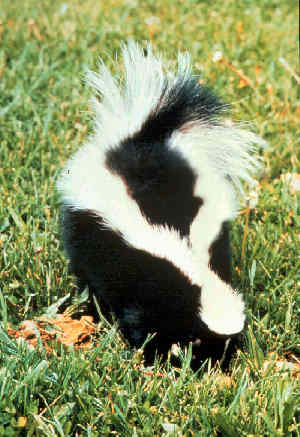
| Appearance | - The striped skunk has predominantly black fur with a narrow white stripe along its snout and forehead and a prominent white marking extending from its neck down its back. animaldiversity.org
- The white dorsal marking typically divides into a thick V-shape near the rump. animaldiversity.org
- The striped skunk has a bushy black tail that frequently has white hairs along its edges. animaldiversity.org
- The striped skunk has a small triangular head, short ears, and black eyes. animaldiversity.org
- The striped skunk has five-toed plantigrade feet and long foreclaws adapted for digging. animaldiversity.org
- The striped skunk has 34 teeth. animaldiversity.org
- Individual striped skunks vary considerably in their fur patterns and coloration. English Wikipedia
- Occasional color mutations in striped skunks include brown and cream-colored fur. English Wikipedia
| - The tail is conspicuously large, long-haired, and measures 10–16 cm. English Wikipedia
- The forefoot claws are longer and more curved than the hind-foot claws. English Wikipedia
- The normally black fur can occasionally appear red or brown, while normally white areas can appear gray or yellow. English Wikipedia
- The species has five toes on each foot. animaldiversity.org
- The underside of the tail is white for nearly half its length, and its tip is extensively white. animaldiversity.org
|
|---|
| Size | | |
|---|
| Habitat | - Striped skunks inhabit woodlands, forests, wooded ravines, and grassy plains. biokids.umich.edu
- Striped skunks also inhabit scrubland, riparian areas, and urban environments. animaldiversity.org
- Striped skunks increasingly occupy suburban neighborhoods and farming areas. biokids.umich.edu
- Striped skunks generally occur at elevations from sea level to 1,800 m, although records extend to 4,200 m. animaldiversity.org
- In cultivated areas, striped skunks may establish dens in fencerows. English Wikipedia
| - The species inhabits mixed woodlands, open areas, and farmlands. English Wikipedia
- In Idaho and Washington, western spotted skunks prefer riparian areas containing brush thickets. English Wikipedia
- In eastern Oregon and northern Mexico, the species is often found near cliffs and canyons. English Wikipedia
- Western spotted skunks prefer rocky bluffs and canyon stream beds bordered by brush. animaldiversity.org
- Suitable habitats include conifer forests, riparian areas, brushy habitats, thickets, and farmlands. wdfw.wa.gov
- In Washington, western spotted skunks generally occur from sea level to 1,970 feet in the Olympic Mountains. wdfw.wa.gov
- The species occasionally occurs at elevations up to 2,950 feet in the Cascade Mountains. wdfw.wa.gov
|
|---|
| Diet | - Striped skunks primarily consume insects, including grasshoppers, beetles, crickets, caterpillars, insect larvae, and bees. English Wikipedia
- Striped skunks also eat worms, crayfish, and other non-insect arthropods. English Wikipedia
- During winter and spring, striped skunks supplement their diet with white-footed mice, voles, eggs, and ground-nesting bird chicks. English Wikipedia
- Striped skunks also consume amphibians, reptiles, carrion, and fish. English Wikipedia
- Striped skunks in California's coastal areas feed on crabs and beached fish. English Wikipedia
- Striped skunks consume apples, blueberries, black cherries, ground cherries, corn, and nightshade when these foods are in season. English Wikipedia
- Striped skunks use their claws to break apart rotting logs in search of grubs and dig in soil for insects. English Wikipedia
| - Western spotted skunks are nocturnal omnivores that consume insects, small vertebrates, roots, grains, fruits, and berries. English Wikipedia
- Common insect prey includes beetles, grasshoppers, and caterpillars. English Wikipedia
- The species also consumes eggs and carrion. English Wikipedia
- Western spotted skunks can consume prey as large as the ashy storm petrel. English Wikipedia
- Small mammals and insects constitute the bulk of the species' diet in Washington. wdfw.wa.gov
- The species also eats birds, bird eggs, reptiles, amphibians, berries, fruits, and carrion. wdfw.wa.gov
|
|---|
| Behaviour | - Striped skunks are primarily nocturnal and solitary. animaldiversity.org
- Striped skunk activity generally begins around twilight and may continue until daybreak. biokids.umich.edu
- Striped skunks use abandoned underground dens of other mammals for daytime shelter but can dig their own dens. biokids.umich.edu
- Striped skunks may shelter in hollow logs, trees, rock piles, brush piles, and beneath buildings. animaldiversity.org
- Striped skunks do not hibernate but become less active during winter. biokids.umich.edu
- Several striped skunks may share a den during winter. biokids.umich.edu
- When threatened, striped skunks arch their backs, raise their tails, and stomp their forefeet as a warning. biokids.umich.edu
- Striped skunks can spray defensive musk up to 6 m. biokids.umich.edu
- Sudden movements or unexpected noises can trigger a striped skunk to spray its defensive musk. animaldiversity.org
| - Western spotted skunks are primarily nocturnal. English Wikipedia
- The species is usually solitary, although two or three females sometimes share a burrow. English Wikipedia
- Western spotted skunks are not true hibernators but may sleep for several weeks during winter. English Wikipedia
- Females may form winter denning groups containing as many as 20 individuals. English Wikipedia
- Males remain solitary during winter. English Wikipedia
- The species stamps its forefeet and raises its hindquarters when threatened. English Wikipedia
- Western spotted skunks can spray musk while standing on their forelegs and raising their hindlegs and tail. English Wikipedia
- The species is an agile climber and an excellent digger. animaldiversity.org
- Western spotted skunks generally remain within half a mile of their dens. animaldiversity.org
- The species generally ignores nearby people and animals unless disturbed. wdfw.wa.gov
|
|---|
| Reproduction | - Female striped skunks normally reproduce once annually, while males mate with multiple females. biokids.umich.edu
- Striped skunks generally breed between February and April. biokids.umich.edu
- Female striped skunks may reproduce again during the same season if they lose their litter. biokids.umich.edu
- The gestation period of striped skunks lasts approximately 59 to 77 days. animaldiversity.org
- Striped skunk litters generally contain between two and ten young. biokids.umich.edu
- Newborn striped skunks weigh approximately 32 to 35 g each. biokids.umich.edu
- Newborn striped skunks are sparsely furred and have visible coat patterns at birth. biokids.umich.edu
- Young striped skunks open their eyes at approximately three weeks of age. biokids.umich.edu
- Young striped skunks nurse for approximately six to seven weeks. biokids.umich.edu
- Male juvenile striped skunks become independent by July or August, while females may remain with their mother until the following spring. biokids.umich.edu
- Both male and female striped skunks reach sexual maturity at approximately ten months of age. biokids.umich.edu
| - Western spotted skunks typically mate in September. English Wikipedia
- After fertilization, embryonic development pauses at the blastocyst stage before implantation several months later. English Wikipedia
- Gestation, including delayed implantation, lasts approximately 230–250 days. English Wikipedia
- Litters typically contain two to five young born in May. English Wikipedia
- Newborn western spotted skunks are blind and almost hairless. English Wikipedia
- Newborn young weigh approximately 11 g. English Wikipedia
- Young females become sexually mature at approximately four or five months of age. animaldiversity.org
|
|---|
| Lifespan | - Striped skunks can live up to seven years in the wild after their first year. biokids.umich.edu
- Striped skunks can live up to ten years in captivity. biokids.umich.edu
- Striped skunks have high mortality during their first year, primarily because of severe weather and disease. biokids.umich.edu
| No checked fact yet |
|---|
| Distribution | - Striped skunks occur across most of North America, from the Atlantic to the Pacific Ocean. animaldiversity.org
- The species occurs throughout much of the continental United States and southern Canada. biokids.umich.edu
- The southern distribution of striped skunks extends into northern Mexico. animaldiversity.org
| - The species occurs throughout the western United States, northern Mexico, and southwestern British Columbia, Canada. English Wikipedia
|
|---|
| Conservation | | - The species is described as neither endangered nor threatened. English Wikipedia
- The population of western spotted skunks in Washington is unknown. wdfw.wa.gov
- Verified occurrences in Washington's Puget Trough have apparently declined substantially since the 1970s. wdfw.wa.gov
- Vehicle collisions, trapping, and pest control may be major sources of mortality in many populations. wdfw.wa.gov
- Western spotted skunks remain widespread and common on Washington's Olympic Peninsula according to recent carnivore surveys. wdfw.wa.gov
|
|---|
| Uses | - Striped skunks have historically been trapped and bred in captivity for their fur. English Wikipedia
- Striped skunks were historically kept in barns to control rats and mice. English Wikipedia
- Striped skunks were regularly eaten by trappers and Indigenous peoples. English Wikipedia
- Striped skunk gall bladders were purchased by Chinese immigrants for medicinal purposes. English Wikipedia
- Striped skunk fat was historically regarded as an effective lubricant. English Wikipedia
- Striped skunk musk was historically used as a folk remedy for asthma. English Wikipedia
| - Western spotted skunks help reduce agricultural and garden pest populations by consuming them. wdfw.wa.gov
|
|---|
| Similar species | No checked fact yet | - The western spotted skunk is smaller than the striped skunk. English Wikipedia
- The western spotted skunk resembles the eastern spotted skunk but has more extensive white markings. animaldiversity.org
|
|---|
| Name origin | - The alternative common name prairie polecat arose because English settlers considered the striped skunk similar to the European polecat. English Wikipedia
| No checked fact yet |
|---|