Comparison

Golden Swallow vs White-rumped Swallow

Golden Swallow (Tachycineta euchrysea) and White-rumped Swallow (Tachycineta leucorrhoa) both belong to the genus Tachycineta (tree swallows) and part ways below it.
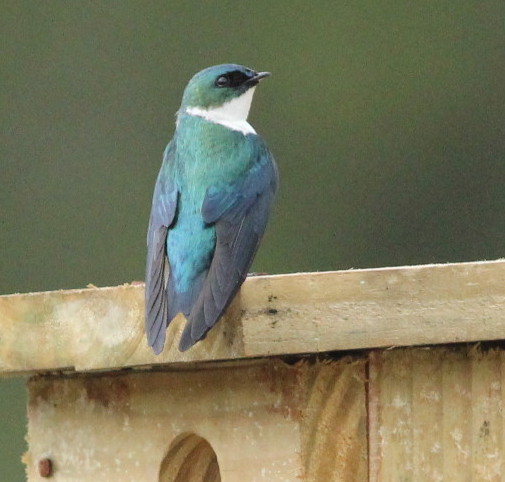
Golden Swallow

Golden Swallow

Tachycineta euchrysea

Cproctor707, CC BY-SA 4.0, via Wikimedia Commons

White-rumped Swallow

White-rumped Swallow

Tachycineta leucorrhoa

Valentina Ferretti (Valeferretti at en.wikipedia), Public domain, via Wikimedia Commons

Side by side

Golden SwallowWhite-rumped Swallow
Scientific nameTachycineta euchrysea (Gosse, 1847)Tachycineta leucorrhoa (Vieillot, 1817)
English nameGolden SwallowWhite-rumped Swallow
GroupBirdsBirds
ClassAves BirdAves Bird
OrderPasseriformes PasserinePasseriformes Passerine
FamilyHirundinidae SwallowHirundinidae Swallow
GenusTachycineta Tree SwallowsTachycineta Tree Swallows
Named in18471817
Red List categoryVulnerableLeast Concern
EnvironmentNot recordedterrestrial
Countries on record3 countries7 countries
GBIF occurrence records2,041 records77,243 records

Rows where the two agree are shown in grey.

Where each is found

Only Golden Swallow (3)

Only White-rumped Swallow (7)

From Catalogue of Life checklists and GBIF occurrence records. A country missing from a list means no record is held, which is not proof of absence.

Checked facts

Golden SwallowWhite-rumped Swallow
Appearance
  • The adult nominate subspecies has iridescent bronze upperparts, including the sides of the head, cheeks, and chin. English Wikipedia
  • The nominate subspecies has white underparts with dusky bronze streaks along the flanks. English Wikipedia
  • The nominate subspecies has a slightly forked tail. English Wikipedia
  • Adult females have grey-brown mottling on the breast and sometimes on the throat and undertail-coverts. English Wikipedia
  • Juveniles have grey-brown mottling and less glossy plumage than adults. English Wikipedia
  • The legs and feet are dark brown, while the bill is black. English Wikipedia
  • The subspecies T. e. sclateri has blue-green forehead and uppertail-coverts and blue-black wings and tail. English Wikipedia
Size
  • The golden swallow measures approximately 12 cm in average body length. English Wikipedia
Habitat
  • The species is restricted to isolated montane forests dominated primarily by Hispaniolan pine. English Wikipedia
  • The species primarily inhabits hills in the interiors of islands and prefers open country. English Wikipedia
  • The species occurs from elevations of 800 m on Hispaniola. English Wikipedia
  • The species formerly occurred from sea level to elevations of 2,000 m in Jamaica. English Wikipedia
DietNo checked fact yet
  • The White-rumped Swallow is an aerial insectivore. English Wikipedia
  • Its recorded prey includes flies, beetles, flying ants, Orthoptera and Lepidoptera. English Wikipedia
  • The species usually feeds close to water, pastures and open woodland. English Wikipedia
Behaviour
  • The golden swallow has a soft, repeated two-note call described as tchee-weet. English Wikipedia
  • The species generally forages below 20 m and very rarely above 30 m. English Wikipedia
  • The golden swallow forages in most habitats except forests. English Wikipedia
  • The species generally begins foraging at dawn, with activity increasing during the morning and declining during the afternoon. English Wikipedia
  • The golden swallow usually forages alone or in small groups. English Wikipedia
Reproduction
  • The golden swallow breeds on Hispaniola from April through July. English Wikipedia
  • The species formerly bred in Jamaica from June through July. English Wikipedia
  • The golden swallow usually nests in pairs and occasionally forms breeding colonies. English Wikipedia
  • The species lays clutches of two to four white to creamy-white eggs. English Wikipedia
  • The eggs measure approximately 18.4 by 13.1 mm and weigh an average of 1.7 g. English Wikipedia
  • The female incubates the eggs for approximately 17 to 20 days. English Wikipedia
  • Young golden swallows usually fledge 24 to 27 days after hatching. English Wikipedia
  • The species constructs deep cup nests in dead snags, particularly those of Hispaniolan pine. English Wikipedia
  • The golden swallow also nests in caves, beneath house eaves, and in recently burned stands. English Wikipedia
  • The species constructs nests using fine vegetable fibres such as silk, cotton, and pappus. English Wikipedia
  • The golden swallow sometimes uses nest boxes for breeding. English Wikipedia
Distribution
  • The golden swallow is native to Hispaniola, which is shared by the Dominican Republic and Haiti. English Wikipedia
  • The species formerly occurred in Jamaica, where its nominate subspecies is now extinct. English Wikipedia
  • The estimated extent of occurrence of the golden swallow is 8,100 km². English Wikipedia
  • The species is native to Argentina, Bolivia, Brazil, Paraguay, Peru and Uruguay. English Wikipedia
  • The White-rumped Swallow occurs at elevations from sea level to 1,100 metres. English Wikipedia
  • Southern populations generally move towards the northern parts of the species' range during the austral winter. English Wikipedia
  • The species occurs in the pampas of Argentina and Uruguay. English Wikipedia
Conservation
  • The golden swallow is classified as Vulnerable by the IUCN. English Wikipedia
  • The remaining T. e. sclateri population is declining, largely because of shifting agriculture and predation by introduced mammals. English Wikipedia
  • The estimated population consists of 1,500 to 7,000 mature birds. English Wikipedia
  • Introduced small Indian mongooses, feral cats, and rats are among the mammalian predators that threaten nests. English Wikipedia
  • The golden swallow is legally protected in Jamaica despite being extinct there. English Wikipedia
  • The White-rumped Swallow is classified as a species of Least Concern by the IUCN. English Wikipedia
  • Its estimated geographic range covers approximately 5,580,000 square kilometres. English Wikipedia
  • The species has an increasing population. English Wikipedia
  • Greater availability of artificial nesting sites may benefit the species. English Wikipedia
Similar speciesNo checked fact yet
  • The White-rumped Swallow can be distinguished from the Chilean Swallow by its white supraloral streak. English Wikipedia
  • The White-rumped Swallow is larger than the Chilean Swallow. English Wikipedia
  • The species was formerly classified as a subspecies of the Chilean Swallow. English Wikipedia
OtherNo checked fact yet
  • The shiny cowbird occasionally parasitizes White-rumped Swallow nests. English Wikipedia
  • Approximately six percent of White-rumped Swallow nests are affected by shiny cowbird parasitism. English Wikipedia
  • The species sometimes loses its nests to the southern house wren. English Wikipedia

In brief

Golden Swallow

Tachycineta euchrysea is native to Hispaniola and occurs from elevations of 800 m. It measures approximately 12 cm in average body length and has iridescent bronze upperparts and white underparts. Full profile

White-rumped Swallow

Tachycineta leucorrhoa inhabits open and semi-open country near water, woodland and forest edges, seasonally flooded grasslands, human settlements and degraded former forest. It is distinguished by a white supraloral streak and a white rump with fine shaft streaks. Full profile

Compare something else

Page built on 29 November 2026 from the data on the two species pages, where every source is listed.

Cite this page

ScientificNames.org. (2026). Golden Swallow vs White-rumped Swallow. Retrieved November 29, 2026, from https://scientificnames.org/compare/golden-swallow-vs-white-rumped-swallow