Species · Birds
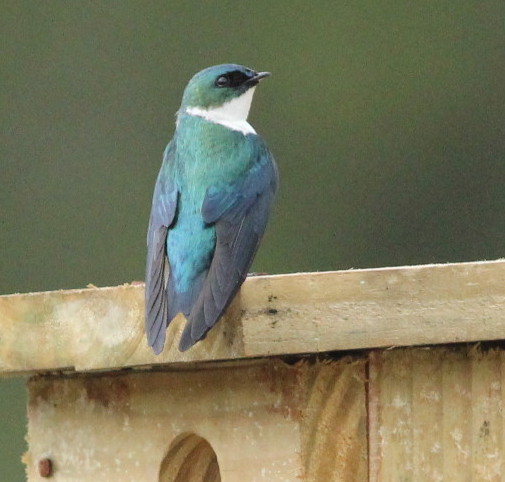
White-rumped Swallow Tachycineta leucorrhoa
The scientific name of the White-rumped Swallow is Tachycineta leucorrhoa. It is a species of bird in the family Hirundinidae (swallow), order Passeriformes. The name dates from 1817.
- Scientific name
- Tachycineta leucorrhoa (Vieillot, 1817)
- Common name
- White-rumped Swallow
- Genus
- Tachycineta
- Family
- Hirundinidae (Swallow)
- Order
- Passeriformes
- Class
- Aves
- Red List category
- LC Least Concern
- Environment
- terrestrial
- Recorded in
- 7 countries
- Name status
- accepted in the Catalogue of Life

Overview
Tachycineta leucorrhoa inhabits open and semi-open country near water, woodland and forest edges, seasonally flooded grasslands, human settlements and degraded former forest. It is distinguished by a white supraloral streak and a white rump with fine shaft streaks.
Written 26 November 2026 from the sources listed below. Each statement was checked against the passage it cites; statements that could not be supported were removed.
Similar species
The White-rumped Swallow can be distinguished from the Chilean Swallow by its white supraloral streak and larger size. It was formerly classified as a subspecies of the Chilean Swallow.[1][2][3]
Appearance
Its white rump has fine shaft streaks rather than being entirely white. The tail is black and shallowly forked.[4][5]
The species has brown irides and black bills, legs and feet. Juveniles are duller and browner than adults and have a dusky breast.[6][7]
The White-rumped Swallow measures approximately 13 centimetres in length. Adults weigh between 17 and 21 grams, and its average wingspan is 115.7 millimetres.[8][9][10]
Habitat
The White-rumped Swallow inhabits open and semi-open country near water and occurs along woodland and forest edges. It also inhabits subtropical and tropical seasonally flooded grasslands.[11][12][13]
The species occurs in human settlements and degraded former forest.[14][15]
The species is native to Argentina, Bolivia, Brazil, Paraguay, Peru and Uruguay. It occurs at elevations from sea level to 1,100 metres and is found in the pampas of Argentina and Uruguay.[16][17][18]
Southern populations generally move towards the northern parts of the species' range during the austral winter.[19]
Diet
The White-rumped Swallow is an aerial insectivore. Its recorded prey includes flies, beetles, flying ants, Orthoptera and Lepidoptera.[20][21]
The species usually feeds close to water, pastures and open woodland.[22]
Behaviour
The species usually feeds alone or in small groups. Its flight is fast and direct, and it occasionally skims the ground while feeding.[23][24]
The species usually sings while flying at dawn. Its song is often described as a soft gurgling or broken warble, and its alarm note is short and harsh.[25][26][27]
Reproduction and life cycle
The species usually nests in holes or crevices in trees and dead snags. It also nests in artificial structures such as fence posts and building eaves, generally nesting solitarily in scattered pairs during the breeding season.[28][29][30]
Its nests are usually constructed from plant fibres and lined with hair and feathers. The shiny cowbird occasionally parasitizes its nests, affecting approximately six percent of nests, and the species sometimes loses its nests to the southern house wren.[31][32][33][34]
The breeding season runs from October to December in Brazil and from October to February in Argentina. The species usually produces one brood per breeding season but occasionally produces a second.[35][36][37]
A typical clutch contains four to seven eggs. The eggs average 19.6 by 13.7 millimetres in size and weigh an average of 1.9 grams.[38][39][40]
Females incubate their eggs for approximately 15 to 16 days. Young typically fledge between 21 and 25 days after hatching.[41][42]
Approximately 56 percent of offspring are extra-pair young. Approximately 58 percent of nests produce at least one fledgling.[43][44]
Conservation
The White-rumped Swallow is classified as a species of Least Concern by the IUCN. Its estimated geographic range covers approximately 5,580,000 square kilometres, and its population is increasing.[45][46][47]
Greater availability of artificial nesting sites may benefit the species.[48]
Classification of the White-rumped Swallow
| Kingdom | Animalia |
|---|---|
| Phylum | Chordata |
| Subphylum | Vertebrata |
| Infraphylum | Gnathostomata |
| Parvphylum | Osteichthyes |
| Megaclass | Tetrapoda |
| Class | Aves (Bird) |
| Order | Passeriformes (Passerine) |
| Family | Hirundinidae (Swallow) |
| Genus | Tachycineta (Tree Swallows) |
| Species | Tachycineta leucorrhoa (Vieillot, 1817) |
Where the White-rumped Swallow is found
Checklists and occurrence records place Tachycineta leucorrhoa in 7 countries across South America. GBIF holds 77,243 georeferenced records of it.
Countries
Regions and cities with the most records
- Buenos Aires, Argentina 13,063
- Buenos Aires, Argentina 12,625
- Santos Lugares, Argentina 12,454
- Valentín Alsina, Argentina 11,735
- Avellaneda, Argentina 11,379
- Lanús, Argentina 11,218
- Sarandí, Argentina 11,109
- Remedios de Escalada de San Martín, Argentina 9,859
- Banfield, Argentina 9,110
- Monte Chingolo, Argentina 9,106
- Lomas de Zamora, Argentina 8,665
- Quilmes, Argentina 7,528
- Villa Sarmiento, Argentina 7,096
- El Palomar, Argentina 6,472
- Hurlingham, Argentina 6,183
- San Isidro, Argentina 6,120
- Haedo, Argentina 5,874
- San Justo, Argentina 5,482
- São Paulo, Brazil 5,348
- Don Torcuato, Argentina 5,196
- Tigre, Argentina 4,332
- Santa Fe, Argentina 4,277
- Entre Rios, Argentina 3,955
- Rio Grande do Sul, Brazil 3,893
- Cordoba, Argentina 3,452
- Corrientes, Argentina 3,353
- Villa de Mayo, Argentina 3,232
- Santa Catarina, Brazil 3,061
- General Pacheco, Argentina 2,975
- Isidro Casanova, Argentina 2,755
- Maldonado, Uruguay 2,466
- Morón, Argentina 2,466
- Minas Gerais, Brazil 2,453
- Castelar, Argentina 2,246
- Laferrere, Argentina 2,090
- Paraná, Brazil 2,090
1 more country has a few records outside this range
These countries hold a few records of Tachycineta leucorrhoa but lie outside the range the checklists give for it. Such records are often zoo or garden specimens, museum material or vagrants, so the species is not counted as occurring there.
Range as the checklists state it
South America
A number beside a place is its count of GBIF occurrence records. A place without a number comes from a checklist alone. Records show where a species has been observed or collected, which can include escapes and vagrants.
Common names
English
- White-rumped Swallow
Names in 27 other languages
- Arabic
- سنونو أبيض الردف
- Catalan
- oreneta cellablanca
- Chinese
- 白腰树燕, 白腰樹燕
- Croatian
- bjeločeli piljak
- Czech
- vlaštovka bělokostřecová
- Danish
- Hvidgumpet Svale
- Dutch
- Witstuizwaluw, witstuitzwaluw
- Esperanto
- blankpuga hirundo
- Estonian
- safiirpääsuke
- Finnish
- ketopääsky
- French
- Hirondelle à diadème
- German
- Weißbürzelschwalbe
- Italian
- Rondine groppabianca
- Japanese
- コシジロミドリツバメ
- Lithuanian
- baltasturplė amerikinė kregždė
- Norwegian
- hvitbrynsvale
- Persian
- پرستوی دمگاهسفید
- Polish
- nadobniczka błękitna
- Portuguese
- andorinha-d'uropígio-branco, andorinha-de-sobre-branco
- Russian
- Белопоясничная американская ласточка, Белопоясничная ласточка
- Serbian
- Lasta sa belim nadrepkom
- Slovak
- lastovička čelenková
- Spanish
- Golondrina ceja blanca, Golondrina cejiblanca
- Swedish
- diademsvala, vitgumpsvala
- Turkish
- Ak Sokumlu Kırlangıç
- Ukrainian
- білозорка лазурова
- Welsh
- gwennol dinwen
Synonyms
2 other scientific names have been used for this species and are now treated as synonyms of Tachycineta leucorrhoa.
- Hirundo leucorrhoa Vieillot, 1817
- Iridoprocne leucorrhoa Coues, E, 1878
Related species
-
 Tree SwallowTachycineta bicolor
-
 Violet-green SwallowTachycineta thalassina
-
 Mangrove SwallowTachycineta albilinea
-
 Chilean SwallowTachycineta leucopyga
-
 Golden SwallowTachycineta euchrysea
-
 Bahama SwallowTachycineta cyaneoviridis
-
 White-winged SwallowTachycineta albiventer
- Tumbes SwallowTachycineta stolzmanni
Compare
Questions and answers
What is the scientific name of the White-rumped Swallow?
The scientific name of the White-rumped Swallow is Tachycineta leucorrhoa. Written with its author, the full name is Tachycineta leucorrhoa (Vieillot, 1817).
Which family does the White-rumped Swallow belong to?
Tachycineta leucorrhoa belongs to the family Hirundinidae, in the order Passeriformes and the class Aves.
Where is the White-rumped Swallow found?
Checklists and occurrence records place Tachycineta leucorrhoa in 7 countries, including Argentina, Brazil, Uruguay, Paraguay, Bolivia and Peru.
What is the conservation status of the White-rumped Swallow?
The IUCN Red List category recorded for Tachycineta leucorrhoa is Least Concern (LC).
What birds have a white rump?
The White-rumped Swallow has a white rump with fine shaft streaks rather than an entirely white rump.[4]
What animals have a white rump?
The White-rumped Swallow has a white rump with fine shaft streaks.[4]
Sources
Passages the profile rests on
- The White-rumped Swallow can be distinguished from the Chilean Swallow by its white supraloral streak. Source passage: “The Chilean swallow but can be differentiated by the Chilean swallow's lack of a supraloral white streak.” — English Wikipedia
- The White-rumped Swallow is larger than the Chilean Swallow. Source passage: “The white-rumped swallow is, in addition, larger than the Chilean swallow.” — English Wikipedia
- The species was formerly classified as a subspecies of the Chilean Swallow. Source passage: “The species was formerly considered a subspecies of the Chilean swallow” — English Wikipedia
- Its white rump has fine shaft streaks rather than being entirely white. Source passage: “The rump is not totally white; it has some fine shaft streaks.” — English Wikipedia
- The White-rumped Swallow has a shallowly forked black tail. Source passage: “The tail is black and has a shallow fork.” — English Wikipedia
- The species has brown irides and black bills, legs and feet. Source passage: “The bill, legs, and feet are black, and the irides are brown.” — English Wikipedia
- Juveniles are duller and browner than adults and have a dusky breast. Source passage: “the juvenile can be distinguished by its dusky breast and the fact that it is duller and more brownish.” — English Wikipedia
- The White-rumped Swallow measures approximately 13 centimetres in length. Source passage: “The white-rumped swallow measures 13 centimetres (5.1 in) in length” — English Wikipedia
- Adults weigh between 17 and 21 grams. Source passage: “weighs 17–21 grams (0.60–0.74 oz).” — English Wikipedia
- Its average wingspan is 115.7 millimetres. Source passage: “It has an average wingspan of 115.7 millimetres (4.56 in).” — English Wikipedia
- The species inhabits open and semi-open country near water. Source passage: “It inhabits open and semi-open country near water” — English Wikipedia
- The species occurs along woodland and forest edges. Source passage: “the edge of woodland” — English Wikipedia
- It inhabits subtropical and tropical seasonally flooded grasslands. Source passage: “both subtropical and tropical seasonally flooded grassland.” — English Wikipedia
- The species also occurs in human settlements. Source passage: “and human settlements.” — English Wikipedia
- The White-rumped Swallow occurs in degraded former forest. Source passage: “It also occurs in dry savannas, degraded former forest” — English Wikipedia
- The species is native to Argentina, Bolivia, Brazil, Paraguay, Peru and Uruguay. Source passage: “This swallow is native to Argentina, Bolivia, Brazil, Paraguay, Peru, and Uruguay.” — English Wikipedia
- The White-rumped Swallow occurs at elevations from sea level to 1,100 metres. Source passage: “This bird can be found at altitudes ranging from sea level to 1,100 metres (3,600 ft).” — English Wikipedia
- The species occurs in the pampas of Argentina and Uruguay. Source passage: “It is additionally known to occur in the pampas of Argentina and Uruguay.” — English Wikipedia
- Southern populations generally move towards the northern parts of the species' range during the austral winter. Source passage: “During the austral winter, the birds in the southern population usually move to the northern parts of its range.” — English Wikipedia
- The White-rumped Swallow is an aerial insectivore. Source passage: “The white-rumped swallow is an aerial insectivore” — English Wikipedia
- Its recorded prey includes flies, beetles, flying ants, Orthoptera and Lepidoptera. Source passage: “feeding on flies, beetles, flying ants, Orthoptera, and Lepidoptera.” — English Wikipedia
- The species usually feeds close to water, pastures and open woodland. Source passage: “It usually feeds close over water, pastures, and open woodland.” — English Wikipedia
- The species usually feeds alone or in small groups. Source passage: “usually feeds alone or in small groups” — English Wikipedia
- Its flight is fast and direct, and it occasionally skims the ground while feeding. Source passage: “Occasionally skimming the ground, its flight is fast and direct.” — English Wikipedia
- The species usually sings while flying at dawn. Source passage: “It usually sings while flying at dawn.” — English Wikipedia
- Its song is often described as a soft gurgling or broken warble. Source passage: “The song of the white-rumped swallow is often described as a soft gurgling or a broken warble.” — English Wikipedia
- Its alarm note is short and harsh. Source passage: “The alarm note it uses is short and harsh.” — English Wikipedia
- The species usually nests in holes or crevices in trees and dead snags. Source passage: “builds nests in holes or crevices in a tree or dead snag.” — English Wikipedia
- It also nests in artificial structures such as fence posts and building eaves. Source passage: “It also builds them in artificial structures like holes in fence posts or under eaves” — English Wikipedia
- The species generally nests solitarily in scattered pairs during the breeding season. Source passage: “This swallow is solitary and, during the breeding season, is scattered in pairs.” — English Wikipedia
- Its nests are usually constructed from plant fibres and lined with hair and feathers. Source passage: “The nests themselves are usually made of plant fibres and lined with hair and feathers.” — English Wikipedia
- The shiny cowbird occasionally parasitizes White-rumped Swallow nests. Source passage: “The shiny cowbird is a brood parasite that occasionally lays its eggs in the nest of white-rumped swallow.” — English Wikipedia
- Approximately six percent of White-rumped Swallow nests are affected by shiny cowbird parasitism. Source passage: “About six percent of nests are affected by this.” — English Wikipedia
- The species sometimes loses its nests to the southern house wren. Source passage: “This swallow has been known to lose nests to the southern house wren” — English Wikipedia
- The breeding season runs from October to December in Brazil. Source passage: “The breeding season of the white-rumped swallow is from October to December in Brazil” — English Wikipedia
- In Argentina, the breeding season runs from October to February. Source passage: “and from October to February in Argentina.” — English Wikipedia
- The species usually produces one brood per breeding season but occasionally produces a second. Source passage: “During this period, one brood is usually laid, although it will occasionally lay a second brood.” — English Wikipedia
- A typical clutch contains four to seven eggs. Source passage: “The clutch is usually four to seven eggs” — English Wikipedia
- The eggs average 19.6 by 13.7 millimetres in size. Source passage: “The eggs measure 19.6 by 13.7 millimetres (0.77 in × 0.54 in)” — English Wikipedia
- The eggs weigh an average of 1.9 grams. Source passage: “and weigh 1.9 grams (0.067 oz) on average.” — English Wikipedia
- Female White-rumped Swallows incubate their eggs for approximately 15 to 16 days. Source passage: “It takes 15 to 16 days for the female to incubate the clutch.” — English Wikipedia
- Young typically fledge between 21 and 25 days after hatching. Source passage: “The fledging period is 21 to 25 days” — English Wikipedia
- Approximately 56 percent of offspring are extra-pair young. Source passage: “Extra-pair young, or young with parents outside of the breeding pair, account for about 56 percent of all offspring.” — English Wikipedia
- Approximately 58 percent of nests produce at least one fledgling. Source passage: “On average, 58 percent of nests will fledge at least one chick.” — English Wikipedia
- The White-rumped Swallow is classified as a species of Least Concern by the IUCN. Source passage: “The white-rumped swallow is classified as a least-concern species by the IUCN.” — English Wikipedia
- Its estimated geographic range covers approximately 5,580,000 square kilometres. Source passage: “its large range, estimated to be 5,580,000 square kilometres (2,150,000 mi2)” — English Wikipedia
- The species has an increasing population. Source passage: “its increase in population” — English Wikipedia
- Greater availability of artificial nesting sites may benefit the species. Source passage: “Increase in the availability of artificial nest sites may benefit this bird” — English Wikipedia
Data
- Catalogue of Life, 2026-10-16 XR cc by
- Global Biodiversity Information Facility CC BY 4.0
- Wikidata CC0
- GeoNames CC BY 4.0
- Wikimedia Commons per image; credit shown with each image
- Within the Catalogue of Life, this name comes from The Integrated Taxonomic Information System cc0
References
- Gill, Frank, & and Minturn Wright. (2006). Birds of the World: Recommended English Names.
This species in other databases
- Catalogue of Life 54CBF
- Wikidata Q3136330
- iNaturalist 11936
- WoRMS urn:lsid:marinespecies.org:taxname:226002
- Avibase whrswa1
Page built on 28 November 2026. See how the catalog is made and all sources and licences.
Cite this page
ScientificNames.org. (2026). Tachycineta leucorrhoa (White-rumped Swallow). Retrieved November 28, 2026, from https://scientificnames.org/species/tachycineta-leucorrhoa
“Tachycineta leucorrhoa (White-rumped Swallow).” ScientificNames.org, 2026, scientificnames.org/species/tachycineta-leucorrhoa. Accessed 28 Nov. 2026.
ScientificNames.org. “Tachycineta leucorrhoa (White-rumped Swallow).” Accessed November 28, 2026. https://scientificnames.org/species/tachycineta-leucorrhoa.
@misc{scientificnames_tachycineta_leucorrhoa_white_rumped_swallow,
  author = {{ScientificNames.org}},
  title = {Tachycineta leucorrhoa (White-rumped Swallow)},
  year = {2026},
  url = {https://scientificnames.org/species/tachycineta-leucorrhoa},
  note = {Accessed 2026-11-28}
}