Comparison
Azure-rumped Parrot vs Blue-backed Parrot
Azure-rumped Parrot (Tanygnathus sumatranus) and Blue-backed Parrot (Tanygnathus everetti) both belong to the genus Tanygnathus (large-billed parrots) and part ways below it. Both are recorded in 1 country.
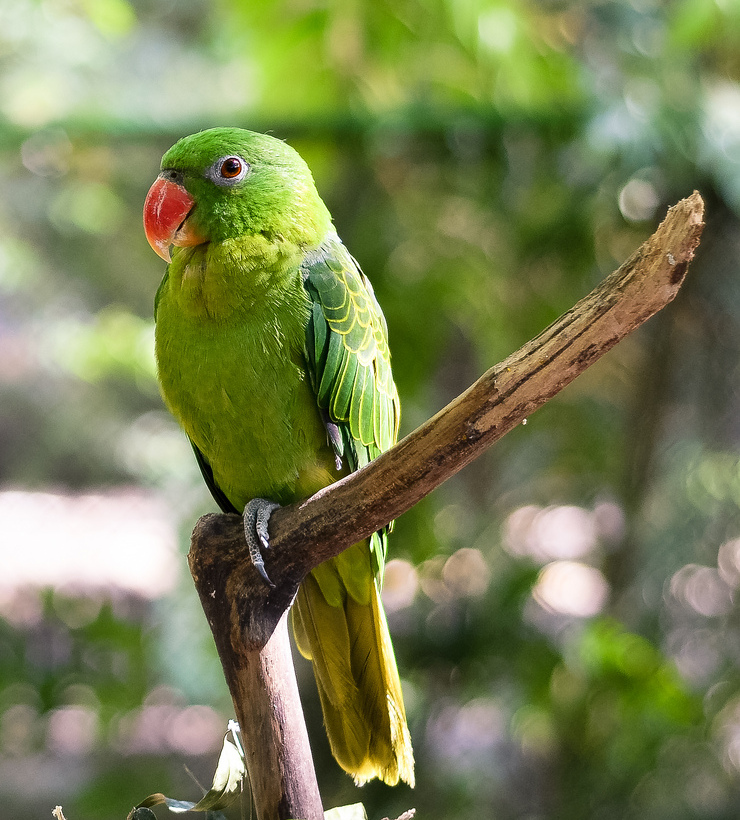
Azure-rumped Parrot
Tanygnathus sumatranus
Tanygnathus_sumatranus_-adult_male-8.jpg: Chris derivative work: Snowmanradio (talk), CC BY 2.0, via Wikimedia Commons


Blue-backed Parrot
Tanygnathus everetti
John Gerrard Keulemans, Public domain, via Wikimedia Commons

Side by side
| Azure-rumped Parrot | Blue-backed Parrot | |
|---|---|---|
| Scientific name | Tanygnathus sumatranus (Raffles, 1822) | Tanygnathus everetti Tweeddale, 1877 |
| English name | Azure-rumped Parrot | Blue-backed Parrot |
| Group | Birds | Birds |
| Class | Aves Bird | Aves Bird |
| Order | Psittaciformes Parrot | Psittaciformes Parrot |
| Family | Psittaculidae Lories | Psittaculidae Lories |
| Genus | Tanygnathus Large-billed Parrots | Tanygnathus Large-billed Parrots |
| Named in | 1822 | 1877 |
| Red List category | Least Concern | Endangered |
| Countries on record | 2 countries | 1 country |
| GBIF occurrence records | 532 records | 39 records |
Rows where the two agree are shown in grey.
Where each is found
Both recorded in 1 country
Only Azure-rumped Parrot (1)
From Catalogue of Life checklists and GBIF occurrence records. A country missing from a list means no record is held, which is not proof of absence.
Checked facts
| Azure-rumped Parrot | Blue-backed Parrot | |
|---|---|---|
| Appearance |
|
|
| Size |
| No checked fact yet |
| Habitat |
|
|
| Diet | No checked fact yet |
|
| Behaviour |
|
|
| Reproduction | No checked fact yet |
|
| Distribution |
|
|
| Conservation |
|
|
| Similar species |
|
|
In brief
Azure-rumped Parrot
The species is endemic to Indonesia and occurs on Sulawesi and the Sangir Islands. It is primarily green, with a blue rump, blue wing bends and yellowish wing edging. Full profile
Blue-backed Parrot
The species is endemic to the Philippines and occurs in tropical moist lowland forests. It has predominantly green plumage, a blue rump, blue wing bends and a red iris. Full profile
Compare something else
Page built on 27 November 2026 from the data on the two species pages, where every source is listed.
Cite this page
ScientificNames.org. (2026). Azure-rumped Parrot vs Blue-backed Parrot. Retrieved November 27, 2026, from https://scientificnames.org/compare/azure-rumped-parrot-vs-blue-backed-parrot
“Azure-rumped Parrot vs Blue-backed Parrot.” ScientificNames.org, 2026, scientificnames.org/compare/azure-rumped-parrot-vs-blue-backed-parrot. Accessed 27 Nov. 2026.
ScientificNames.org. “Azure-rumped Parrot vs Blue-backed Parrot.” Accessed November 27, 2026. https://scientificnames.org/compare/azure-rumped-parrot-vs-blue-backed-parrot.
@misc{scientificnames_azure_rumped_parrot_vs_blue_backed_parrot,
  author = {{ScientificNames.org}},
  title = {Azure-rumped Parrot vs Blue-backed Parrot},
  year = {2026},
  url = {https://scientificnames.org/compare/azure-rumped-parrot-vs-blue-backed-parrot},
  note = {Accessed 2026-11-27}
}