Species · Birds
Azure-rumped Parrot Tanygnathus sumatranus
The scientific name of the Azure-rumped Parrot is Tanygnathus sumatranus. It is a species of bird in the family Psittaculidae (lories), order Psittaciformes. The name dates from 1822.
- Scientific name
- Tanygnathus sumatranus (Raffles, 1822)
- Common name
- Azure-rumped Parrot
- Genus
- Tanygnathus
- Family
- Psittaculidae (Lories)
- Order
- Psittaciformes
- Class
- Aves
- Red List category
- LC Least Concern
- Recorded in
- 2 countries
- Name status
- accepted in the Catalogue of Life
Overview
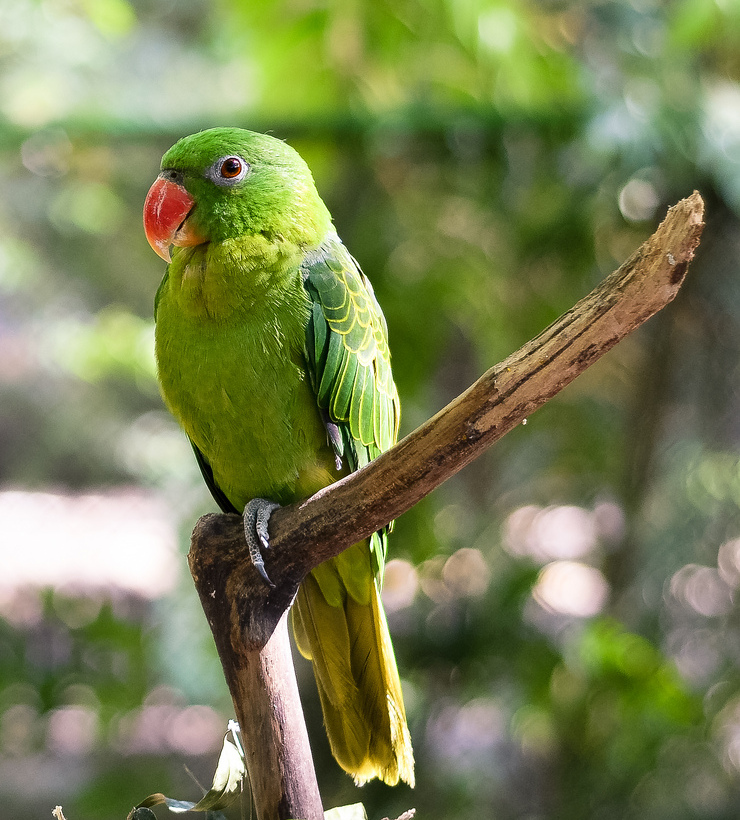
The species is endemic to Indonesia and occurs on Sulawesi and the Sangir Islands. It is primarily green, with a blue rump, blue wing bends and yellowish wing edging.
Written 26 November 2026 from the sources listed below. Each statement was checked against the passage it cites; statements that could not be supported were removed.
Habitat
The Azure-rumped Parrot inhabits lowland and foothill forests.[1][2]
Behaviour
The species forms small flocks that are often active at night.[3]
Appearance
The Azure-rumped Parrot has a medium body size of approximately 32 cm. Its plumage is primarily green, with yellowish edging on the wings, a blue rump and blue wing bends.[4][5]
The head, mantle, wings and tail are darker green, while the belly and collar are lighter green.[6]
The species exhibits sexual dimorphism in bill coloration, with males having red bills and females having pale yellow or horn-colored bills.[7]
The subspecies Tanygnathus sumatranus sangirensis has more blue on its wing bends and wing coverts and a darker green head.[8]
Conservation
Habitat loss and trapping for the pet trade are identified as major threats to the Azure-rumped Parrot.[9][10]
Similar species
The Azure-rumped Parrot was previously treated as conspecific with the blue-backed parrot. The blue-backed parrot has a red iris and blue back, whereas the Azure-rumped Parrot has a yellow iris and plain back.[11][12]
Classification of the Azure-rumped Parrot
| Kingdom | Animalia |
|---|---|
| Phylum | Chordata |
| Subphylum | Vertebrata |
| Infraphylum | Gnathostomata |
| Parvphylum | Osteichthyes |
| Megaclass | Tetrapoda |
| Class | Aves (Bird) |
| Order | Psittaciformes (Parrot) |
| Family | Psittaculidae (Lories) |
| Genus | Tanygnathus (Large-billed Parrots) |
| Species | Tanygnathus sumatranus (Raffles, 1822) |
Where the Azure-rumped Parrot is found
Checklists and occurrence records place Tanygnathus sumatranus in 2 countries across Asia. GBIF holds 532 georeferenced records of it.
Countries
Regions and cities with the most records
- Bitung, Indonesia 134
- Airmadidi, Indonesia 40
- Manado, Indonesia 15
- Tomohon, Indonesia 14
- Tondano, Indonesia 10
- Gorontalo, Indonesia 5
1 more country has a few records outside this range
These countries hold a few records of Tanygnathus sumatranus but lie outside the range the checklists give for it. Such records are often zoo or garden specimens, museum material or vagrants, so the species is not counted as occurring there.
Range as the checklists state it
Southern Asia
A number beside a place is its count of GBIF occurrence records. A place without a number comes from a checklist alone. Records show where a species has been observed or collected, which can include escapes and vagrants.
Common names
English
- Azure-rumped Parrot
- Blue-backed Parrot
Names in 29 other languages
- Catalan
- lloro becgròs de Muller
- Chinese
- 蘇門答臘藍背鸚鵡, 青蓝腰鹦鹉
- Croatian
- müllerova papiga
- Czech
- alexandr noční, mada Müllerův, papoušek rudozobý
- Danish
- Grøn Grovnæbspapegøje
- Dutch
- Müllers Papegaai, Sulawesiblauwstuitpapegaai
- Esperanto
- lazurdorsa papago
- Estonian
- rohe-konkpapagoi
- Finnish
- vihernokkakaija
- French
- Perruche de Müller
- German
- Azurbürzelpapagei, Blaubürzelpapagei, Blaurückenpapagei, Everettpapagei
- Hungarian
- celebeszi nagycsőrűpapagáj, éjszakai madapapagáj
- Indonesian
- Betet-kelapa punggung-biru
- Italian
- Pappagallo groppazzurra
- Japanese
- ササハインコ
- Lithuanian
- sumatrinė didžiasnapė papūga
- Norwegian
- asurgumppapegøye
- Persian
- طوطی پشت آبی
- Polish
- aleksandretta zielona, papuga zielona
- Portuguese
- papagaio-de-dorso-azul, papagaio-de-dorso-celeste
- Russian
- Мюллеров благородный попугай, Синеспинный попугай
- Serbian
- Celebeski edel papagaj
- Slovak
- ladniak olivový
- Spanish
- Loro de Müller
- Swedish
- Müllers papegoja, müllerpapegoja, sulawesipapegoja
- Turkish
- Gökçe Belli Papağan
- Ukrainian
- папуга-червонодзьоб суматранський, папужець-червонодзьоб суматранський
- Welsh
- parot Müller
- pnb
- پچھوں نیلا طوطا
Synonyms
2 other scientific names have been used for this species and are now treated as synonyms of Tanygnathus sumatranus.
- Psittacus sumatranus Raffles, TS, 1822
- Tanygnathus muelleri Müller, S, 1841
Subspecies and varieties
- Tanygnathus sumatranus sangirensis subspecies
- Tanygnathus sumatranus sumatranus subspecies
Related species
-
 Blue-naped ParrotTanygnathus lucionensis
-
 Great-billed ParrotTanygnathus megalorynchos
-
 Blue-backed ParrotTanygnathus everetti
-
 Black-lored ParrotTanygnathus gramineus
- BudgerigarMelopsittacus undulatus
-
 Rose-ringed ParakeetPsittacula krameri
-
 Rainbow LorikeetTrichoglossus moluccanus
-
 Australian King ParrotAlisterus scapularis
Compare
Questions and answers
What is the scientific name of the Azure-rumped Parrot?
The scientific name of the Azure-rumped Parrot is Tanygnathus sumatranus. Written with its author, the full name is Tanygnathus sumatranus (Raffles, 1822).
Which family does the Azure-rumped Parrot belong to?
Tanygnathus sumatranus belongs to the family Psittaculidae, in the order Psittaciformes and the class Aves.
Where is the Azure-rumped Parrot found?
Checklists and occurrence records place Tanygnathus sumatranus in 2 countries: Indonesia and Philippines.
What is the conservation status of the Azure-rumped Parrot?
The IUCN Red List category recorded for Tanygnathus sumatranus is Least Concern (LC).
What other names does the Azure-rumped Parrot have?
Tanygnathus sumatranus is also known in English as Blue-backed Parrot.
Sources
Passages the profile rests on
- The species inhabits forests. Source passage: “It is found in forests.” — English Wikipedia
- The species inhabits lowland and foothill forests. Source passage: “Inhabits lowland and foothill forests,” — ebird.org
- The species forms small flocks that are often active at night. Source passage: “Flocks are small and often active at night.” — English Wikipedia
- The species has a medium body size of approximately 32 cm. Source passage: “It is of medium size (32 cm)” — English Wikipedia
- The species is primarily green with yellowish edging on its wings, a blue rump and blue wing bends. Source passage: “primarily green with yellowish edging to the wings, a blue rump, and blue wing bends.” — English Wikipedia
- The head, mantle, wings and tail are darker green, while the belly and collar are lighter green. Source passage: “The head, mantle, wings and tail are darker green, the belly and collar are lighter green.” — English Wikipedia
- The species exhibits sexual dimorphism in bill coloration, with males having red bills and females having pale yellow or horn-colored bills. Source passage: “It is sexually dimorphic, with the male having a red beak and the female a pale yellow or horn colored beak.” — English Wikipedia
- The subspecies Tanygnathus sumatranus sangirensis has more blue on its wing bends and wing coverts and a darker green head. Source passage: “More blue on wing bends and wing coverts, head darker green.” — English Wikipedia
- Habitat loss is identified as a major threat to the species. Source passage: “Its main threats are habitat loss and trapping for the pet trade.” — English Wikipedia
- Trapping for the pet trade is identified as a major threat to the species. Source passage: “Its main threats are habitat loss and trapping for the pet trade.” — English Wikipedia
- The azure-rumped parrot was previously treated as conspecific with the blue-backed parrot. Source passage: “It was previously conspecific with the blue-backed parrot” — English Wikipedia
- The blue-backed parrot differs from the azure-rumped parrot by having a red iris and blue back, whereas the azure-rumped parrot has a yellow iris and plain back. Source passage: “which is differentiated with its red iris and blue back versus the azure-rumped parrot's yellow iris and plain back.” — English Wikipedia
Data
- Catalogue of Life, 2026-10-16 XR cc by
- Global Biodiversity Information Facility CC BY 4.0
- Wikidata CC0
- GeoNames CC BY 4.0
- Wikimedia Commons per image; credit shown with each image
- Within the Catalogue of Life, this name comes from The Integrated Taxonomic Information System cc0
References
- Gill, Frank, & and Minturn Wright. (2006). Birds of the World: Recommended English Names.
- Dickinson, E. C., and L. Christidis, eds. (2014). The Howard and Moore Complete Checklist of the Birds of the World, 4th Edition, Vol. 2 Passerines.
This species in other databases
Page built on 27 November 2026. See how the catalog is made and all sources and licences.
Cite this page
ScientificNames.org. (2026). Tanygnathus sumatranus (Azure-rumped Parrot). Retrieved November 27, 2026, from https://scientificnames.org/species/tanygnathus-sumatranus
“Tanygnathus sumatranus (Azure-rumped Parrot).” ScientificNames.org, 2026, scientificnames.org/species/tanygnathus-sumatranus. Accessed 27 Nov. 2026.
ScientificNames.org. “Tanygnathus sumatranus (Azure-rumped Parrot).” Accessed November 27, 2026. https://scientificnames.org/species/tanygnathus-sumatranus.
@misc{scientificnames_tanygnathus_sumatranus_azure_rumped_parrot,
  author = {{ScientificNames.org}},
  title = {Tanygnathus sumatranus (Azure-rumped Parrot)},
  year = {2026},
  url = {https://scientificnames.org/species/tanygnathus-sumatranus},
  note = {Accessed 2026-11-27}
}