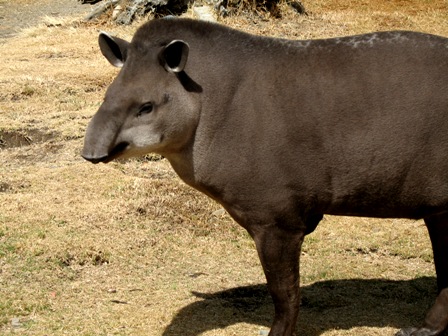
| Appearance | - Adults have dark brown to red coats, while juveniles have brown coats with horizontal white stripes. animaldiversity.org
- The species has a prominent sagittal crest extending from the eyes toward the neck, accompanied by a short mane. animaldiversity.org
- Its dark, rounded ears have distinctive white edges. English Wikipedia
- The species has a pronounced proboscis composed entirely of soft tissue. animaldiversity.org
| - Mountain tapirs have black or very dark brown fur, sometimes flecked with pale hairs. English Wikipedia
- The fur is paler on the underside, around the anal region, and on the cheeks. English Wikipedia
- A white band surrounds the lips, although its extent varies between individuals. English Wikipedia
- Mountain tapirs usually have white bands along the upper surfaces of their ears. English Wikipedia
- Adult mountain tapirs have paired patches of bare skin on their rumps that may indicate sexual maturity. English Wikipedia
- The eyes change from blue in young animals to pale brown as they age. English Wikipedia
- Mountain tapirs have long, woolly fur, particularly on their undersides and flanks. English Wikipedia
- Their fur can reach at least 3.5 cm in length in some individuals. English Wikipedia
- Mountain tapirs have small, stubby tails and long, flexible proboscises. English Wikipedia
- Each front foot has four toes, while each back foot has three toes. English Wikipedia
- Their toes have large nails and are supported by padded soles. English Wikipedia
- A pale pink or grey patch of bare skin extends above each toe. English Wikipedia
|
|---|
| Size | | |
|---|
| Habitat | - The species inhabits tropical montane forests, swamps, and lowland forests. animaldiversity.org
- The species prefers habitats close to rivers and other bodies of water. animaldiversity.org
- The species occurs at elevations ranging from sea level to 4,500 meters. animaldiversity.org
- The highest population densities occur in areas receiving 2,000 to 4,000 mm of annual rainfall and supporting lush vegetation. animaldiversity.org
- The species inhabits tropical rainforests, flooded grasslands, and savannas. pmc.ncbi.nlm.nih.gov
| - Mountain tapirs inhabit cloud forests and páramo ecosystems. English Wikipedia
- Mountain tapirs commonly inhabit elevations between 2,000 and 4,300 metres. English Wikipedia
- During the wet season, mountain tapirs tend to inhabit Andean forests. English Wikipedia
- During drier months, mountain tapirs move into páramo habitats. English Wikipedia
- Mountain tapirs require continuous areas of cloud forest and páramo to breed successfully and maintain healthy populations. English Wikipedia
|
|---|
| Diet | - The species is herbivorous and eats leaves, buds, shoots, small branches, fruits, grasses, and aquatic plants. English Wikipedia
- The species feeds on a wide variety of seeds found in rainforest habitats. English Wikipedia
- Its preferred forage plants include mombins, huito, and moriche palm. animaldiversity.org
- The species browses and grazes, consuming both fruit and other plant material. animaldiversity.org
- A study in Carlos Botelho State Park recorded 61 plant species in the diets of lowland tapirs. pmc.ncbi.nlm.nih.gov
- The recorded dietary plants predominantly belonged to the Melastomataceae, Asteraceae, and Myrtaceae families. pmc.ncbi.nlm.nih.gov
| - Mountain tapirs are herbivores that consume leaves, grasses, and bromeliads. English Wikipedia
- Common foods of wild mountain tapirs include lupins, Gynoxys, ferns, and umbrella plants. English Wikipedia
- Mountain tapirs visit natural salt licks to obtain essential minerals. English Wikipedia
- Mountain tapirs sometimes consume agricultural crops. English Wikipedia
|
|---|
| Behaviour | | - Mountain tapirs are generally shy and solitary animals. English Wikipedia
- Mountain tapirs spend their waking hours independently foraging along established tapir paths. English Wikipedia
- Mountain tapirs communicate with other members of their species through high-pitched whistles. English Wikipedia
- Mountain tapirs frequently wallow and swim in water. English Wikipedia
- Mountain tapirs are generally crepuscular but are more active during daylight than other tapir species. English Wikipedia
- Mountain tapirs generally sleep from midnight until dawn. English Wikipedia
- Mountain tapirs prefer sleeping in areas with dense vegetation cover. English Wikipedia
- Mountain tapirs sometimes stand on their hind legs to reach elevated plants and grasp them with their snouts. English Wikipedia
- Mountain tapirs rely on smell, taste, and sensitive proboscis bristles to compensate for poor eyesight. English Wikipedia
- Mountain tapirs mark territories using dung piles, urine, and tree rubbings. English Wikipedia
- Individual mountain tapir territories generally overlap and cover more than 800 hectares. English Wikipedia
|
|---|
| Reproduction | | - Female mountain tapirs have an estrous cycle lasting approximately 30 days. English Wikipedia
- Female mountain tapirs typically breed once every two years. English Wikipedia
- Mountain tapir gestation lasts approximately 392 or 393 days. English Wikipedia
- Female mountain tapirs generally give birth to one offspring at a time. English Wikipedia
- Newborn mountain tapirs weigh approximately 5.4 to 6.2 kg. English Wikipedia
- Newborn mountain tapirs have brown coats marked with yellowish-white spots and stripes. English Wikipedia
- Weaning of young mountain tapirs begins at approximately three months of age. English Wikipedia
- Mother mountain tapirs continue caring for their offspring for approximately 18 months. English Wikipedia
- Mountain tapirs reach sexual maturity at approximately three years of age. English Wikipedia
|
|---|
| Distribution | | - Mountain tapirs occur in the Eastern and Central Cordilleras of Colombia, Ecuador, and northern Peru. English Wikipedia
- Mountain tapirs are restricted to certain parts of the Andean Mountain Range in northwestern South America. English Wikipedia
|
|---|
| Conservation | - The IUCN Red List classifies the species as Vulnerable. animaldiversity.org
- Major threats to the species include overhunting, livestock competition, and habitat loss through deforestation. animaldiversity.org
- The species is listed under Appendix II of CITES. animaldiversity.org
- The species occurs in numerous protected areas throughout its geographic range. animaldiversity.org
- Hunting laws protecting the species are rarely enforced and have been ineffective. animaldiversity.org
| - The mountain tapir was classified as Endangered by the IUCN in 1996. English Wikipedia
- Deforestation for agriculture and mining, together with poaching, are major threats to mountain tapirs. English Wikipedia
- Fragmentation of the surviving range may have reduced mountain tapir populations below the level needed to maintain genetic diversity. English Wikipedia
- Mountain tapirs are protected in Peru's National Sanctuary Tabaconas Namballe. English Wikipedia
- Mountain tapirs have been identified as a keystone species of the high Andes. English Wikipedia
- Mountain tapirs contribute to seed dispersal because many seeds they consume successfully germinate in their dung. English Wikipedia
|
|---|
| Uses | - The species is hunted for its hide and meat, which provide protein to rural populations. animaldiversity.org
- Brazilian tapirs have been domesticated in Brazil for plowing and carrying children. animaldiversity.org
| - Mountain tapirs have historically been hunted for their meat and hides. English Wikipedia
- Mountain tapir toes, proboscises, and intestines have been used in local folk medicine and as aphrodisiacs. English Wikipedia
|
|---|
| Similar species | No checked fact yet | - The Brazilian tapir is identified as the mountain tapir's closest relative. English Wikipedia
|
|---|
| Other | No checked fact yet | - The mountain tapir is the smallest of the four widely recognized tapir species. English Wikipedia
|
|---|