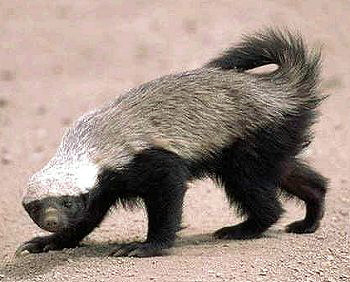
| Appearance | | - The honey badger has short, sturdy legs and five toes on each foot. English Wikipedia
- Its forelimbs have remarkably long claws, whereas its hind-leg claws are short. English Wikipedia
- Its coat generally has a black lower body and a white or grey upper mantle extending to the base of the tail. animaldiversity.org
- Individuals belonging to the cottoni subspecies have an entirely black coat. English Wikipedia
|
|---|
| Size | | |
|---|
| Habitat | - The tayra inhabits tropical and subtropical forests. English Wikipedia
- The tayra occurs in tropical deciduous forests, evergreen forests, secondary growth, and plantations. animaldiversity.org
- The tayra occurs at elevations ranging from lowlands to approximately 2,000–2,400 metres. animaldiversity.org
- The tayra uses hollow trees, burrows made by other animals, and occasionally tall grass as shelters. animaldiversity.org
- The tayra can also occur in cultivated areas, tree plantations, and farmland. English Wikipedia
| - Honey badgers inhabit tropical and subtropical green forests, thorn forests, open woodlands, riparian forests, grasslands, arid steppes, rocky hills, and deserts. animaldiversity.org
- Honey badgers occupy elevations from sea level to approximately 4,050 m. animaldiversity.org
- Honey badgers require sheltering places such as burrows or rock crevices. animaldiversity.org
- Honey badgers are not historically found in the extremely dry parts of the Sahara Desert or along the Mediterranean coast. animaldiversity.org
|
|---|
| Diet | | - Honey badgers consume insects, frogs, tortoises, turtles, lizards, rodents, snakes, birds, and eggs. English Wikipedia
- Honey badgers also eat berries, roots, and bulbs. English Wikipedia
- Honey badgers raid beehives to obtain bee larvae and honey. English Wikipedia
- Honey badgers consume all parts of their prey, including bones, feathers, hair, and skin. English Wikipedia
|
|---|
| Behaviour | - The tayra is primarily active during the day but may also be active during evenings or nights. English Wikipedia
- The tayra usually travels alone or in pairs. animaldiversity.org
- Tayras have occasionally been observed in groups of three to four individuals. animaldiversity.org
- The tayra uses its tail as a balancing aid when moving through trees. animaldiversity.org
- When alarmed, the tayra gives a short barking call and seeks refuge in the nearest tree. animaldiversity.org
- Tayras produce yowls, snarls, and clicking sounds when interacting in groups. animaldiversity.org
- The tayra can cache unripe green plantains and return several days later to consume their softened pulp. English Wikipedia
- The tayra primarily locates prey using its sense of smell. English Wikipedia
- The tayra actively chases detected prey rather than stalking or ambushing it. English Wikipedia
- The tayra can swim across rivers when necessary. English Wikipedia
| - Honey badgers are predominantly solitary animals. English Wikipedia
- Honey badgers may be active at any time of day depending on their location. English Wikipedia
- Honey badgers in the Serengeti are mostly nocturnal during the dry season and active throughout the day during the wet season. English Wikipedia
- Honey badgers are skilled diggers capable of excavating tunnels in hard ground within ten minutes. English Wikipedia
- Honey badger burrows are generally 1–3 m long and have a single entrance and an unlined nesting chamber. English Wikipedia
- Adult male honey badgers have an average home range of 548 km², compared with 138 km² for females. English Wikipedia
- Honey badgers scent-mark their territories using anal gland secretions, feces, and urine. English Wikipedia
- Honey badgers can repel larger predators by releasing a pungent yellow liquid from their anal glands. English Wikipedia
- Honey badgers sometimes hunt in pairs in Africa. English Wikipedia
|
|---|
| Reproduction | - Tayras can breed throughout the year. English Wikipedia
- Female tayras enter estrus several times annually, with each episode lasting between 3 and 20 days. English Wikipedia
- The gestation period of the tayra lasts approximately 63 to 67 days. English Wikipedia
- Female tayras give birth to between one and three offspring per litter. English Wikipedia
- Newborn tayras weigh approximately 100 grams. English Wikipedia
- Young tayras open their eyes between 35 and 47 days after birth. English Wikipedia
- Young tayras begin eating solid food at approximately 70 days of age. English Wikipedia
- Young tayras are fully weaned by approximately 100 days of age. English Wikipedia
- Young tayras begin displaying hunting behaviour as early as three months of age. English Wikipedia
- Young tayras are fully grown at approximately six months of age. English Wikipedia
- Young tayras leave their mothers to establish their own territories by approximately ten months of age. English Wikipedia
| - Honey badgers can breed throughout the year rather than during a fixed mating season. English Wikipedia
- Female honey badgers have an estimated oestrus period of approximately 14 days. English Wikipedia
- The gestation period of honey badgers is approximately 50–70 days. animaldiversity.org
- Female honey badgers move their cubs between dens during the first three months after birth. animaldiversity.org
- Honey badger cubs begin accompanying their mothers while foraging at approximately three months of age. animaldiversity.org
- Female honey badgers care for their offspring for approximately 12–16 months. animaldiversity.org
- Male honey badgers generally reach sexual maturity at two to three years of age. animaldiversity.org
|
|---|
| Distribution | No checked fact yet | - Honey badgers occur across most of sub-Saharan Africa, from South Africa's Western Cape to southern Morocco and southwestern Algeria. English Wikipedia
- The species' range extends beyond Africa through Arabia, Iran, Western Asia, Turkmenistan, and the Indian Peninsula. English Wikipedia
|
|---|
| Conservation | - The tayra is classified as a species of least concern. English Wikipedia
- Wild tayra populations are declining, particularly in Mexico, because of agricultural habitat destruction. English Wikipedia
- The Mexican subspecies Eira barbara senex is considered vulnerable. animaldiversity.org
| - The honey badger is classified as Least Concern on the IUCN Red List. English Wikipedia
- Honey badgers are threatened by killings associated with beekeeping and farming, including poisoning and trapping. English Wikipedia
|
|---|
| Uses | - Indigenous people historically used tayras to control rodent populations. animaldiversity.org
- Tayras can be tamed and kept as pets. animaldiversity.org
- Indigenous people of Central and South America historically used tayras for rodent control. lamar.edu
| - Honey badgers are used in traditional medicine and consumed as bushmeat. English Wikipedia
|
|---|
| Other | | - The honey badger is the only living species in the genus Mellivora. English Wikipedia
- The honey badger is the sole living representative of the subfamily Mellivorinae. English Wikipedia
|
|---|