| Appearance | | |
|---|
| Size | | |
|---|
| Habitat | - The common tenrec occurs in open forests, arid shrublands, and savannas. English Wikipedia
- The common tenrec also inhabits agricultural land, pastures, plantations, private gardens, and landscaped urban areas. English Wikipedia
- The common tenrec generally occurs near water sources where brush and undergrowth provide cover. animaldiversity.org
- The common tenrec occurs in eastern rainforests and western gallery forests bordering river systems in Madagascar. animaldiversity.org
- Common tenrecs are frequently found near rice paddy fields. animaldiversity.org
| |
|---|
| Diet | - The common tenrec is omnivorous. English Wikipedia
- The common tenrec eats larger invertebrates, including frogs, reptiles, mice, and other small mammals. English Wikipedia
- The common tenrec also consumes fruits, leaves, and other vegetation. English Wikipedia
- The common tenrec's main food source consists of invertebrates. animaldiversity.org
- The common tenrec probes cracks in rocks and logs with its snout to locate prey using its sensitive whiskers. animaldiversity.org
| |
|---|
| Behaviour | - Common tenrecs are generally solitary and avoid other members of their species except for interactions between mothers and young. animaldiversity.org
- Common tenrecs forage and hibernate alone. animaldiversity.org
- Common tenrecs have two main daily activity periods, from 18:00 to 21:00 and from 01:00 to 05:00. animaldiversity.org
- Common tenrecs sometimes swim in rice paddies while foraging. animaldiversity.org
- Common tenrecs can climb steep rock faces while searching for food. animaldiversity.org
- Common tenrecs cover between 0.5 and 2 hectares per night while searching for food. animaldiversity.org
- When threatened, the common tenrec raises its spiny hairs, vocalizes, jumps, bucks, and bites. English Wikipedia
- Common tenrecs construct daytime nests from grass and leaves beneath rocks, logs, or bushes. English Wikipedia
- Common tenrecs use scent marking by dragging their cloacas along the ground. animaldiversity.org
| - Greater hedgehog tenrecs forage primarily at ground level but can also climb. English Wikipedia
- The species is nocturnal. animaldiversity.org
- The species undergoes both daily torpor and seasonal torpor or hibernation. animaldiversity.org
- During daylight, individuals nest in shallow ground holes or tree cavities. animaldiversity.org
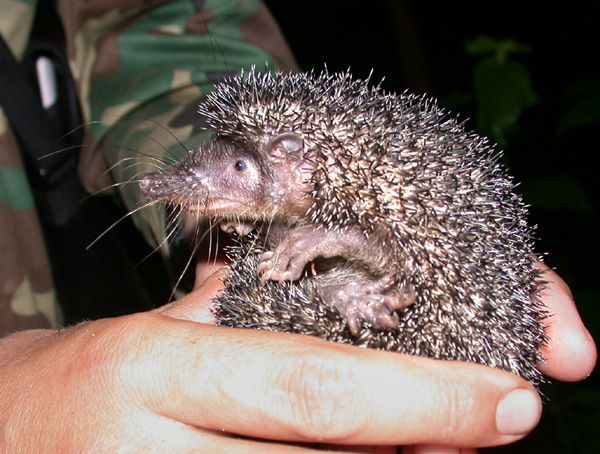
- Individuals can curl into a ball and enclose themselves in a protective shield of spines. animaldiversity.org
- Males have an average home range of 13.7 hectares, with a standard deviation of 4.9 hectares. animaldiversity.org
- Females have an average home range of 6.7 hectares, with a standard deviation of 2.0 hectares. animaldiversity.org
- The species may communicate through grunts, squeaks, and chirps. animaldiversity.org
- Individuals may use hissing and puffing sounds during offensive and defensive interactions. animaldiversity.org
- When disturbed, individuals may curl into a spiny ball or jump and scratch with their spines. animaldiversity.org
- Individuals may mark territory by placing feces and urine outside their burrows. animaldiversity.org
|
|---|
| Reproduction | - The common tenrec breeds during October and November. animaldiversity.org
- The gestation period of the common tenrec lasts between 56 and 64 days. animaldiversity.org
- Common tenrec young are generally born in December and January. animaldiversity.org
- Common tenrec litters contain between 1 and 32 young. animaldiversity.org
- Average litter size varies geographically and by habitat, ranging from 10 in Seychelles rainforests to 20 in seasonal woodland and savanna regions. animaldiversity.org
- Common tenrec mothers may produce a second litter if their first litter dies after birth. animaldiversity.org
- Young common tenrecs begin following their mothers to forage at approximately three weeks old. animaldiversity.org
- Young common tenrecs begin consuming solid food at approximately four weeks old. animaldiversity.org
- Young common tenrecs lose their characteristic stripes at 36 days old. animaldiversity.org
| - The species is promiscuous and breeds seasonally. animaldiversity.org
- The breeding season begins shortly after emergence from hibernation between late September and mid-October. animaldiversity.org
- The breeding season continues until shortly before hibernation resumes in April. animaldiversity.org
- Females produce between one and five young during a breeding season. animaldiversity.org
- Gestation lasts between 51 and 65 days. animaldiversity.org
- In captivity, young weigh approximately 20 grams and measure 75 millimetres three days after birth. animaldiversity.org
- In captivity, lactation continues until approximately three weeks after birth. animaldiversity.org
- Young begin accompanying their mothers outside the nest at approximately 14 days of age. animaldiversity.org
- Females increase nest-building activity during the week of parturition. animaldiversity.org
- Maternal care includes licking and huddling over the young while they nurse. animaldiversity.org
|
|---|
| Distribution | - The common tenrec is native to Madagascar. English Wikipedia
- The common tenrec has been introduced to the Comoros, Mauritius, Réunion, and Seychelles island groups. English Wikipedia
| - Setifer setosus is endemic to Madagascar and occurs throughout the island. English Wikipedia
|
|---|
| Conservation | | |
|---|
| Uses | - The common tenrec has served as an important food source for people in Madagascar for thousands of years. animaldiversity.org
- The common tenrec helps reduce insect pest populations through its insectivorous feeding habits. animaldiversity.org
| |
|---|
| Similar species | No checked fact yet | - Despite its hedgehog-like appearance, the greater hedgehog tenrec is not closely related to true hedgehogs. English Wikipedia
- The greater hedgehog tenrec resembles the lesser hedgehog tenrec, Echinops telfairi, in having a spiny back and hedgehog-like appearance. nhm.ac.uk
|
|---|
| Other | - The common tenrec is the only species belonging to the genus Tenrec. English Wikipedia
| No checked fact yet |
|---|