Species · Mammals
Tailless Tenrec Tenrec ecaudatus
The scientific name of the Tailless Tenrec is Tenrec ecaudatus. It is a species of mammal in the family Tenrecidae, order Afrosoricida. The name dates from 1778.
- Scientific name
- Tenrec ecaudatus (Schreber, 1778)
- Common name
- Tailless Tenrec
- Genus
- Tenrec
- Family
- Tenrecidae
- Order
- Afrosoricida
- Class
- Mammalia
- Red List category
- LC Least Concern
- Recorded in
- 6 countries
- Name status
- accepted in the Catalogue of Life

Overview
Tenrec ecaudatus is native to Madagascar and has been introduced to the Comoros, Mauritius, Réunion, and Seychelles island groups. It has coarse grey to reddish-grey fur, long sharp spines, and a small tail measuring 1.0 to 1.5 cm.
Written 26 November 2026 from the sources listed below. Each statement was checked against the passage it cites; statements that could not be supported were removed.
Appearance
The Tailless Tenrec has coarse fur ranging in color from grey to reddish-grey and long, sharp spines along its body. Its tail measures 1.0 to 1.5 cm.[1][2][3]
Adults have a mane of stiff, long hairs, while young have longitudinal rows of white spines along their backs. The forelimbs are longer than the hindlimbs.[4][5][6]
It has a cylindrical skull and an elongated snout. Its head-and-body length ranges from 265 to 390 mm, and it can weigh up to 2 kilograms.[7][8][9]
Habitat
The Tailless Tenrec occurs in open forests, arid shrublands, and savannas. It also inhabits agricultural land, pastures, plantations, private gardens, and landscaped urban areas.[10][11]
It generally occurs near water sources where brush and undergrowth provide cover. It occurs in eastern rainforests and western gallery forests bordering river systems in Madagascar and is frequently found near rice paddy fields.[12][13][14]
Diet
The Tailless Tenrec is omnivorous, and its main food source consists of invertebrates. It also eats larger invertebrates, including frogs, reptiles, mice, and other small mammals.[15][16][17]
Its diet also includes fruits, leaves, and other vegetation. It probes cracks in rocks and logs with its snout to locate prey using its sensitive whiskers.[18][19]
Behaviour
Tailless Tenrecs are generally solitary and avoid other members of their species except during interactions between mothers and young. They forage and hibernate alone.[20][21]
They have two main daily activity periods, from 18:00 to 21:00 and from 01:00 to 05:00. They sometimes swim in rice paddies while foraging and can climb steep rock faces while searching for food.[22][23][24]
They cover between 0.5 and 2 hectares per night while searching for food. They construct daytime nests from grass and leaves beneath rocks, logs, or bushes.[25][26]
When threatened, they raise their spiny hairs, vocalize, jump, buck, and bite. They also use scent marking by dragging their cloacas along the ground.[27][28]
Reproduction and life cycle
The Tailless Tenrec breeds during October and November. Gestation lasts between 56 and 64 days, and young are generally born in December and January.[29][30][31]
Litters contain between 1 and 32 young. Average litter size varies geographically and by habitat, ranging from 10 in Seychelles rainforests to 20 in seasonal woodland and savanna regions.[32][33]
Mothers may produce a second litter if their first litter dies after birth. Young begin following their mothers to forage at approximately three weeks old and consuming solid food at approximately four weeks old.[34][35][36]
Young lose their characteristic stripes at 36 days old.[37]
Conservation
The Tailless Tenrec is classified as Least Concern by the IUCN. It is not listed under the CITES treaty.[38][39]
Uses
The Tailless Tenrec has served as an important food source for people in Madagascar for thousands of years. Its insectivorous feeding habits help reduce insect pest populations.[40][41]
Similar species
The Tailless Tenrec is the only species belonging to the genus Tenrec.[42]
Classification of the Tailless Tenrec
| Kingdom | Animalia |
|---|---|
| Phylum | Chordata |
| Subphylum | Vertebrata |
| Infraphylum | Gnathostomata |
| Parvphylum | Osteichthyes |
| Megaclass | Tetrapoda |
| Class | Mammalia (Mammal) |
| Subclass | Theria |
| Infraclass | Eutheria |
| Order | Afrosoricida (Tenrecs) |
| Suborder | Tenrecomorpha (Tenrecs) |
| Family | Tenrecidae |
| Subfamily | Tenrecinae (Spiny Tenrecs) |
| Genus | Tenrec |
| Species | Tenrec ecaudatus (Schreber, 1778) |
Where the Tailless Tenrec is found
Checklists and occurrence records place Tenrec ecaudatus in 6 countries across Africa. GBIF holds 1,194 georeferenced records of it.
Countries
Regions and cities with the most records
- Le Tampon, Reunion 121
- Le Port, Reunion 104
- Piton Saint-Leu, Reunion 103
- Saint-Leu, Reunion 102
- La Possession, Reunion 97
- Sainte-Marie, Reunion 90
- Saint-Louis, Reunion 87
- Saint-Paul, Reunion 81
- Saint-Benoît, Reunion 78
- Sainte-Suzanne, Reunion 72
- Saint-Denis, Reunion 69
- Saint-André, Reunion 62
- Victoria, Seychelles 60
- Saint-Pierre, Reunion 52
- Saint-Joseph, Reunion 51
- Vacoas, Mauritius 37
- Baie Sainte Anne, Seychelles 31
- Black River, Mauritius 29
- Curepipe, Mauritius 29
- Bambous, Mauritius 27
- Quatre Bornes, Mauritius 26
- Dzaoudzi, Mayotte 25
- Kaouéni, Mayotte 25
- Mamoudzou, Mayotte 25
- Labattoir, Mayotte 23
- Beau Bassin-Rose Hill, Mauritius 22
- Koungou, Mayotte 22
- Port Glaud, Seychelles 22
- Port Louis, Mauritius 20
- Le Hochet, Mauritius 17
- Saint Pierre, Mauritius 17
- Centre de Flacq, Mauritius 15
- Bel Air Rivière Sèche, Mauritius 14
- Ouangani, Mayotte 14
- Baie du Tombeau, Mauritius 12
- Moka, Mauritius 12
2 more countries have a few records outside this range
These countries hold a few records of Tenrec ecaudatus but lie outside the range the checklists give for it. Such records are often zoo or garden specimens, museum material or vagrants, so the species is not counted as occurring there.
Range as the checklists state it
Africa
A number beside a place is its count of GBIF occurrence records. A place without a number comes from a checklist alone. Records show where a species has been observed or collected, which can include escapes and vagrants.
Common names
English
- Tailless Tenrec
- Common Tenrec
- Tail-less Tenrec
- Tail-less Tenrec.
- Tailess Tenrec
Names in 17 other languages
- Arabic
- طنرق شائع
- Czech
- bodlín bezocasý
- Dutch
- Gewone Tenrek
- Finnish
- isotanrekki
- French
- Hérisson malgache, Tangue, Tenrec acaude
- German
- Großer Tenrek, Tenrek
- Greek
- Μυγαλή
- Hungarian
- farkatlan tanrek
- Italian
- Tenrec comune
- Japanese
- テンレック
- Norwegian Bokmål
- Børstepiggsvin
- Polish
- Kretojeż bezogonowy, Tenrek zwyczajny
- Portuguese
- Tenrec-sem-cauda
- Russian
- Обыкновенный тенрек
- Slovenian
- navadni tenrek
- Spanish
- Tenrec sin Cola
- Ukrainian
- Тенрек звичайний
Synonyms
One other scientific name has been used for this species and is now treated as a synonym of Tenrec ecaudatus.
- Erinaceus ecaudatus Schreber, 1778
Related species
-
 Lowland Streaked TenrecHemicentetes semispinosus
-
 Lesser Hedgehog TenrecEchinops telfairi
-
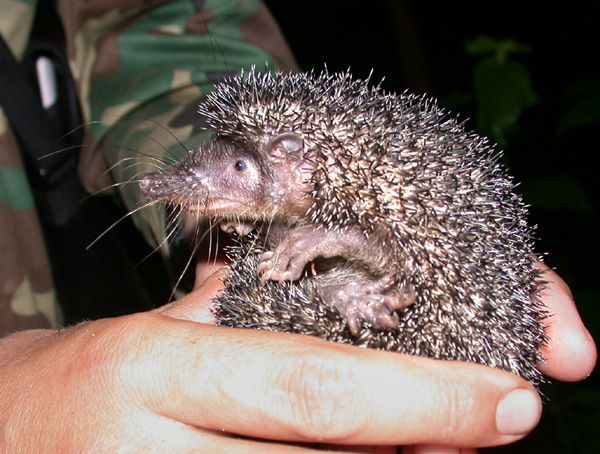 Greater Hedgehog TenrecSetifer setosus
-
 Highland Streaked TenrecHemicentetes nigriceps
- Large-eared TenrecGeogale aurita
-
 Mole-like Rice TenrecOryzorictes hova
- Short-tailed Shrew TenrecMicrogale brevicaudata
-
 Cowan's Shrew TenrecMicrogale cowani
Compare
Questions and answers
What is the scientific name of the Tailless Tenrec?
The scientific name of the Tailless Tenrec is Tenrec ecaudatus. Written with its author, the full name is Tenrec ecaudatus (Schreber, 1778).
Which family does the Tailless Tenrec belong to?
Tenrec ecaudatus belongs to the family Tenrecidae, in the order Afrosoricida and the class Mammalia.
Where is the Tailless Tenrec found?
Checklists and occurrence records place Tenrec ecaudatus in 6 countries: Madagascar, Reunion, Seychelles, Mauritius, Mayotte and Comoros.
What is the conservation status of the Tailless Tenrec?
The IUCN Red List category recorded for Tenrec ecaudatus is Least Concern (LC).
What other names does the Tailless Tenrec have?
Tenrec ecaudatus is also known in English as Common Tenrec, Tail-less Tenrec, Tail-less Tenrec. and Tailess Tenrec.
Sources
Passages the profile rests on
- The common tenrec has coarse fur ranging in color from grey to reddish-grey. Source passage: “It has medium-sized, coarse grey to reddish-grey fur and long, sharp spines along its body.” — English Wikipedia
- The common tenrec has long, sharp spines along its body. Source passage: “long, sharp spines along its body.” — English Wikipedia
- The common tenrec has a small tail measuring 1.0 to 1.5 cm. Source passage: “it has a small tail 1.0 to 1.5 cm (0.39 to 0.59 in) in length.” — English Wikipedia
- Adult common tenrecs have a mane of stiff, long hairs. Source passage: “these are replaced in the adult by a mane of stiff long hairs.” — animaldiversity.org
- Young common tenrecs have longitudinal rows of white spines along their backs. Source passage: “The young have rows of white spines in longitudinal rows along their backs;” — animaldiversity.org
- The forelimbs of the common tenrec are longer than its hindlimbs. Source passage: “The forelimbs are longer than the hindlimbs.” — animaldiversity.org
- The common tenrec has a cylindrical skull and an elongated snout. Source passage: “The skull is cylindrical and the snout elongated.” — animaldiversity.org
- The common tenrec has a head-and-body length ranging from 265 to 390 mm. Source passage: “Head and body length ranges from 265 to 390 mm.” — animaldiversity.org
- The common tenrec can weigh up to 2 kilograms. Source passage: “weighs up to 2 kilograms (4.4 lb).” — English Wikipedia
- The common tenrec occurs in open forests, arid shrublands, and savannas. Source passage: “open forest, arid shrub-land, savanna,” — English Wikipedia
- The common tenrec also inhabits agricultural land, pastures, plantations, private gardens, and landscaped urban areas. Source passage: “arable land, pastures, crop plantations, private gardens, and some landscaped, urban areas.” — English Wikipedia
- The common tenrec generally occurs near water sources where brush and undergrowth provide cover. Source passage: “generally found near water sources in areas with ample brush and undergrowth for cover.” — animaldiversity.org
- The common tenrec occurs in eastern rainforests and western gallery forests bordering river systems in Madagascar. Source passage: “Generally, the common tenrec is found in the eastern rainforests and in the gallery forests that border the river systems of the west.” — animaldiversity.org
- Common tenrecs are frequently found near rice paddy fields. Source passage: “These animals are very common near paddy fields.” — animaldiversity.org
- The common tenrec is omnivorous. Source passage: “The animal is omnivorous,” — English Wikipedia
- The common tenrec eats larger invertebrates, including frogs, reptiles, mice, and other small mammals. Source passage: “a diet of larger invertebrates, frogs, reptiles, mice, and other small mammals,” — English Wikipedia
- The common tenrec's main food source consists of invertebrates. Source passage: “in addition to its main diet of invertebrates.” — animaldiversity.org
- The common tenrec also consumes fruits, leaves, and other vegetation. Source passage: “as well as fruits, leaves, and other vegetation.” — English Wikipedia
- The common tenrec probes cracks in rocks and logs with its snout to locate prey using its sensitive whiskers. Source passage: “These tenrecs probe fissures in rocks and logs with the snout and detect prey with long, sensitive whiskers.” — animaldiversity.org
- Common tenrecs are generally solitary and avoid other members of their species except for interactions between mothers and young. Source passage: “The common tenrec is a solitary animal and attempts to avoid conspecifics; with the exception of mother and young.” — animaldiversity.org
- Common tenrecs forage and hibernate alone. Source passage: “Tenrec ecaudatus forages and hibernates alone.” — animaldiversity.org
- Common tenrecs have two main daily activity periods, from 18:00 to 21:00 and from 01:00 to 05:00. Source passage: “the first from 1800 to 2100 hours and the second from 0100 to 0500 hours.” — animaldiversity.org
- Common tenrecs sometimes swim in rice paddies while foraging. Source passage: “It is not unusual to see tenrecs swimming in rice paddies during their forays.” — animaldiversity.org
- Common tenrecs can climb steep rock faces while searching for food. Source passage: “They will climb steep rock faces when seeking food,” — animaldiversity.org
- Common tenrecs cover between 0.5 and 2 hectares per night while searching for food. Source passage: “These animals cover 0.5 to 2 hectares per night in search of food.” — animaldiversity.org
- Common tenrecs construct daytime nests from grass and leaves beneath rocks, logs, or bushes. Source passage: “It shelters in a nest of grass and leaves under a rock, log, or bush by day.” — English Wikipedia
- When threatened, the common tenrec raises its spiny hairs, vocalizes, jumps, bucks, and bites. Source passage: “If threatened, this tenrec will scream, erect its spiny hairs to a crest, jump, buck, and bite.” — English Wikipedia
- Common tenrecs use scent marking by dragging their cloacas along the ground. Source passage: “scent-marking by dragging its cloaca on the ground” — animaldiversity.org
- The common tenrec breeds during October and November. Source passage: “during the austral breeding season (October to November)” — animaldiversity.org
- The gestation period of the common tenrec lasts between 56 and 64 days. Source passage: “Gestation lasts 56 to 64 days.” — animaldiversity.org
- Common tenrec young are generally born in December and January. Source passage: “Young are born in the wet months of December and January,” — animaldiversity.org
- Common tenrec litters contain between 1 and 32 young. Source passage: “Litter size ranges from 1 to 32,” — animaldiversity.org
- Average litter size varies geographically and by habitat, ranging from 10 in Seychelles rainforests to 20 in seasonal woodland and savanna regions. Source passage: “average size is 10 in the Seychelles rainforests near the equator, 15 in most rainforest areas examined, and 20 in seasonal woodland and savanna regions.” — animaldiversity.org
- Common tenrec mothers may produce a second litter if their first litter dies after birth. Source passage: “the presence of small young in March suggests that a second litter is possible if the first litter dies after birth.” — animaldiversity.org
- Young common tenrecs begin following their mothers to forage at approximately three weeks old. Source passage: “At three weeks the young begin to forage with their mother,” — animaldiversity.org
- Young common tenrecs begin consuming solid food at approximately four weeks old. Source passage: “They begin to nurse less and to take solid food at approximately four weeks.” — animaldiversity.org
- Young common tenrecs lose their characteristic stripes at 36 days old. Source passage: “The young molt their characteristic stripes at 36 days,” — animaldiversity.org
- The common tenrec is classified as Least Concern by the IUCN. Source passage: “The IUCN rates the species as being of "Least Concern,"” — animaldiversity.org
- The common tenrec is not listed under the CITES treaty. Source passage: “the species is not listed in the CITES treaty.” — animaldiversity.org
- The common tenrec has served as an important food source for people in Madagascar for thousands of years. Source passage: “The common tenrec has been an important food source for the human inhabitants of Madagascar for thousands of years.” — animaldiversity.org
- The common tenrec helps reduce insect pest populations through its insectivorous feeding habits. Source passage: “as an insectivore it undoubtedly reduces the numbers of insect pests.” — animaldiversity.org
- The common tenrec is the only species belonging to the genus Tenrec. Source passage: “It is the only member of the genus Tenrec.” — English Wikipedia
Data
- Catalogue of Life, 2026-10-16 XR cc by
- Global Biodiversity Information Facility CC BY 4.0
- Wikidata CC0
- GeoNames CC BY 4.0
- Wikimedia Commons per image; credit shown with each image
- Within the Catalogue of Life, this name comes from The Integrated Taxonomic Information System cc0
References
- Die Säugethiere .. mit Beschreibungen vol.3 p.590, pl. 165 where the name was published
- Wilson, Don E., and DeeAnn M. Reeder, eds. (1993). Mammal Species of the World: A Taxonomic and Geographic Reference, 2nd Ed., 3rd Printing.
- Wilson, Don E., and F. Russell Cole. (2000). Common Names of Mammals of the World.
- Wilson, Don E., and DeeAnn M. Reeder, eds. (2005). Mammal Species of the World: A Taxonomic and Geographic Reference, 3rd Ed., Vols. 1 & 2.
- Jenkins, P. D. / Don E. Wilson and Russell A. Mittermeier, eds. (2018). Family Tenrecidae (Tenrecs and Shrew Tenrecs). Handbook of the Mammals of the World. Vol. 8: Insectivores, Sloths and Colugos.
This species in other databases
Page built on 26 November 2026. See how the catalog is made and all sources and licences.
Cite this page
ScientificNames.org. (2026). Tenrec ecaudatus (Tailless Tenrec). Retrieved November 26, 2026, from https://scientificnames.org/species/tenrec-ecaudatus
“Tenrec ecaudatus (Tailless Tenrec).” ScientificNames.org, 2026, scientificnames.org/species/tenrec-ecaudatus. Accessed 26 Nov. 2026.
ScientificNames.org. “Tenrec ecaudatus (Tailless Tenrec).” Accessed November 26, 2026. https://scientificnames.org/species/tenrec-ecaudatus.
@misc{scientificnames_tenrec_ecaudatus_tailless_tenrec,
  author = {{ScientificNames.org}},
  title = {Tenrec ecaudatus (Tailless Tenrec)},
  year = {2026},
  url = {https://scientificnames.org/species/tenrec-ecaudatus},
  note = {Accessed 2026-11-26}
}