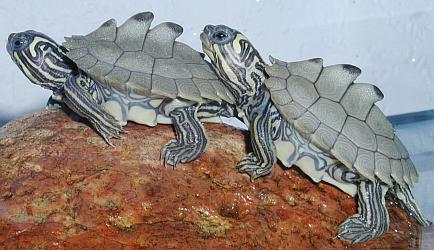
| Appearance | - The species has a flattened carapace that facilitates movement through water. animaldiversity.org
- The head, feet, and tail are olive or olive-brown. animaldiversity.org
- The carapace bears orange markings, while the head, arms, and legs have orange vertical lines. animaldiversity.org
- The orange body markings form patterns resembling topographical map lines. animaldiversity.org
- Orange patches behind the eyes frequently form J-shaped patterns. animaldiversity.org
- The chin has two vivid orange spots. animaldiversity.org
- The plastron is yellow and orange with dark seams. animaldiversity.org
- The lateral shell surfaces have five or six thin, dark lines. animaldiversity.org
- Adult males generally display more vivid coloration than females. animaldiversity.org
- Juveniles have brighter markings than adults, and their orange markings become duller as they mature. animaldiversity.org
- The carapace is oval-shaped when viewed from above, with its widest point just above the rear legs. English Wikipedia
- The posterior marginal shell scutes are serrated and the carapacial scutes are convex. English Wikipedia
- The vertebral scutes possess a medial keel, most prominent on the first three scutes. English Wikipedia
- The vertebral scute apices are yellowish but frequently become worn with age. English Wikipedia
- The carapace has an olive-green base color with yellow reticulations. English Wikipedia
- Juveniles and young adults often have slight patterns along the central seams of their plastral scutes. English Wikipedia
- Some adults have an unmarked creamy-yellow plastron. English Wikipedia
| - The species has a slightly domed, dark olive-brown carapace with four black, backward-projecting knob-like processes on its first four vertebrae. English Wikipedia
- The head is dark brown with yellow stripes and yellow crescent-shaped markings behind the eyes. English Wikipedia
- Females have higher carapaces than males, whereas males have longer tails. English Wikipedia
- The black vertical knobs on the outer scutes are a distinguishing physical feature of this species. animaldiversity.org
- The coloration of young turtles is more prominent than that of adults. animaldiversity.org
|
|---|
| Size | | |
|---|
| Habitat | - The species inhabits shallow, clear streams and muddy rivers with moderate currents. animaldiversity.org
- The species is most frequently found in open-canopied flowing-water habitats with dense vegetation. animaldiversity.org
- Females construct nests on sandbars and shorelines, generally choosing open areas. animaldiversity.org
- Females may travel farther inland to nest in sandy areas when their river lacks an exposed shoreline. animaldiversity.org
| - The species inhabits freshwater river systems with sand or clay substrates and moderate to strong currents. animaldiversity.org
- Individuals bask on brush, exposed trees, and floating plant rafts. animaldiversity.org
- Juveniles are commonly found in shallower waters in lower river courses, whereas older turtles occur more often in middle river courses. animaldiversity.org
- Hatchlings prefer slower-moving waters away from the main river channel. English Wikipedia
- The species occurs exclusively in aquatic habitats. animaldiversity.org
- Individuals can dive to depths of up to three metres. animaldiversity.org
|
|---|
| Diet | - Documented dietary items include freshwater sponges, algae, seeds, Asian clams, aquatic insects, leeches, and crayfish. English Wikipedia
| - The species feeds primarily on insects. English Wikipedia
- Observed insect prey includes beetles and dragonflies that fall into the river. English Wikipedia
- Freshwater sponges, bryozoans, and molluscs are three major sources of animal matter in the diet. English Wikipedia
- Freshwater algae was the only plant material identified in examined stomach contents. English Wikipedia
|
|---|
| Behaviour | - The species rarely occurs on land but uses partially submerged logs and rocks for basking. animaldiversity.org
- Individuals spend most of their time underwater at depths between 0 and 75 cm, surfacing to bask or breathe. animaldiversity.org
- The species is diurnal and spends most of its time submerged in shallow streams or rivers. animaldiversity.org
- Individuals bask on partially submerged logs or rocks to warm their bodies. animaldiversity.org
- Basking individuals remain vigilant and quickly retreat into the water when they perceive a threat. animaldiversity.org
- Males perform courtship by positioning their noses near female cloacas and usually drumming their claws against female faces. animaldiversity.org
- Individuals release pheromones that communicate their sex and reproductive status to nearby members of the same species. animaldiversity.org
| - The species is seasonally active from April until late November. English Wikipedia
- Individuals regularly bask in the early morning and early afternoon. English Wikipedia
- When approached, individuals escape into nearby water and seek shelter among fallen branches on the river bottom. English Wikipedia
- The species is solitary and relatively sedentary. animaldiversity.org
|
|---|
| Reproduction | | - Females lay between two and four clutches of eggs annually. animaldiversity.org
- Clutches contain three to seven eggs, averaging 5.5 eggs. animaldiversity.org
- Females construct nests on sandbars and deposit their eggs at the mouths of the nests. animaldiversity.org
- Females lay eggs nocturnally in nesting sites exposed to direct sunlight. animaldiversity.org
- Males use an elongated foreclaw vibration display during courtship. animaldiversity.org
- Newly hatched individuals are independent immediately after hatching. animaldiversity.org
- Sex is influenced by incubation temperature, with temperatures of at least 31°C producing primarily females and temperatures of at most 25°C producing primarily males. animaldiversity.org
|
|---|
| Distribution | - The Texas map turtle is endemic to Texas. English Wikipedia
- The species occurs within the Colorado River drainage in Texas. English Wikipedia
- The species is endemic to west-central Texas. animaldiversity.org
- Its populations occur primarily in the Colorado River watershed around the Edwards Plateau, including the Llano, San Saba, and Concho River tributaries. animaldiversity.org
- The species does not typically occur in waters southeast of Bastrop County, Texas. animaldiversity.org
| No checked fact yet |
|---|
| Conservation | No checked fact yet | - The species is classified as vulnerable by The Nature Conservancy. English Wikipedia
- Habitat degradation and human encroachment are identified as likely threats to the species. English Wikipedia
- Fishing equipment including trotlines, gill nets, and hoop nets can cause turtle deaths. English Wikipedia
|
|---|
| Uses | No checked fact yet | |
|---|
| Similar species | No checked fact yet | - Species sharing characteristics with the black-knobbed map turtle include the Alabama map turtle, Escambia map turtle, Pascagoula map turtle, and Barbour's map turtle. animaldiversity.org
|
|---|
| Other | - The species is classified in the reptile category by the United States Fish and Wildlife Service. fws.gov
| No checked fact yet |
|---|