Species · Reptiles
Black-knobbed Map Turtle Graptemys nigrinoda
The scientific name of the Black-knobbed Map Turtle is Graptemys nigrinoda. It is a species of reptile in the family Emydidae (terrapins), order Testudines. The name dates from 1954.
- Scientific name
- Graptemys nigrinoda Cagle, 1954
- Common name
- Black-knobbed Map Turtle
- Genus
- Graptemys
- Family
- Emydidae (Terrapins)
- Order
- Testudines
- Class
- Reptilia
- Red List category
- LC Least Concern
- Environment
- freshwater
- Recorded in
- 1 country
- Name status
- accepted in the Catalogue of Life
Overview
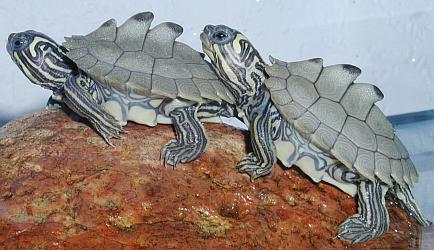
Graptemys nigrinoda inhabits freshwater river systems with sand or clay substrates and moderate to strong currents. It is distinguished by four black, backward-projecting knob-like processes on the first four vertebrae of its carapace.
Written 26 November 2026 from the sources listed below. Each statement was checked against the passage it cites; statements that could not be supported were removed.
Appearance
The head is dark brown with yellow stripes and yellow crescent-shaped markings behind the eyes. Young turtles have more prominent coloration than adults.[1][2]
Females have higher carapaces than males, whereas males have longer tails.[3]
Male carapace lengths range from approximately 7.6 to 10.2 cm, while female carapace lengths range from approximately 10.2 to 19.1 cm. Female carapaces average 152–178 mm, compared with 76–102 mm in males.[4][5][6]
The average total length of females is 221 mm, while that of males is 122 mm.[7][8]
Newly hatched individuals have an average carapace length of 35.5 mm and an average weight of 8.9 g.[9][10]
Habitat
The Black-knobbed Map Turtle inhabits freshwater river systems with sand or clay substrates and moderate to strong currents. It occurs exclusively in aquatic habitats and can dive to depths of up to three metres.[11][12][13]
Individuals bask on brush, exposed trees, and floating plant rafts. Juveniles are commonly found in shallower waters in lower river courses, whereas older turtles occur more often in middle river courses.[14][15]
Hatchlings prefer slower-moving waters away from the main river channel.[16]
Diet
The species feeds primarily on insects. Observed insect prey includes beetles and dragonflies that fall into the river.[17][18]
Freshwater sponges, bryozoans, and molluscs are major sources of animal matter in the diet. Freshwater algae was the only plant material identified in examined stomach contents.[19][20]
Behaviour
The species is seasonally active from April until late November. Individuals regularly bask in the early morning and early afternoon.[21][22]
When approached, individuals escape into nearby water and seek shelter among fallen branches on the river bottom. The species is solitary and relatively sedentary.[23][24]
Reproduction and life cycle
Females lay between two and four clutches of eggs annually. Clutches contain three to seven eggs, averaging 5.5 eggs.[25][26]
Females construct nests on sandbars and deposit their eggs at the mouths of the nests. Egg laying occurs nocturnally at nesting sites exposed to direct sunlight.[27][28]
Males use an elongated foreclaw vibration display during courtship. Newly hatched individuals are independent immediately after hatching.[29][30]
Sex is influenced by incubation temperature. Temperatures of at least 31°C produce primarily females, while temperatures of at most 25°C produce primarily males.[31]
Conservation
The species is classified as vulnerable by The Nature Conservancy. Habitat degradation and human encroachment are identified as likely threats.[32][33]
Fishing equipment, including trotlines, gill nets, and hoop nets, can cause turtle deaths.[34]
Uses
The species is traded as a pet.[35]
Similar species
Species sharing characteristics with the Black-knobbed Map Turtle include the Alabama map turtle, Escambia map turtle, Pascagoula map turtle, and Barbour's map turtle.[36]
Classification of the Black-knobbed Map Turtle
| Kingdom | Animalia |
|---|---|
| Phylum | Chordata |
| Subphylum | Vertebrata |
| Infraphylum | Gnathostomata |
| Parvphylum | Osteichthyes |
| Megaclass | Tetrapoda |
| Class | Reptilia (Reptile) |
| Order | Testudines (Turtle) |
| Suborder | Cryptodira |
| Superfamily | Testudinoidea |
| Family | Emydidae (Terrapins) |
| Genus | Graptemys (Map Turtles) |
| Species | Graptemys nigrinoda Cagle, 1954 |
Where the Black-knobbed Map Turtle is found
Checklists and occurrence records place Graptemys nigrinoda in 1 country across North America. GBIF holds 813 georeferenced records of it.
Countries
Regions and cities with the most records
- Alabama, United States 623
- Northport, United States 173
- Tuscaloosa, United States 173
- Prichard, United States 81
- Mobile, United States 78
- Montgomery, United States 65
- Millbrook, United States 64
- Prattville, United States 46
- Mississippi, United States 20
- Selma, United States 20
- Columbus, United States 8
- Daphne, United States 8
Range as the checklists state it
USA (Alabama, Mississippi [Alabama, Tombigbee, Black Warrior river systems])
A number beside a place is its count of GBIF occurrence records. A place without a number comes from a checklist alone. Records show where a species has been observed or collected, which can include escapes and vagrants.
Common names
English
- Black-knobbed Map Turtle
- Black-knobbed Sawback
Names in 9 other languages
- Arabic
- سلحفاة الخريطة سوداء النتوء
- Chinese
- 黑瘤地圖龜
- Czech
- želva černohrbá
- German
- Alabama-Höckerschildkröte, Schwarzbeulen-Höckerschildkröte, Schwarzknopf-Höckerschildkröte, Sägerücken-Schildkröte
- Hungarian
- alabamai tarajosteknős
- Japanese
- クロコブチズガメ
- Korean
- 검은혹지도거북
- Russian
- Чёрная шишковатая черепаха
- Spanish
- Tortuga Mapa de Punta Negra
Synonyms
2 other scientific names have been used for this species and are now treated as synonyms of Graptemys nigrinoda.
- Graptemys nigrinoda delticola Folkerts & Mount, 1969
- Graptemys nigrinoda nigrinoda Cagle, 1954
Related species
-
 Northern Map TurtleGraptemys geographica
-
 Barbour's Map TurtleGraptemys barbouri
-
 False Map TurtleGraptemys pseudogeographica
-
 Ouachita Map TurtleGraptemys ouachitensis
-
 Ringed Map TurtleGraptemys oculifera
-
 Yellow-blotched Map TurtleGraptemys flavimaculata
-
 Cagle's Map TurtleGraptemys caglei
-
 Alabama Map TurtleGraptemys pulchra
Compare
Questions and answers
What is the scientific name of the Black-knobbed Map Turtle?
The scientific name of the Black-knobbed Map Turtle is Graptemys nigrinoda. Written with its author, the full name is Graptemys nigrinoda Cagle, 1954.
Which family does the Black-knobbed Map Turtle belong to?
Graptemys nigrinoda belongs to the family Emydidae, in the order Testudines and the class Reptilia.
Where is the Black-knobbed Map Turtle found?
Checklists and occurrence records place Graptemys nigrinoda in 1 country: United States.
What is the conservation status of the Black-knobbed Map Turtle?
The IUCN Red List category recorded for Graptemys nigrinoda is Least Concern (LC).
What other names does the Black-knobbed Map Turtle have?
Graptemys nigrinoda is also known in English as Black-knobbed Sawback.
How rare is a map turtle?
The Black-knobbed Map Turtle is classified as vulnerable by The Nature Conservancy.[32]
What is the diet of a turtle?
The Black-knobbed Map Turtle feeds primarily on insects, including beetles and dragonflies that fall into the river. Freshwater sponges, bryozoans, and molluscs are major sources of animal matter, while freshwater algae is the only plant material identified in examined stomach contents.[17][18][19][20]
Sources
Passages the profile rests on
- The head is dark brown with yellow stripes and yellow crescent-shaped markings behind the eyes. Source passage: “The head is small, and is dark brown with yellow stripes, with yellow crescents behind the eye facing towards the posterior end of the turtle.” — English Wikipedia
- The coloration of young turtles is more prominent than that of adults. Source passage: “These colored features are most prominent on young turtles.” — animaldiversity.org
- Females have higher carapaces than males, whereas males have longer tails. Source passage: “females' carapaces tend to be higher than those of males, though the males have longer tails than the females.” — English Wikipedia
- Male carapace lengths range from approximately 7.6 to 10.2 cm. Source passage: “Sizes (carapace lengths) have been recorded as ranging from 7.6 to 10.2 cm (3.0 to 4.0 in) in males” — English Wikipedia
- Female carapace lengths range from approximately 10.2 to 19.1 cm. Source passage: “10.2–19.1 cm (4.0–7.5 in) in females.” — English Wikipedia
- Female carapaces average 152–178 mm, while male carapaces average 76–102 mm. Source passage: “Females have an average carapace size of 152 to 178 mm” — animaldiversity.org
- The average total length of females is 221 mm. Source passage: “and a total length of 221 mm.” — animaldiversity.org
- The average total length of males is 122 mm. Source passage: “Males have an average carapace size of 76 to 102 mm and a total length of 122 mm.” — animaldiversity.org
- Newly hatched individuals have an average carapace length of 35.5 mm. Source passage: “with a carapace length of 35.5 mm.” — animaldiversity.org
- Newly hatched individuals weigh an average of 8.9 g. Source passage: “The weight of new hatchlings, on average, is 8.9 g” — animaldiversity.org
- The species inhabits freshwater river systems with sand or clay substrates and moderate to strong currents. Source passage: “Black-knobbed map turtles are most commonly found in sand and clay substrates of rivers, with a moderate to strong river current.” — animaldiversity.org
- The species occurs exclusively in aquatic habitats. Source passage: “Black-knobbed map turtles live strictly in aquatic areas.” — animaldiversity.org
- Individuals can dive to depths of up to three metres. Source passage: “These turtles can dive up to three meters deep.” — animaldiversity.org
- Individuals bask on brush, exposed trees, and floating plant rafts. Source passage: “When out of water, these turtles bask on brush, exposed trees, and rafted plants to acquire direct sunlight.” — animaldiversity.org
- Juveniles are commonly found in shallower waters in lower river courses, whereas older turtles occur more often in middle river courses. Source passage: “Older turtles are most commonly observed at the middle course of the river while juveniles are sighted at lower courses, in more shallow waters.” — animaldiversity.org
- Hatchlings prefer slower-moving waters away from the main river channel. Source passage: “Hatchlings prefer more sluggish waters off the main channel.” — English Wikipedia
- The species feeds primarily on insects. Source passage: “This species feeds primarily on insects.” — English Wikipedia
- Observed insect prey includes beetles and dragonflies that fall into the river. Source passage: “this species has been observed to consume beetles and dragonflies that have fallen into the river.” — English Wikipedia
- Freshwater sponges, bryozoans, and molluscs are three major sources of animal matter in the diet. Source passage: “The three primary sources of animal matter came from freshwater sponges, bryozoans, and molluscs.” — English Wikipedia
- Freshwater algae was the only plant material identified in examined stomach contents. Source passage: “The only plant matter found was a freshwater alga.” — English Wikipedia
- The species is seasonally active from April until late November. Source passage: “Black-knobbed map turtles are seasonally active from April to late November.” — English Wikipedia
- Individuals regularly bask in the early morning and early afternoon. Source passage: “Basking is a routine part of their day, occurring in the early morning and early afternoon.” — English Wikipedia
- When approached, individuals escape into nearby water and seek shelter among fallen branches on the river bottom. Source passage: “When approached, the turtles jump into the nearby water. Once in the water, they seek protection between the branches of fallen trees on the river bottom.” — English Wikipedia
- The species is solitary and relatively sedentary. Source passage: “Black-knobbed map turtles are a solitary, fairly sedentary species.” — animaldiversity.org
- Females lay between two and four clutches of eggs annually. Source passage: “Females lay 2 to 4 clutches of eggs between March and August.” — animaldiversity.org
- Clutches contain three to seven eggs, averaging 5.5 eggs. Source passage: “Clutch sizes range from 3 to 7 eggs (5.5 on average).” — animaldiversity.org
- Females construct nests on sandbars and deposit their eggs at the mouths of the nests. Source passage: “Black-knobbed map turtles dig nests on sandbars and lay their eggs at the mouths of these nests.” — animaldiversity.org
- Females lay eggs nocturnally in nesting sites exposed to direct sunlight. Source passage: “Although they lay eggs nocturnally, females choose nesting sites in areas that are in direct sunlight” — animaldiversity.org
- Males use an elongated foreclaw vibration display during courtship. Source passage: “Male black-knobbed map turtles employ a courtship method called titillation, in which they extend a specially adapted elongated foreclaw and vibrate it in the water in front of females.” — animaldiversity.org
- Newly hatched individuals are independent immediately after hatching. Source passage: “Upon hatching, young are independent immediately.” — animaldiversity.org
- Sex is influenced by incubation temperature, with temperatures of at least 31°C producing primarily females and temperatures of at most 25°C producing primarily males. Source passage: “At temperatures of 31°C or above, hatchlings are primarily female; and at temperatures of 25°C or below, hatchlings are primarily male.” — animaldiversity.org
- The species is classified as vulnerable by The Nature Conservancy. Source passage: “is classified as vulnerable by The Nature Conservancy.” — English Wikipedia
- Habitat degradation and human encroachment are identified as likely threats to the species. Source passage: “The black-knobbed map turtle is most likely threatened by habitat degradation and encroachment by humans.” — English Wikipedia
- Fishing equipment including trotlines, gill nets, and hoop nets can cause turtle deaths. Source passage: “Fishermen, though, in most cases not purposely, can kill turtles with their trotlines, gill nets, and hoop nets.” — English Wikipedia
- The species is traded as a pet. Source passage: “Black-knobbed map turtles are popular in the pet trade” — English Wikipedia
- Species sharing characteristics with the black-knobbed map turtle include the Alabama map turtle, Escambia map turtle, Pascagoula map turtle, and Barbour's map turtle. Source passage: “Black-knobbed map turtles share characteristics between other turtles in the genus Graptemys , such as Alabama map turtles ( Graptemys pulchra ), Escambia map turtles ( Graptemys ernsti ), Pascaloula map turtles ( Graptemys gibbonsi ), and Barbour's map turtles ( Graptemys barbouri ).” — animaldiversity.org
Data
- Catalogue of Life, 2026-10-16 XR cc by
- Global Biodiversity Information Facility CC BY 4.0
- Wikidata CC0
- GeoNames CC BY 4.0
- Wikimedia Commons per image; credit shown with each image
- Within the Catalogue of Life, this name comes from The Reptile Database cc by
References
- Cagle, Fred R. (1954). Two new species of the genus Graptemys. Tulane Studies in Zoology 1 (11): 165-186.
- Shoop, C. R. (1967). Graptemys nigrinoda in Mississippi. Herpetologica 23 (1): 56.
- Folkerts, G. W., & Mount, R. H. (1969). A new subspecies of the turtle Graptemys nigrinoda Cagle. Copeia 1969 (4): 677-682.
- Folkerts, G. W., & Mount, R. H. (1970). Reply to H. L. Freeman’s comments on : A new subspecies of the turtle Graptemys nigrinoda Cagle. Herpetological Review 2: 3-4.
- Freeman, H. L. (1970). A comment on: A new species of the turtle Graptemy nigrinoda Cagle. Herpetological Review 2: 3.
- Gilbert, Carter R. (1974). Catalogue of type specimens in the Department of Natural Sciences, Florida State Museum. Bulletin of the Florida State Museum Biological Sciences 18 (2): 102-120.
- Lahanas P N. (1986). Graptemys nigrinoda Cagle. Black-knobbed sawback. Catalogue of American Amphibians and Reptiles ( 396: 1-2.
- Ernst,C.H. and Barbour,R.W. (1989). Turtles of the World. Smithsonian Institution Press, Washington D.C. - London.
- Conant, R., & Collins, J. T. (1991). A Field Guide to Reptiles and Amphibians of Eastern/Central North America, 3rd ed. Houghton Mifflin (Boston/New York), Xx + 450 P.
- Kirkpatrick, & David. (1993). Map turtles of the United States. Reptile & Amphibian Magazine (November/December): 7-17.
- Hertwig, S. (2001). Ökologie, Haltung, und Fortpflanzung im Terrarium von Graptemys caglei, G. flavimaculata, G. nigrinoda nigrinoda und G. oculifera. Salamandra 37 (1): 21-48.
- Stephens, P. R., & Wiens, J. J. (2003). Ecological diversification and phylogeny of emydid turtles. Biol. J. Linn. Soc. 79: 577-610.
- Joyce, Walter G. and Christopher J. Bell. (2004). A review of the comparative morphology of extant testudinoid turtles (Reptilia: Testudines). Asiatic Herpetological Research 10: 53-109.
- Sánchez-Villagra, Marcelo R.; Ziermann, Janine M.; Olsson, Lennart. (2008). Limb chondrogenesis in Graptemys nigrinoda (Emydidae), with comments on the primary axis and the digital arch in turtles. Amphibia-Reptilia 29 (1): 85-92.
- Lechowicz, Christopher. (2008). Tour d’horizon de l’histoire naturelle, la taxonomie, la préservation et les problémes actuels des tortues géographiques du genre Graptemys (Agassiz, 1857). Chéloniens 11:30-45.
- Bour, R. (2008). Global diversity of turtles (Chelonii; Reptilia) in freshwater. Hydrobiologia 595:593–598.
- Ernst, Carl H.; Lovich, Jeffrey E. (2009). Turtles of the United States and Canada, 2nd edition. Johns Hopkins University Press, 827 Pp.
- TTWG; Rhodin, A.G.J.; van Dijk, P.P.; Iverson, J.B. & Shaffer, H.B. [turtle taxonomy working group]. (2010). Turtles of the World, 2010 Update: Annotated Checklist of Taxonomy, Synonymy, Distribution, and Conservation Status. Chelonian Research Monographs (ISSN 1088-7105) No. 5, Doi:10.3854/Crm.5.000.Checklist.V3.2010.
- Ennen, Joshua R.; Jeffrey E. Lovich, Brian R. Kreiser, W. Selman, Carl P. Qualls. (2010). Genetic and Morphological Variation Between Populations of the Pascagoula Map Turtle (Graptemys gibbonsi) in the Pearl and Pascagoula Rivers with Description of a New Species. Chelonian Conservation and Biology. 9 (1): 98–113.
- Crother, B. I. (ed.). (2012). Standard Common and Current Scientific Names for North American Amphibians, Turtles, Reptiles, and Crocodilians, Seventh Edition. Herpetological Circular 39: 1-92.
- Ennen, Joshua R.; Marley E. Kalis, Adam L. Patterson, Brian R. Kreiser, Jeffrey E. Lovich, James Godwin and Carl P. Qualls. (2014). Clinal variation or validation of a subspecies? A case study of the Graptemys nigrinoda complex (Testudines: Emydidae). Biological Journal of the Linnean Society111 (4): 810–822; DOI: 10.1111/Bij.12234.
- Lindeman, Peter V. (2016). Diets of Syntopic Black-knobbed Sawbacks (Graptemys nigrinoda) and Alabama Map Turtles (Graptemys pulchra) in the Alabama River. The American Midland Naturalist 175 (2): 194-205.
- Seidel, Michael E. & Carl H. Ernst. (2017). A Systematic Review of the Turtle Family Emydidae. Vertebrate Zoology 67 (1): 1–122.
- Praschag P, Ihlow F, Flecks M, Vamberger M, Fritz U. (2017). Diversity of North American map and sawback turtles (Testudines: Emydidae: Graptemys). Zoologica Scripta 46: 675– 682.
- Lindeman, Peter V. L. (2020). Comparative Reproductive Allometry of Syntopic Black-Knobbed Sawbacks (Graptemys nigrinoda) and Alabama Map Turtles (Graptemys pulchra) in the Alabama River, with Comparison to Three Congeners. Chelonian Conservation and Biology 19 (2): 246-255.
This species in other databases
- Catalogue of Life 6KSVB
- Wikidata Q558742
- iNaturalist 39855
- WoRMS urn:lsid:marinespecies.org:taxname:1313651
- ITIS 173797
Page built on 29 November 2026. See how the catalog is made and all sources and licences.
Cite this page
ScientificNames.org. (2026). Graptemys nigrinoda (Black-knobbed Map Turtle). Retrieved November 29, 2026, from https://scientificnames.org/species/graptemys-nigrinoda
“Graptemys nigrinoda (Black-knobbed Map Turtle).” ScientificNames.org, 2026, scientificnames.org/species/graptemys-nigrinoda. Accessed 29 Nov. 2026.
ScientificNames.org. “Graptemys nigrinoda (Black-knobbed Map Turtle).” Accessed November 29, 2026. https://scientificnames.org/species/graptemys-nigrinoda.
@misc{scientificnames_graptemys_nigrinoda_black_knobbed_map_turtle,
  author = {{ScientificNames.org}},
  title = {Graptemys nigrinoda (Black-knobbed Map Turtle)},
  year = {2026},
  url = {https://scientificnames.org/species/graptemys-nigrinoda},
  note = {Accessed 2026-11-29}
}