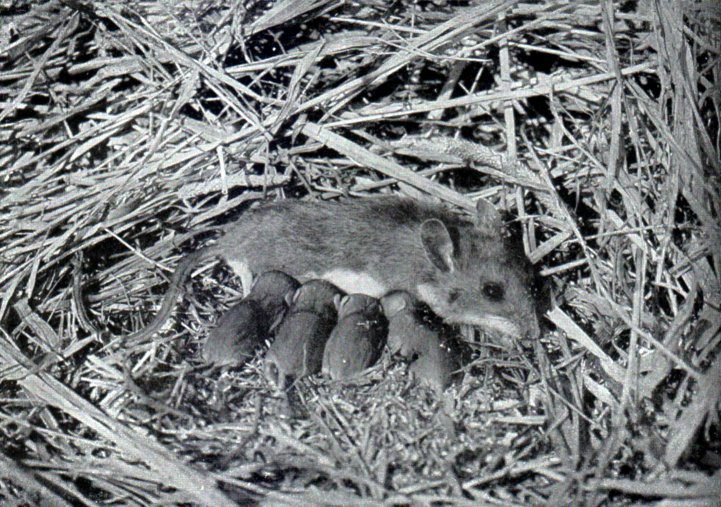
| Appearance | - The Texas mouse has a moderately haired tail that is approximately as long as or slightly longer than its head and body. depts.ttu.edu
- The Texas mouse has a tail that is darker on its upper surface than underneath and usually has a terminal tuft. depts.ttu.edu
- Its dorsal fur is sayal brown, becoming darker and mixed with blackish hairs along the midline. depts.ttu.edu
- Its sides are pinkish cinnamon in color. depts.ttu.edu
- Its ventral fur is pure white, although the hair bases are plumbeous. depts.ttu.edu
- The Texas mouse has large hind feet measuring 24–27 mm and usually has dark or dusky ankles. depts.ttu.edu
- Its upper and lower molars each possess an accessory loph. depts.ttu.edu
- Its skull has a length of 27.6–30.4 mm and a broad, non-rounded braincase. English Wikipedia
| - The upperparts of this species range from pale to rich reddish brown, while its underside and feet are white. animaldiversity.org
- Its tail is darker on the upper surface and lighter underneath. biokids.umich.edu
|
|---|
| Size | | |
|---|
| Habitat | - The Texas mouse inhabits rocky areas, including cliffs and limestone outcrops with woody vegetation. animaldiversity.org
- The Edwards Plateau of Texas is one of its documented habitats. animaldiversity.org
- The species inhabits cliffs and rocky outcrops in the Edwards Plateau, west Cross Timbers, Rolling Plains, and Llano Estacado escarpment of Texas. depts.ttu.edu
- The Texas mouse prefers rocky areas of the Edwards Plateau where juniper is the dominant vegetation. depts.ttu.edu
- Along the Llano Estacado escarpment, it inhabits rocky and gravelly areas vegetated with junipers, sumacs, oaks, grasses, and forbs. depts.ttu.edu
- The Texas mouse can also occupy open grassy areas with scattered rocky cover. depts.ttu.edu
| - This species is most frequently encountered in warm, dry forests and brushlands at low and intermediate elevations. animaldiversity.org
- It can inhabit environments ranging from high-elevation forests to semi-desert landscapes. animaldiversity.org
- It also occupies suburban and agricultural environments. biokids.umich.edu
- In the southern and western portions of its range, this species mainly inhabits wooded areas and semi-desert scrub near waterways. animaldiversity.org
- In southern Mexico, this species is primarily associated with agricultural environments. biokids.umich.edu
- It constructs nests in warm, dry locations such as hollow trees and abandoned bird nests. animaldiversity.org
|
|---|
| Diet | - Seeds and insects constitute the bulk of the Texas mouse's diet. depts.ttu.edu
- The Texas mouse feeds on grasshoppers, crickets, and other arthropods. depts.ttu.edu
- Its diet also includes juniper berries, green vegetation, acorns, and plant bulbs. depts.ttu.edu
- The Texas mouse consumes acorns particularly during winter and spring. English Wikipedia
| - This species is omnivorous and consumes seeds, berries, nuts, insects, grains, fruits, and fungi. biokids.umich.edu
- Its diet includes seeds, nuts, fruits, berries, and insects. tn.gov
- It consumes the pupal stage of invasive gypsy moths. English Wikipedia
- It gathers and stores seeds and nuts during autumn for consumption during winter. biokids.umich.edu
|
|---|
| Behaviour | - The Texas mouse is nocturnal in its foraging and activity. depts.ttu.edu
- The Texas mouse is highly arboreal and may forage for berries and nuts in trees. depts.ttu.edu
- The species is semiarboreal in at least some areas and frequently travels in trees. depts.ttu.edu
- The Texas mouse is a particularly capable and cautious climber compared with other Peromyscus species. depts.ttu.edu
- The Texas mouse does not hibernate. English Wikipedia
- The average home range of the Texas mouse is approximately 0.2 ha. English Wikipedia
- Male Texas mice have home ranges approximately twice as large as those of females. English Wikipedia
| - This species is primarily active during nighttime. animaldiversity.org
- Individuals are generally solitary and territorial, although neighboring home ranges can overlap. animaldiversity.org
- Its home ranges generally cover between 0.5 and 1.5 acres. biokids.umich.edu
- Its population density can range from 4 to 12 individuals per acre. animaldiversity.org
- Individuals are capable of climbing and swimming effectively. animaldiversity.org
- Captured individuals have demonstrated the ability to return to their original capture location after being released two miles away. animaldiversity.org
- Individuals produce a prolonged buzzing sound by striking hollow reeds or dry leaves with their forepaws. biokids.umich.edu
- Females transport threatened offspring individually by holding them around the neck with their teeth. biokids.umich.edu
|
|---|
| Reproduction | - Reproductive activity in the Texas mouse begins in late September and continues throughout winter. depts.ttu.edu
- No evidence of breeding during late spring and summer has been found for the Texas mouse. depts.ttu.edu
- The Texas mouse typically produces approximately four young per litter, with litter sizes ranging from one to six. depts.ttu.edu
- Gestation in the Texas mouse lasts approximately 23 days. English Wikipedia
- Lactation in the Texas mouse lasts approximately eight days. English Wikipedia
- Newborn Texas mice weigh approximately 1.5 g and are hairless with closed eyes and pink skin. English Wikipedia
- Young Texas mice are weaned approximately one month after birth. English Wikipedia
| |
|---|
| Distribution | No checked fact yet | - This species occurs across much of eastern North America, extending from Nova Scotia westward to Saskatchewan and Montana. animaldiversity.org
- Its geographical range extends southward into eastern and southern Mexico and the Yucatan Peninsula. biokids.umich.edu
|
|---|
| Conservation | - The Texas mouse is classified as a species of least concern by the IUCN. depts.ttu.edu
- The Texas mouse is considered common throughout its Texas range. depts.ttu.edu
- No immediate threats to the conservation status of the Texas mouse have been identified. depts.ttu.edu
| |
|---|
| Uses | No checked fact yet | - This species contributes to controlling populations of insect pests such as gypsy moths. animaldiversity.org
- It serves as an important prey species for numerous small predators. maine.gov
- It is commonly used as a laboratory animal, ranking among the most frequently used mouse species after the house mouse. English Wikipedia
- Domesticated individuals are also maintained as pets and have been selectively bred for different coat colors. English Wikipedia
|
|---|
| Similar species | - The Texas mouse can be distinguished from Peromyscus boylii by its larger hind foot, measuring 24–27 mm rather than 20–23 mm in Texas populations of P. boylii. depts.ttu.edu
- Unlike Peromyscus boylii, the Texas mouse has an accessory loph in both its upper and lower molars. depts.ttu.edu
- The Texas mouse can be distinguished from Peromyscus truei by its longer hind foot, exceeding 23 mm, and shorter ears, measuring less than 21 mm. depts.ttu.edu
| - The eastern deer mouse (Peromyscus maniculatus) is a similar species. English Wikipedia
- Other closely related species that can be difficult to distinguish from it include Peromyscus maniculatus, P. eremicus, P. polionotus, and P. gossypinus. animaldiversity.org
|
|---|