Species · Mammals
Texas Mouse Peromyscus attwateri
The scientific name of the Texas Mouse is Peromyscus attwateri. It is a species of mammal in the family Cricetidae (new world mice and rats), order Rodentia. The name dates from 1895.
- Scientific name
- Peromyscus attwateri J. A. Allen, 1895
- Common name
- Texas Mouse
- Genus
- Peromyscus
- Family
- Cricetidae (New World Mice and Rats)
- Order
- Rodentia
- Class
- Mammalia
- Red List category
- LC Least Concern
- Recorded in
- 1 country
- Name status
- accepted in the Catalogue of Life
Overview
Peromyscus attwateri inhabits rocky areas, cliffs, and outcrops in the Edwards Plateau, west Cross Timbers, Rolling Plains, and Llano Estacado escarpment of Texas. It is distinguished by its large hind feet measuring 24–27 mm and an accessory loph in both its upper and lower molars.
Written 26 November 2026 from the sources listed below. Each statement was checked against the passage it cites; statements that could not be supported were removed.
Appearance
The Texas Mouse has sayal brown dorsal fur that becomes darker and mixed with blackish hairs along the midline. Its sides are pinkish cinnamon, while its ventral fur is pure white with plumbeous hair bases.[1][2][3]
Its moderately haired tail is approximately as long as or slightly longer than its head and body. The upper surface is darker than the underside, and the tail usually has a terminal tuft.[4][5]
Its hind feet measure 24–27 mm, and its ankles are usually dark or dusky. Its skull measures 27.6–30.4 mm in length and has a broad, non-rounded braincase.[6][7]
Both its upper and lower molars possess an accessory loph.[8]
Adult Texas Mice typically measure 182–220 mm in total length and weigh approximately 25–35 g. Their average total length is 198 mm, hind feet measure approximately 24–27 mm, and ears measure approximately 18–20 mm.[9][10][11][12][13]
Habitat
The Texas Mouse inhabits rocky areas, including cliffs and limestone outcrops with woody vegetation. Documented habitats include the Edwards Plateau, west Cross Timbers, Rolling Plains, and Llano Estacado escarpment of Texas.[14][15][16]
In the Edwards Plateau, it prefers rocky areas where juniper is the dominant vegetation. Along the Llano Estacado escarpment, it occupies rocky and gravelly areas vegetated with junipers, sumacs, oaks, grasses, and forbs.[17][18]
The species can also occupy open grassy areas with scattered rocky cover.[19]
Diet
Seeds and insects constitute the bulk of the Texas Mouse's diet. It feeds on grasshoppers, crickets, and other arthropods.[20][21]
Its diet also includes juniper berries, green vegetation, acorns, and plant bulbs. It consumes acorns particularly during winter and spring.[22][23]
Behaviour
The Texas Mouse is nocturnal in its foraging and activity. It is highly arboreal, may forage for berries and nuts in trees, and is semiarboreal in at least some areas, frequently travelling in trees.[24][25][26]
It is a particularly capable and cautious climber compared with other Peromyscus species. It does not hibernate.[27][28]
Its average home range is approximately 0.2 ha. Male home ranges are approximately twice as large as those of females.[29][30]
Reproduction and life cycle
Reproductive activity begins in late September and continues throughout winter. No evidence of breeding during late spring and summer has been found.[31][32]
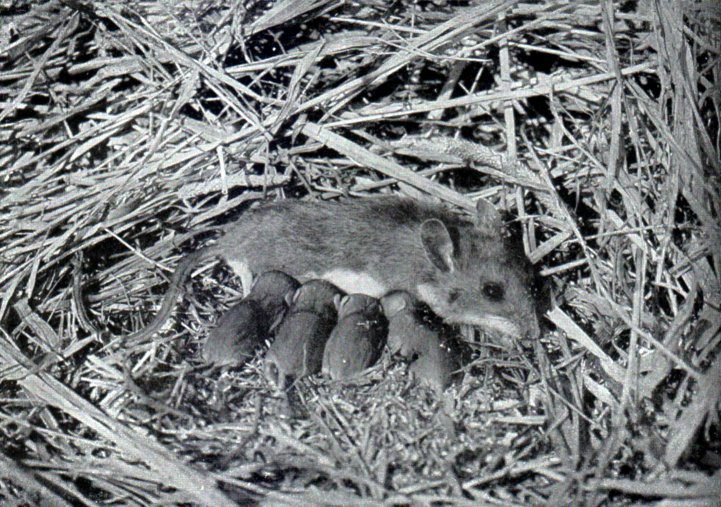
The Texas Mouse typically produces approximately four young per litter, with litter sizes ranging from one to six. Gestation lasts approximately 23 days, and lactation lasts approximately eight days.[33][34][35]
Newborns weigh approximately 1.5 g and are hairless, with closed eyes and pink skin. Young are weaned approximately one month after birth.[36][37]
Conservation
The Texas Mouse is classified as a species of least concern by the IUCN and is considered common throughout its Texas range. No immediate threats to its conservation status have been identified.[38][39][40]
Similar species
The Texas Mouse can be distinguished from Peromyscus boylii by its larger hind feet, measuring 24–27 mm rather than 20–23 mm in Texas populations of P. boylii. Unlike P. boylii, it has an accessory loph in both its upper and lower molars.[41][42]
It can be distinguished from Peromyscus truei by its longer hind feet, exceeding 23 mm, and shorter ears, measuring less than 21 mm.[43]
Classification of the Texas Mouse
| Kingdom | Animalia |
|---|---|
| Phylum | Chordata |
| Subphylum | Vertebrata |
| Infraphylum | Gnathostomata |
| Parvphylum | Osteichthyes |
| Megaclass | Tetrapoda |
| Class | Mammalia (Mammal) |
| Subclass | Theria |
| Infraclass | Eutheria |
| Order | Rodentia (Rodent) |
| Suborder | Myomorpha (Mice) |
| Superfamily | Muroidea |
| Family | Cricetidae (New World Mice and Rats) |
| Subfamily | Neotominae |
| Genus | Peromyscus (Deer Mice) |
| Species | Peromyscus attwateri J. A. Allen, 1895 |
Where the Texas Mouse is found
Checklists and occurrence records place Peromyscus attwateri in 1 country across North America. GBIF holds 4,049 georeferenced records of it.
Countries
Regions and cities with the most records
- Texas, United States 1,744
- Oklahoma, United States 616
- Kansas, United States 171
- Fort Cavazos, United States 142
- Killeen, United States 137
- Arkansas, United States 110
- Harker Heights, United States 90
- Copperas Cove, United States 79
- Lawton, United States 63
- Joplin, United States 32
- Brownwood, United States 28
- Missouri, United States 28
- San Angelo, United States 28
- Big Spring, United States 26
- Muskogee, United States 26
- Kerrville, United States 13
- Bartlesville, United States 11
- Gatesville, United States 10
- Bella Vista, United States 4
- Belton, United States 3
- Fort Smith, United States 3
- Van Buren, United States 3
Range as the checklists state it
North America
A number beside a place is its count of GBIF occurrence records. A place without a number comes from a checklist alone. Records show where a species has been observed or collected, which can include escapes and vagrants.
Common names
English
- Texas Mouse
- Attwater's Mouse
- Texas Deermouse
Names in 6 other languages
- Finnish
- teksasinpeurahiiru
- German
- Texasmaus
- Japanese
- カンザスシロアシマウス
- Polish
- myszak teksański
- Russian
- Техасский хомячок
- Spanish
- Ratón de Texas
Synonyms
3 other scientific names have been used for this species and are now treated as synonyms of Peromyscus attwateri.
- Peromyscus bellus Bangs, 1896
- Peromyscus boylei laceyi Bailey, 1905
- Peromyscus boylii cansensis Long, 1961
Related species
-
 White-footed MousePeromyscus leucopus
-
 Eastern Deer MousePeromyscus maniculatus
-
 Oldfield MousePeromyscus polionotus
-
 Cactus MousePeromyscus eremicus
-
 California DeermousePeromyscus californicus
-
 Brush MousePeromyscus boylii
- Angel Island MousePeromyscus guardia
-
 Cotton MousePeromyscus gossypinus
Compare
Questions and answers
What is the scientific name of the Texas Mouse?
The scientific name of the Texas Mouse is Peromyscus attwateri. Written with its author, the full name is Peromyscus attwateri J. A. Allen, 1895.
Which family does the Texas Mouse belong to?
Peromyscus attwateri belongs to the family Cricetidae, in the order Rodentia and the class Mammalia.
Where is the Texas Mouse found?
Checklists and occurrence records place Peromyscus attwateri in 1 country: United States.
What is the conservation status of the Texas Mouse?
The IUCN Red List category recorded for Peromyscus attwateri is Least Concern (LC).
What other names does the Texas Mouse have?
Peromyscus attwateri is also known in English as Attwater's Mouse and Texas Deermouse.
What is the diet of mice?
The Texas Mouse eats seeds and insects, including grasshoppers, crickets, and other arthropods. Its diet also includes juniper berries, green vegetation, acorns, and plant bulbs.[20][21][22]
Sources
Passages the profile rests on
- Its dorsal fur is sayal brown, becoming darker and mixed with blackish hairs along the midline. Source passage: “dorsal color near sayal brown, darker and mixed with blackish along midline” — depts.ttu.edu
- Its sides are pinkish cinnamon in color. Source passage: “sides pinkish cinnamon” — depts.ttu.edu
- Its ventral fur is pure white, although the hair bases are plumbeous. Source passage: “ventral color pure white, the bases of the hairs plumbeous” — depts.ttu.edu
- The Texas mouse has a moderately haired tail that is approximately as long as or slightly longer than its head and body. Source passage: “the tail about as long as (or slightly longer than) the head and body, moderately haired” — depts.ttu.edu
- The Texas mouse has a tail that is darker on its upper surface than underneath and usually has a terminal tuft. Source passage: “darker above than below (but not sharply bicolor) and usually with a terminal tuft” — depts.ttu.edu
- The Texas mouse has large hind feet measuring 24–27 mm and usually has dark or dusky ankles. Source passage: “hind foot large (24–27 mm); ankles usually dark or dusky” — depts.ttu.edu
- Its skull has a length of 27.6–30.4 mm and a broad, non-rounded braincase. Source passage: “Their skull is large with a length of 27.6 to 30.4 mm (1.09 to 1.20 in), and they have wide and not rounded braincase.” — English Wikipedia
- Its upper and lower molars each possess an accessory loph. Source passage: “each large upper and lower molar has an accessory loph” — depts.ttu.edu
- Adult Texas mice typically measure 182–220 mm in total length. Source passage: “Adult Peromyscus attwateri usually reach a total length of about 182 to 220 mm (7.2 to 8.7 in)” — English Wikipedia
- Adult Texas mice weigh approximately 25–35 g. Source passage: “Weight of adults, 25–35 g.” — depts.ttu.edu
- The average total length of the Texas mouse is 198 mm. Source passage: “Averages for external measurements: total length, 198 mm” — depts.ttu.edu
- Its hind foot measures approximately 24–27 mm. Source passage: “hind foot large (24–27 mm)” — depts.ttu.edu
- Its ears measure approximately 18–20 mm in length. Source passage: “ear length is about 18–20 mm” — English Wikipedia
- The Texas mouse inhabits rocky areas, including cliffs and limestone outcrops with woody vegetation. Source passage: “Peromyscus attwateri inhabits rocky areas including cliffs and limestone outcrops with woody vegetation” — animaldiversity.org
- The Edwards Plateau of Texas is one of its documented habitats. Source passage: “such as the Edwards plateau of Texas” — animaldiversity.org
- The species inhabits cliffs and rocky outcrops in the Edwards Plateau, west Cross Timbers, Rolling Plains, and Llano Estacado escarpment of Texas. Source passage: “Peromyscus attwateri inhabits the cliffs and rocky outcrops of the Edwards Plateau, the west Cross Timbers, the Rolling Plains, and the escarpment of the Llano Estacado in Texas.” — depts.ttu.edu
- The Texas mouse prefers rocky areas of the Edwards Plateau where juniper is the dominant vegetation. Source passage: “They seem to prefer rocky areas on the Edwards Plateau where the dominant vegetation is juniper.” — depts.ttu.edu
- Along the Llano Estacado escarpment, it inhabits rocky and gravelly areas vegetated with junipers, sumacs, oaks, grasses, and forbs. Source passage: “inhabiting rocky, gravelly areas that are vegetated with Juniperus spp., Rhus trilobata, Quercus spp., and various grasses and forbs.” — depts.ttu.edu
- The Texas mouse can also occupy open grassy areas with scattered rocky cover. Source passage: “but also in more open, grassy areas with only scattered rock cover.” — depts.ttu.edu
- Seeds and insects constitute the bulk of the Texas mouse's diet. Source passage: “Seeds and insects make up the bulk of its diet.” — depts.ttu.edu
- The Texas mouse feeds on grasshoppers, crickets, and other arthropods. Source passage: “Peromyscus attwateri readily feeds on grasshoppers, crickets, and other arthropods.” — depts.ttu.edu
- Its diet also includes juniper berries, green vegetation, acorns, and plant bulbs. Source passage: “Other diet items include juniper berries, green vegetation, acorns, and plant bulbs.” — depts.ttu.edu
- The Texas mouse consumes acorns particularly during winter and spring. Source passage: “Acorns are often used in winter and spring” — English Wikipedia
- The Texas mouse is nocturnal in its foraging and activity. Source passage: “It is nocturnal in its foraging and activity period.” — depts.ttu.edu
- The Texas mouse is highly arboreal and may forage for berries and nuts in trees. Source passage: “This mouse is highly arboreal and may forage for berries and nuts in trees.” — depts.ttu.edu
- The species is semiarboreal in at least some areas and frequently travels in trees. Source passage: “Recent studies using tagged P. attwateri have shown that this deermouse, at least in some areas, is semiarboreal and travels frequently in trees.” — depts.ttu.edu
- The Texas mouse is a particularly capable and cautious climber compared with other Peromyscus species. Source passage: “P. attwateri, compared with other species of Peromyscus, is a superior and more cautious climber” — depts.ttu.edu
- The Texas mouse does not hibernate. Source passage: “and does not hibernate.” — English Wikipedia
- The average home range of the Texas mouse is approximately 0.2 ha. Source passage: “The average home range of the Texas mouse is 0.2 ha (0.49 acres)” — English Wikipedia
- Male Texas mice have home ranges approximately twice as large as those of females. Source passage: “the male home range is twice that of the female.” — English Wikipedia
- Reproductive activity in the Texas mouse begins in late September and continues throughout winter. Source passage: “reproductive activity began in late September and continued throughout the winter.” — depts.ttu.edu
- No evidence of breeding during late spring and summer has been found for the Texas mouse. Source passage: “He found no evidence of their breeding during late spring and summer.” — depts.ttu.edu
- The Texas mouse typically produces approximately four young per litter, with litter sizes ranging from one to six. Source passage: “The number of young per litter varies from one to six and averages about four.” — depts.ttu.edu
- Gestation in the Texas mouse lasts approximately 23 days. Source passage: “gestation lasts 23 days” — English Wikipedia
- Lactation in the Texas mouse lasts approximately eight days. Source passage: “lactation lasts about 8 days.” — English Wikipedia
- Newborn Texas mice weigh approximately 1.5 g and are hairless with closed eyes and pink skin. Source passage: “The young of the mouse weigh about 1.5 g, and are hairless with closed eyes and pinkly skin.” — English Wikipedia
- Young Texas mice are weaned approximately one month after birth. Source passage: “A month after, their young are weaned” — English Wikipedia
- The Texas mouse is classified as a species of least concern by the IUCN. Source passage: “The IUCN lists Texas deermouse as a species of least concern” — depts.ttu.edu
- The Texas mouse is considered common throughout its Texas range. Source passage: “The Texas deermouse is common throughout its range in Texas” — depts.ttu.edu
- No immediate threats to the conservation status of the Texas mouse have been identified. Source passage: “There are no immediate threats to its conservation status.” — depts.ttu.edu
- The Texas mouse can be distinguished from Peromyscus boylii by its larger hind foot, measuring 24–27 mm rather than 20–23 mm in Texas populations of P. boylii. Source passage: “the larger hind foot (24–27 mm in attwateri and 20–23 mm in Texas-taken boylii)” — depts.ttu.edu
- Unlike Peromyscus boylii, the Texas mouse has an accessory loph in both its upper and lower molars. Source passage: “In attwateri, an accessory loph is present in both the upper and lower molars, but that structure is absent from the lower molars of boylii” — depts.ttu.edu
- The Texas mouse can be distinguished from Peromyscus truei by its longer hind foot, exceeding 23 mm, and shorter ears, measuring less than 21 mm. Source passage: “Peromyscus attwateri can be distinguished from P. truei by its longer hind foot (>23 mm rather than <23 mm) and shorter ears (<21 mm rather than >22 mm).” — depts.ttu.edu
Data
- Catalogue of Life, 2026-10-16 XR cc by
- Global Biodiversity Information Facility CC BY 4.0
- Wikidata CC0
- GeoNames CC BY 4.0
- Within the Catalogue of Life, this name comes from The Integrated Taxonomic Information System cc0
References
- Bull. Am. Mus. Nat. Hist. vol.7 p.330 where the name was published
- Hall, & Raymond, E. (1981). The Mammals of North America, 2nd Ed., Vol. 2.
- Banks, R. C., R. W. McDiarmid, and A. L. Gardner. (1987). Checklist of Vertebrates of the United States, the U.S. Territories, and Canada. Resource Publication, No. 166.
- Wilson, Don E., and DeeAnn M. Reeder, eds. (1993). Mammal Species of the World: A Taxonomic and Geographic Reference, 2nd Ed., 3rd Printing.
- Wilson, Don E., and F. Russell Cole. (2000). Common Names of Mammals of the World.
- Musser, Guy G., and Michael D. Carleton / Wilson, Don E., and DeeAnn M. Reeder, eds. (2005). Superfamily Muroidea. Mammal Species of the World: A Taxonomic and Geographic Reference, 3rd Ed., Vol. 2.
This species in other databases
Page built on 28 November 2026. See how the catalog is made and all sources and licences.
Cite this page
ScientificNames.org. (2026). Peromyscus attwateri (Texas Mouse). Retrieved November 28, 2026, from https://scientificnames.org/species/peromyscus-attwateri
“Peromyscus attwateri (Texas Mouse).” ScientificNames.org, 2026, scientificnames.org/species/peromyscus-attwateri. Accessed 28 Nov. 2026.
ScientificNames.org. “Peromyscus attwateri (Texas Mouse).” Accessed November 28, 2026. https://scientificnames.org/species/peromyscus-attwateri.
@misc{scientificnames_peromyscus_attwateri_texas_mouse,
  author = {{ScientificNames.org}},
  title = {Peromyscus attwateri (Texas Mouse)},
  year = {2026},
  url = {https://scientificnames.org/species/peromyscus-attwateri},
  note = {Accessed 2026-11-28}
}