Comparison

Uniform Antshrike vs Black-hooded Antshrike

Uniform Antshrike (Thamnophilus unicolor) and Black-hooded Antshrike (Thamnophilus bridgesi) both belong to the genus Thamnophilus (antshrikes) and part ways below it.

Uniform Antshrike

Uniform Antshrike

Thamnophilus unicolor

José Loaiza, Aves y Conservación, Public domain, via Wikimedia Commons

Black-hooded Antshrike

Black-hooded Antshrike

Thamnophilus bridgesi

Francesco Veronesi from Italy, CC BY-SA 2.0, via Wikimedia Commons

Side by side

Uniform AntshrikeBlack-hooded Antshrike
Scientific nameThamnophilus unicolor (P. L. Sclater, 1859)Thamnophilus bridgesi P. L. Sclater, 1856
English nameUniform AntshrikeBlack-hooded Antshrike
GroupBirdsBirds
ClassAves BirdAves Bird
OrderPasseriformes PasserinePasseriformes Passerine
FamilyThamnophilidae AntbirdThamnophilidae Antbird
GenusThamnophilus AntshrikesThamnophilus Antshrikes
Named in18591856
Red List categoryLeast ConcernLeast Concern
Countries on record4 countries2 countries
GBIF occurrence records11,287 records40,536 records

Rows where the two agree are shown in grey.

Where each is found

Only Uniform Antshrike (4)

Only Black-hooded Antshrike (2)

From Catalogue of Life checklists and GBIF occurrence records. A country missing from a list means no record is held, which is not proof of absence.

Checked facts

Uniform AntshrikeBlack-hooded Antshrike
Appearance
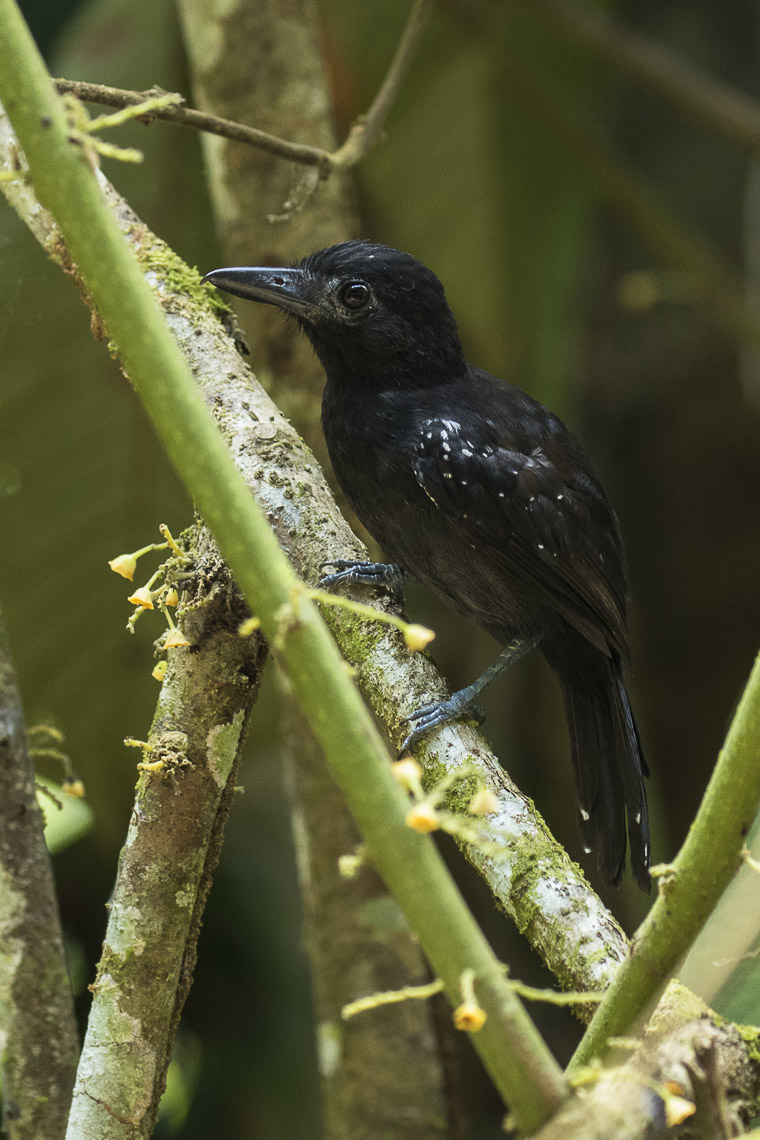
  • Adult males of the nominate subspecies are predominantly deep gray or blackish gray. English Wikipedia
  • Adult females have a rufous crown, gray face, rufous-brown upperparts, and pale rufous-brown underparts. English Wikipedia
  • Immature birds of both sexes resemble adult females. English Wikipedia
  • Both sexes have gray-white to whitish-gray irises, black bills, and gray or blue-gray legs and feet. English Wikipedia
  • Males occasionally have white tips on their outer tail feathers. English Wikipedia
  • Females of the caudatus subspecies are darker and more rufous than females of the other two subspecies. English Wikipedia
  • Males are described as uniformly dark gray without distinctive markings. ebird.org
  • Adult males are predominantly black. English Wikipedia
  • Adult males have a white patch between the scapulars, small white wing-coverts spots, and dark gray belly and undertail coverts. English Wikipedia
  • Adult females have a blackish-gray forehead, crown, and face marked with narrow white streaks. English Wikipedia
  • Adult females have very dark grayish-brown upperparts and wings with white-edged scapulars and white-spotted wing coverts. English Wikipedia
  • Adult females have olive underparts with white streaking on the throat, breast, and belly. English Wikipedia
  • Juveniles are browner than adults and have larger white spots on their wing coverts. English Wikipedia
  • Subadult males are browner than adults and have white breast streaks. English Wikipedia
  • The species exhibits differences in plumage between the sexes. English Wikipedia
  • Male Black-hooded Antshrikes are mostly black with a slightly paler belly and small white shoulder spots. ebird.org
  • Female Black-hooded Antshrikes are generally paler gray with whitish streaking. ebird.org
Size
Habitat
  • The species inhabits the understory of humid montane forests. English Wikipedia
  • The species favors forest edges and gaps created by fallen trees over the forest interior. English Wikipedia
  • Its natural habitat includes subtropical or tropical moist montane forests. inaturalist.org
  • The species occupies the understory of subtropical forests in the Andes. ebird.org
  • The species inhabits the edges of lowland evergreen forests. English Wikipedia
  • The species occurs in semi-deciduous forests, gallery forests, taller secondary woodland, and mangroves. English Wikipedia
  • The species generally occupies vegetation from the understorey to the mid-storey. English Wikipedia
  • The species favors shrubby areas and vine tangles. English Wikipedia
  • The species also occurs in the interior of gallery forests. English Wikipedia
  • The species mostly occurs below 1,000 m elevation but reaches 1,200 m in Costa Rica. English Wikipedia
Diet
  • Its diet consists mainly of insects and other arthropods, although seeds are also consumed. English Wikipedia
  • The species feeds on various insects and other arthropods, including spiders. English Wikipedia
Behaviour
  • The species generally forages alone or in pairs. English Wikipedia
  • It seldom participates in mixed-species feeding flocks. English Wikipedia
  • It generally forages close to the ground but occasionally feeds at heights of up to 8 metres. English Wikipedia
  • While foraging, it hops between branches and gleans prey from leaves, stems, vines, and branches. English Wikipedia
  • The species is presumed to remain in its range throughout the year. English Wikipedia
  • The species usually forages alone or in pairs. English Wikipedia
  • The species often joins mixed-species feeding flocks. English Wikipedia
  • The species forages slowly in dense vegetation from near ground level to approximately 15 m above the ground. English Wikipedia
  • The species captures prey by gleaning from leaves, stems, branches, and trunks using quick stabs and lunges. English Wikipedia
  • In drier habitats, the species commonly forages on the ground by probing and flipping leaf litter. English Wikipedia
  • The species occasionally follows army ant swarms to catch fleeing prey. English Wikipedia
  • The species is presumed to remain resident throughout its range year-round. English Wikipedia
Reproduction
  • The species is believed to have a monogamous mating system. English Wikipedia
  • Its breeding season in Colombia appears to extend from February through June. English Wikipedia
  • It constructs a deep cup-shaped nest from plant fibers, usually with moss hanging beneath the cup. English Wikipedia
Distribution
  • The species occurs in Colombia, Ecuador, and Peru. English Wikipedia
  • The nominate subspecies occurs along nearly the entire Pacific slope of the Andes in Ecuador. English Wikipedia
  • The grandior subspecies occurs throughout all three ranges of the Colombian Andes. English Wikipedia
  • The grandior subspecies also occurs along the eastern Andes from southeastern Ecuador into northern Peru, reaching northern San Martín Department. English Wikipedia
  • The caudatus subspecies occurs on the eastern Andean slope from southern San Martín southward to Cuzco Department. English Wikipedia
  • In Colombia, the species occurs at elevations between 1,200 and 2,200 metres. English Wikipedia
  • In Ecuador, the species generally occurs at elevations between 1,000 and 2,000 metres. English Wikipedia
  • In Peru, the species occurs at elevations between 1,250 and 2,300 metres. English Wikipedia
  • The species occurs in Costa Rica and Panama. English Wikipedia
  • Its range extends from southern Guanacaste Province in Costa Rica along the Pacific slope through western Panama to Los Santos Province. English Wikipedia
Conservation
  • The IUCN classifies the species as Least Concern. English Wikipedia
  • The species has an estimated population of at least 50,000 mature individuals. English Wikipedia
  • The estimated mature population is believed to be decreasing. English Wikipedia
  • No immediate threats to the species have been identified. English Wikipedia
  • The species is considered rare in northern Costa Rica and common in southern Costa Rica. English Wikipedia
  • The species has gradually disappeared from much of its formerly occupied range in deforested parts of Panama. English Wikipedia
Name originNo checked fact yet
  • The specific epithet bridgesi honors Mr. Bridges, who collected the holotype. English Wikipedia
OtherNo checked fact yet

In brief

Uniform Antshrike

Thamnophilus unicolor occurs in Colombia, Ecuador, and Peru, inhabiting the understory of humid montane forests in the Andes. Males are predominantly deep gray or blackish gray, while females have rufous and gray plumage. Full profile

Black-hooded Antshrike

The Black-hooded Antshrike is a monotypic bird species described by Philip Sclater in 1856. It occurs in Costa Rica and Panama, ranging from southern Guanacaste Province in Costa Rica along the Pacific slope through western Panama to Los Santos Province. The species exhibits differences in plumage between the sexes. Full profile

Compare something else

Page built on 29 November 2026 from the data on the two species pages, where every source is listed.

Cite this page

ScientificNames.org. (2026). Uniform Antshrike vs Black-hooded Antshrike. Retrieved November 29, 2026, from https://scientificnames.org/compare/uniform-antshrike-vs-black-hooded-antshrike