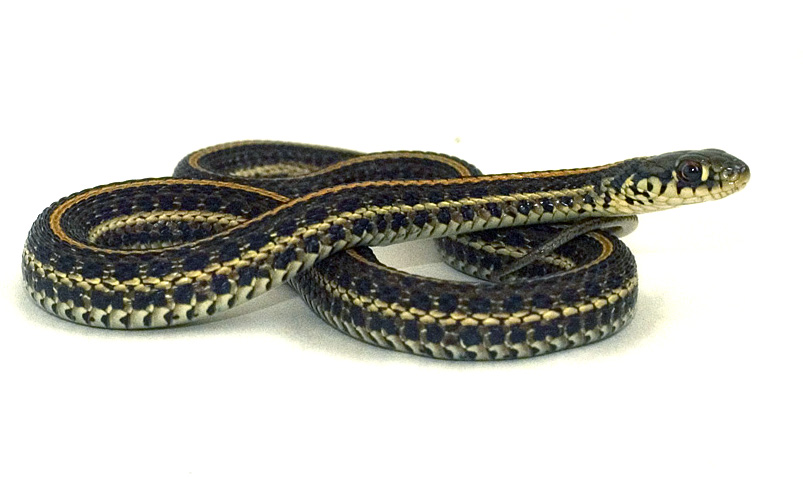
| Appearance | - The species has no apparent distinction between its head and body. English Wikipedia
- Its dorsal coloration is generally olive or olive-green. English Wikipedia
- It has three longitudinal stripes, consisting of one dorsal stripe and two lateral stripes, that range from beige to yellow. English Wikipedia
- Females are larger than males, demonstrating sexual dimorphism. English Wikipedia
| |
|---|
| Size | - Its total length, including the tail, ranges from 254 to 559 mm (10.0 to 22.0 inches). English Wikipedia
| No checked fact yet |
|---|
| Habitat | - The species commonly inhabits old fields and meadows. English Wikipedia
- It occasionally occurs in wooded areas. English Wikipedia
- Individuals are almost always found within several hundred meters of a field. English Wikipedia
- During a population study, individuals were most frequently found beneath cover objects such as wood and rocks. English Wikipedia
| - The species inhabits meadows and prairies near marshes, streams, and ponds. English Wikipedia
- It occurs in grasslands near ponds, streams, marshes, and sloughs. animaldiversity.org
- The species can inhabit swampy areas and riverbanks. animaldiversity.org
- It can occur in vacant lots in suburban and urban areas. animaldiversity.org
- In the Chicago area, individuals have been observed in abandoned buildings, trash heaps, and vacant lots. English Wikipedia
- Individuals may use drier habitats when they occur alongside common garter snakes. animaldiversity.org
- The species hibernates in burrows and rock crevices. animaldiversity.org
- Hibernation sites can include rodent burrows, ant mounds, crayfish burrows, and artificial crevices. animaldiversity.org
|
|---|
| Diet | - Wild individuals feed exclusively on earthworms. English Wikipedia
- Captive individuals may also consume leeches, salamanders, frogs, and fish. English Wikipedia
- Before non-native earthworms were introduced to North America, the species primarily consumed native earthworms restricted to the unglaciated Allegheny Plateau. English Wikipedia
| - Its diet includes earthworms, slugs, and small amphibians. English Wikipedia
- The species has been recorded eating frogs, toads, salamanders, fish, birds, small rodents, leeches, earthworms, and grasshoppers. animaldiversity.org
- Its recorded fish prey include mosquitofish, southern redbelly dace, and bluntnose minnows. animaldiversity.org
- Recorded bird prey include bank swallows and eastern meadowlarks. animaldiversity.org
|
|---|
| Behaviour | - The species is believed to bask in exposed locations on sunny days. English Wikipedia
- Individuals were encountered in exposed locations during a population study only on cloudy days. English Wikipedia
- The species is slow to bite people attempting to handle it. English Wikipedia
- When handled, it readily releases musk and feces from its cloaca. English Wikipedia
- Individuals commonly occur near one another beneath cover objects. English Wikipedia
- The occurrence of individuals together beneath cover objects has no apparent relationship with seasonality or breeding cycles. English Wikipedia
| - The species is active during the day when temperatures are warm. animaldiversity.org
- Its daytime activity generally occurs at air temperatures between 21 and 29 degrees Celsius. animaldiversity.org
- It switches to nighttime activity when air temperatures exceed 31 degrees Celsius. animaldiversity.org
- Individuals may emerge from hibernation to bask during warm winter days. English Wikipedia
- The species is active from March to November, depending on its geographic region. animaldiversity.org
- Individuals are generally solitary except during mating interactions and communal hibernation. animaldiversity.org
- Individuals may move no more than 76 meters over periods exceeding one year. animaldiversity.org
- The species uses chemical trails to locate prey, mates, and hibernation sites. animaldiversity.org
- When threatened, individuals may bite, release foul-smelling musk, or defecate. animaldiversity.org
- The species is described as mildly venomous, with venom that is not toxic to humans. English Wikipedia
|
|---|
| Reproduction | - Reproduction occurs in spring shortly after individuals emerge from their hibernacula. English Wikipedia
- Females generally emerge from hibernation with ovarian follicles already well developed. English Wikipedia
- Females in New York generally breed every other year. English Wikipedia
- Females in Pennsylvania generally breed annually. English Wikipedia
- Males use sperm stored from an earlier period for reproduction. English Wikipedia
- Male testes are small immediately after emergence from hibernation and reach full size by midsummer. English Wikipedia
- Males store sperm after their testes reach full size for use during the following spring. English Wikipedia
- The species is believed to be viviparous. English Wikipedia
- Experiments have demonstrated the transfer of amino acids between mothers and offspring. English Wikipedia
| |
|---|
| Distribution | - Its native distribution includes small, isolated populations in northwestern Pennsylvania and southwestern New York. English Wikipedia
| - The species occurs across the central United States, extending north into Canada and south to Texas. English Wikipedia
- Its documented Canadian range includes southern Alberta, Saskatchewan, and Manitoba. animaldiversity.org
- Its documented United States range includes the Oklahoma panhandle, northern Texas, northeastern New Mexico, Minnesota, Wisconsin, and Indiana. animaldiversity.org
- The species occurs at elevations from 400 to 7,500 feet. English Wikipedia
- The species generally prefers elevations below 6,000 feet. English Wikipedia
|
|---|
| Conservation | No checked fact yet | |
|---|
| Similar species | - Unlike Thamnophis sirtalis, this species lacks black spots between its stripes. English Wikipedia
| - The species shares portions of its habitat with the common garter snake. English Wikipedia
- The plains garter snake and common garter snake may hybridize where their ranges overlap. English Wikipedia
|
|---|