Species · Reptiles
Shorthead Garter Snake Thamnophis brachystoma
The scientific name of the Shorthead Garter Snake is Thamnophis brachystoma. It is a species of reptile in the family Colubridae (colubrid), order Squamata. The name dates from 1892.
- Scientific name
- Thamnophis brachystoma (Cope, 1892)
- Common name
- Shorthead Garter Snake
- Genus
- Thamnophis
- Family
- Colubridae (Colubrid)
- Order
- Squamata
- Class
- Reptilia
- Red List category
- LC Least Concern
- Recorded in
- 1 country
- Name status
- accepted in the Catalogue of Life
Overview
The native distribution includes small, isolated populations in northwestern Pennsylvania and southwestern New York. It has an olive or olive-green dorsal coloration and three beige-to-yellow longitudinal stripes.
Written 26 November 2026 from the sources listed below. Each statement was checked against the passage it cites; statements that could not be supported were removed.
Appearance
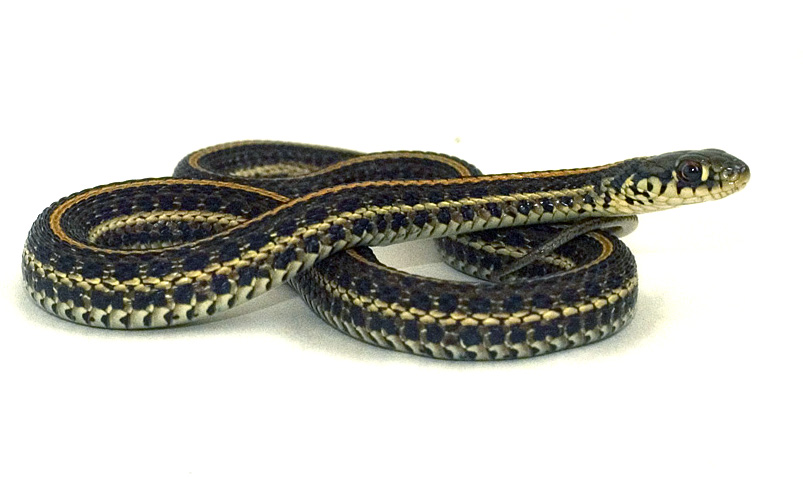
The Shorthead Garter Snake has no apparent distinction between its head and body. Its dorsal coloration is generally olive or olive-green, with one dorsal stripe and two lateral stripes ranging from beige to yellow.[1][2][3]
Females are larger than males, demonstrating sexual dimorphism. Total length, including the tail, ranges from 254 to 559 mm (10.0 to 22.0 inches).[4][5]
Habitat
The Shorthead Garter Snake commonly inhabits old fields and meadows and occasionally occurs in wooded areas. Individuals are almost always found within several hundred meters of a field.[6][7][8]
During a population study, individuals were most frequently found beneath cover objects such as wood and rocks.[9]
Behaviour
The species is believed to bask in exposed locations on sunny days. During a population study, individuals were encountered in exposed locations only on cloudy days.[10][11]
The Shorthead Garter Snake is slow to bite people attempting to handle it. When handled, it readily releases musk and feces from its cloaca.[12][13]
Individuals commonly occur near one another beneath cover objects. This occurrence has no apparent relationship with seasonality or breeding cycles.[14][15]
Diet
Wild individuals feed exclusively on earthworms. Before non-native earthworms were introduced to North America, the species primarily consumed native earthworms restricted to the unglaciated Allegheny Plateau.[16][17]
Captive individuals may also consume leeches, salamanders, frogs, and fish.[18]
Reproduction and life cycle
Reproduction occurs in spring shortly after individuals emerge from their hibernacula. Females generally emerge from hibernation with ovarian follicles already well developed.[19][20]
Females in New York generally breed every other year, while females in Pennsylvania generally breed annually.[21][22]
Males use sperm stored from an earlier period for reproduction. Their testes are small immediately after emergence from hibernation and reach full size by midsummer, after which males store sperm for use during the following spring.[23][24][25]
The species is believed to be viviparous. Experiments have demonstrated the transfer of amino acids between mothers and offspring.[26][27]
Similar species
Unlike Thamnophis sirtalis, the Shorthead Garter Snake lacks black spots between its stripes.[28]
Classification of the Shorthead Garter Snake
| Kingdom | Animalia |
|---|---|
| Phylum | Chordata |
| Subphylum | Vertebrata |
| Infraphylum | Gnathostomata |
| Parvphylum | Osteichthyes |
| Megaclass | Tetrapoda |
| Class | Reptilia (Reptile) |
| Order | Squamata (Snakes) |
| Suborder | Serpentes (Snakes) |
| Infraorder | Alethinophidia |
| Family | Colubridae (Colubrid) |
| Subfamily | Natricinae |
| Genus | Thamnophis (Garter Snake) |
| Species | Thamnophis brachystoma (Cope, 1892) |
Where the Shorthead Garter Snake is found
Checklists and occurrence records place Thamnophis brachystoma in 1 country across North America. GBIF holds 1,246 georeferenced records of it.
Countries
Regions and cities with the most records
- Pennsylvania, United States 670
- New York, United States 116
- Buffalo, United States 25
- Elmira, United States 25
- Kenmore, United States 25
- Fort Erie, Canada 24
- Lackawanna, United States 24
- Pittsburgh, United States 24
- West Seneca, United States 24
- Eggertsville, United States 23
- Wilkinsburg, United States 23
- Amherst, United States 22
- Allison Park, United States 21
- Cheektowaga, United States 21
- Erie, United States 20
- Jamestown, United States 20
- Monroeville, United States 20
- Plum, United States 20
- West Mifflin, United States 20
- Depew, United States 18
- McKeesport, United States 18
- Baldwin, United States 16
- Grand Island, United States 15
- Murrysville, United States 15
- North Tonawanda, United States 15
- Mount Lebanon, United States 13
- Bethel Park, United States 12
- Ohio, United States 10
- Upper Saint Clair, United States 10
- East Amherst, United States 6
- Niagara Falls, Canada 5
- Niagara Falls, United States 5
- Ontario, Canada 5
- Wexford, United States 5
Range as the checklists state it
USA (S Michigan, NW Pennsylvania, W New York)
A number beside a place is its count of GBIF occurrence records. A place without a number comes from a checklist alone. Records show where a species has been observed or collected, which can include escapes and vagrants.
Common names
English
- Shorthead Garter Snake
- Short-headed Garter Snake
Names in 4 other languages
- Chinese
- 短頭帶蛇
- German
- Kurzkopf-Strumpfbandnatter
- Portuguese
- Cobra-liga-de-cabeça-pequena
- Russian
- Короткоротая садовая змея
Synonyms
One other scientific name has been used for this species and is now treated as a synonym of Thamnophis brachystoma.
- Eutaenia brachystoma Cope, 1892
Related species
-
 Common Garter SnakeThamnophis sirtalis
-
 Common Ribbon SnakeThamnophis saurita
-
 Checkered Garter SnakeThamnophis marcianus
-
 Plains Garter SnakeThamnophis radix
-
 Western Ribbon SnakeThamnophis proximus
-
 Western Terrestrial Garter SnakeThamnophis elegans
-
 Giant Garter SnakeThamnophis gigas
-
 Mexican Garter SnakeThamnophis eques
Compare
Questions and answers
What is the scientific name of the Shorthead Garter Snake?
The scientific name of the Shorthead Garter Snake is Thamnophis brachystoma. Written with its author, the full name is Thamnophis brachystoma (Cope, 1892).
Which family does the Shorthead Garter Snake belong to?
Thamnophis brachystoma belongs to the family Colubridae, in the order Squamata and the class Reptilia.
Where is the Shorthead Garter Snake found?
Checklists and occurrence records place Thamnophis brachystoma in 1 country: United States.
What is the conservation status of the Shorthead Garter Snake?
The IUCN Red List category recorded for Thamnophis brachystoma is Least Concern (LC).
What other names does the Shorthead Garter Snake have?
Thamnophis brachystoma is also known in English as Short-headed Garter Snake.
Sources
Passages the profile rests on
- The species has no apparent distinction between its head and body. Source passage: “There is no apparent distinction between the body and head.” — English Wikipedia
- Its dorsal coloration is generally olive or olive-green. Source passage: “Dorsal coloration tends to be olive or olive-green” — English Wikipedia
- It has three longitudinal stripes, consisting of one dorsal stripe and two lateral stripes, that range from beige to yellow. Source passage: “with three (1 dorsal, 2 lateral) beige to yellow stripes running the length of the body.” — English Wikipedia
- Females are larger than males, demonstrating sexual dimorphism. Source passage: “There is a distinct sexual dimorphism in this species with females being larger than males.” — English Wikipedia
- Its total length, including the tail, ranges from 254 to 559 mm (10.0 to 22.0 inches). Source passage: “with a total length (including tail) of 254–559 mm (10.0–22.0 in).” — English Wikipedia
- The species commonly inhabits old fields and meadows. Source passage: “The shorthead garter snake is commonly found in old fields and meadows” — English Wikipedia
- It occasionally occurs in wooded areas. Source passage: “but can occasionally be found in wooded areas.” — English Wikipedia
- Individuals are almost always found within several hundred meters of a field. Source passage: “It is almost always found within several hundred meters of a field.” — English Wikipedia
- During a population study, individuals were most frequently found beneath cover objects such as wood and rocks. Source passage: “when a population study was conducted, it was almost invariably found under objects such as wood and rocks.” — English Wikipedia
- The species is believed to bask in exposed locations on sunny days. Source passage: “It is believed that on sunny days it will be openly basking;” — English Wikipedia
- Individuals were encountered in exposed locations during a population study only on cloudy days. Source passage: “Individuals were only encountered in the open on cloudy days.” — English Wikipedia
- The species is slow to bite people attempting to handle it. Source passage: “Thamnophis brachystoma is slow to bite would be handlers” — English Wikipedia
- When handled, it readily releases musk and feces from its cloaca. Source passage: “but will readily expel musk and feces from the cloaca.” — English Wikipedia
- Individuals commonly occur near one another beneath cover objects. Source passage: “Shorthead garter snakes can commonly be found near one another under cover objects” — English Wikipedia
- The occurrence of individuals together beneath cover objects has no apparent relationship with seasonality or breeding cycles. Source passage: “with no apparent correlation to seasonality or breeding cycles.” — English Wikipedia
- Wild individuals feed exclusively on earthworms. Source passage: “In the wild, T. brachystoma feeds exclusively on earthworms.” — English Wikipedia
- Before non-native earthworms were introduced to North America, the species primarily consumed native earthworms restricted to the unglaciated Allegheny Plateau. Source passage: “Prior to the introduction of non-native earthworms to North America, T. brachystoma would have primarily fed on native earthworms that were restricted to the unglaciated Allegheny Plateau.” — English Wikipedia
- Captive individuals may also consume leeches, salamanders, frogs, and fish. Source passage: “in captivity shorthead garter snakes may consume other food items such as leeches, salamanders, frogs, and fish.” — English Wikipedia
- Reproduction occurs in spring shortly after individuals emerge from their hibernacula. Source passage: “Reproduction in T. brachystoma occurs in spring shortly after emerging from the hibernacula.” — English Wikipedia
- Females generally emerge from hibernation with ovarian follicles already well developed. Source passage: “Females generally emerge with ovarian follicles already well developed.” — English Wikipedia
- Females in New York generally breed every other year. Source passage: “Females in New York breed every other year” — English Wikipedia
- Females in Pennsylvania generally breed annually. Source passage: “females in Pennsylvania breed annually.” — English Wikipedia
- Males use sperm stored from an earlier period for reproduction. Source passage: “Males use stored sperm for breeding.” — English Wikipedia
- Male testes are small immediately after emergence from hibernation and reach full size by midsummer. Source passage: “The testes are small after emergence, reaching full size by midsummer.” — English Wikipedia
- Males store sperm after their testes reach full size for use during the following spring. Source passage: “After this point, sperm will be stored for later use in the spring.” — English Wikipedia
- The species is believed to be viviparous. Source passage: “T. brachystoma is believed to be viviparous” — English Wikipedia
- Experiments have demonstrated the transfer of amino acids between mothers and offspring. Source passage: “with experiments showing a transfer of amino acids between mother and offspring.” — English Wikipedia
- Unlike Thamnophis sirtalis, this species lacks black spots between its stripes. Source passage: “Unlike Thamnophis sirtalis, there are no black spots between stripes in T. brachystoma.” — English Wikipedia
Data
- Catalogue of Life, 2026-10-16 XR cc by
- Global Biodiversity Information Facility CC BY 4.0
- Wikidata CC0
- GeoNames CC BY 4.0
- Within the Catalogue of Life, this name comes from The Reptile Database cc by
References
- Cope, E. D. (1892). A new species of Eutaenia from western Pennsylvania. American Naturalist 26: 964-965.
- Cope, E. D. (1900). The crocodilians, lizards and snakes of North America. Ann. Rep. U.S. Natl. Mus. 1898: 153-1270.
- Clark, H. L. (1903). The short-mouthed snake (Eutaenia brachystoma COPE) in Southern Michigan. Proc. Biol. Soc. Washington 16: 83-88.
- Smith, A. G. (1945). The status of Thamnophis butleri COPE, and a redescription of Thamnophis brachystoma (COPE). Proc. Biol. Soc. Washington 58: 147-154.
- Barton, A. J. (1956). A statistical study of Thamnophis brachystoma (Cope) with comments on the kinship of T. butleri (Cope). Proc. Biol. Soc. Washington 69: 71-82.
- Bothner, R. C. (1963). A hibernaculum of the short-headed gartersnake, Thamnophis brachystoma (Cope). Copeia 1963 (3): 572-573.
- Asplund, K. K. (1963). Ecological factors in the distribution of Thamnophis brachystoma (Cope). Herpetologica 19 (2): 128-132.
- Pisani, G. R. (1967). Notes on the Courtship and mating Behavior of Thamnophis brachystoma (Cope). Herpetologica 23 (2): 112-115.
- Bothner, Richard C. (1976). Thamnophis brachystoma. Catalogue of American Amphibians and Reptiles (190): 1-2.
- Price, Andrew H. (1978). New locality records and range extensions for Thamnophis brachystoma (reptilia: Serpentes) in Pennsylvania. Bull. Maryland Herp. Soc. 14 (4): 260-263.
- Ernst, C. H., & Gotte, S. W. (1986). Notes on the reproduction of the shorthead garter snake, Thamnophis brachystoma. Bull. Maryland Herp. Soc. 22 (1): 6-9.
- Ernst, C.H., & Barbour, R.W. (1989). Snakes of eastern North America. George Mason Univ. Press, Fairfax, VA 282 Pp.
- Conant, R., & Collins, J. T. (1991). A Field Guide to Reptiles and Amphibians of Eastern/Central North America, 3rd ed. Houghton Mifflin (Boston/New York), Xx + 450 P.
- Rossman, Douglas A.; Ford, Neil B. & Seigel, Richard A. (1996). The Garter Snakes: Evolution and Ecology. University of Oklahoma Press, Norman, OK, Xx + 332 + Pp.
- Tennant, A., & Bartlett, R. D. (2000). Snakes of North America - Eastern and Central Regions. Gulf Publishing, Houston, TX, 588 Pp.
- Hallmen, M., & Chlebowy, J. (2001). Strumpfbandnattern. Natur Und Tier Verlag (Münster), 192 Pp.
- Bourguignon, T. (2002). Strumpfbandnattern: Herkunft - Pflege - Arten. E. Ulmer Verlag, 125 Pp.
- Queiroz, Alan de; Robin Lawson and Julio A. Lemos-Espinal. (2002). Phylogenetic Relationships of North American Garter Snakes (Thamnophis) Based on Four Mitochondrial Genes: How Much DNA Sequence Is Enough? Molecular Phylogenetics and Evolution 22: 315-329.
- Gray, B. S. (2003). A note regarding defensive behavior in the short-headed gartersnake (Thamnophis brachystoma). Bull. Maryland Herpetol. Soc., 39(1): 8-9.
- Tennant, A. (2003). Snakes of North America - Eastern and Central Regions, revised edition. Lone Star Books, 605 Pp.
- Grübner, D. (2006). Die seltener beobachteten Strumpfbandnattern. Draco 6 (25): 66-76.
- Gray, Brian S. (2008). Observations on the Diet of the Shorthead Garter Snake, Thamnophis brachystoma. Journal of Kansas Herpetology (25): 24-28.
- Pyron, R.Alexander; Frank T. Burbrink. (2009). Neogene diversification and taxonomic stability in the snake tribe Lampropeltini (Serpentes: Colubridae). Molecular Phylogenetics and Evolution 52 (2): 524-529.
- Lethaby, Mark. (2011). Thamnophis brachystoma (short-headed gartersnake) coloration. Herpetological Review 42 (3): 445-446.
- Gray, Brian S. (2011). Longevity and Growth in the Shorthead Garter Snake, Thamnophis brachystoma. Journal of Kansas Herpetology (38): 9.
This species in other databases
Page built on 27 November 2026. See how the catalog is made and all sources and licences.
Cite this page
ScientificNames.org. (2026). Thamnophis brachystoma (Shorthead Garter Snake). Retrieved November 27, 2026, from https://scientificnames.org/species/thamnophis-brachystoma
“Thamnophis brachystoma (Shorthead Garter Snake).” ScientificNames.org, 2026, scientificnames.org/species/thamnophis-brachystoma. Accessed 27 Nov. 2026.
ScientificNames.org. “Thamnophis brachystoma (Shorthead Garter Snake).” Accessed November 27, 2026. https://scientificnames.org/species/thamnophis-brachystoma.
@misc{scientificnames_thamnophis_brachystoma_shorthead_garter_snake,
  author = {{ScientificNames.org}},
  title = {Thamnophis brachystoma (Shorthead Garter Snake)},
  year = {2026},
  url = {https://scientificnames.org/species/thamnophis-brachystoma},
  note = {Accessed 2026-11-27}
}