Comparison

Butler's Garter Snake vs Plains Garter Snake

Butler's Garter Snake (Thamnophis butleri) and Plains Garter Snake (Thamnophis radix) both belong to the genus Thamnophis (garter snake) and part ways below it. Both are recorded in 2 countries.

Butler's Garter Snake

Butler's Garter Snake

Thamnophis butleri

Alkatar at English Wikipedia, Public domain, via Wikimedia Commons
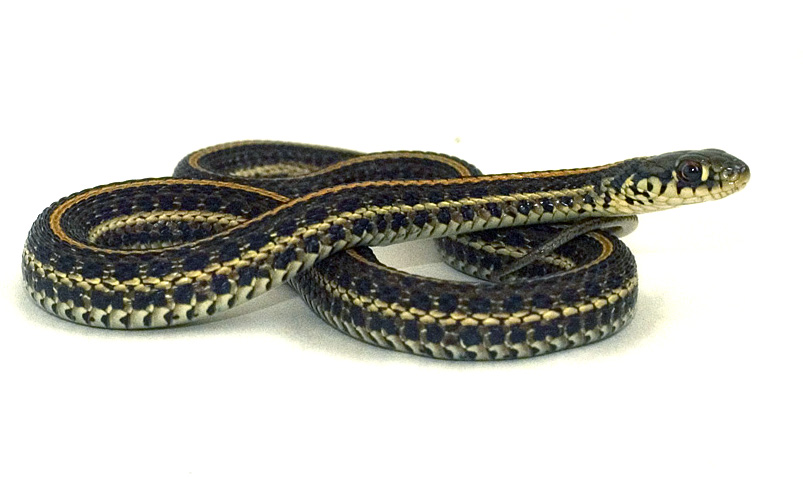
Plains Garter Snake

Plains Garter Snake

Thamnophis radix

Thamnophis, CC BY-SA 3.0, via Wikimedia Commons

Side by side

Butler's Garter SnakePlains Garter Snake
Scientific nameThamnophis butleri (Cope, 1889)Thamnophis radix (Baird & Girard, 1853)
English nameButler's Garter SnakePlains Garter Snake
GroupReptilesReptiles
ClassReptilia ReptileReptilia Reptile
OrderSquamata SnakesSquamata Snakes
FamilyColubridae ColubridColubridae Colubrid
GenusThamnophis Garter SnakeThamnophis Garter Snake
Named in18891853
Red List categoryLeast ConcernLeast Concern
Countries on record2 countries2 countries
GBIF occurrence records1,713 records14,658 records

Rows where the two agree are shown in grey.

Where each is found

Both recorded in 2 countries

From Catalogue of Life checklists and GBIF occurrence records. A country missing from a list means no record is held, which is not proof of absence.

Checked facts

Butler's Garter SnakePlains Garter Snake
Appearance
  • The species has three yellow to orange longitudinal stripes against an olive-brown to black background. English Wikipedia
  • The lateral stripes are centered on the third scale row above the ventral scales and overlap the second and fourth rows. English Wikipedia
  • The species has an unusually small head compared with other garter snakes. English Wikipedia
  • Its belly is pale green or yellow with black spots along the edges. animaldiversity.org
  • Its scales are keeled. animaldiversity.org
SizeNo checked fact yet
Habitat
  • The species inhabits moist grassy areas with open canopies, including meadows, wet prairies, marshes, savannas, and grasslands. English Wikipedia
  • The species can occur in grassy vacant lots in suburban and residential areas. English Wikipedia
  • The species inhabits meadows and prairies near marshes, streams, and ponds. English Wikipedia
  • It occurs in grasslands near ponds, streams, marshes, and sloughs. animaldiversity.org
  • The species can inhabit swampy areas and riverbanks. animaldiversity.org
  • It can occur in vacant lots in suburban and urban areas. animaldiversity.org
  • In the Chicago area, individuals have been observed in abandoned buildings, trash heaps, and vacant lots. English Wikipedia
  • Individuals may use drier habitats when they occur alongside common garter snakes. animaldiversity.org
  • The species hibernates in burrows and rock crevices. animaldiversity.org
  • Hibernation sites can include rodent burrows, ant mounds, crayfish burrows, and artificial crevices. animaldiversity.org
Diet
  • Its diet includes earthworms, slugs, and small amphibians. English Wikipedia
  • The species has been recorded eating frogs, toads, salamanders, fish, birds, small rodents, leeches, earthworms, and grasshoppers. animaldiversity.org
  • Its recorded fish prey include mosquitofish, southern redbelly dace, and bluntnose minnows. animaldiversity.org
  • Recorded bird prey include bank swallows and eastern meadowlarks. animaldiversity.org
Behaviour
  • The species is active during the day when temperatures are warm. animaldiversity.org
  • Its daytime activity generally occurs at air temperatures between 21 and 29 degrees Celsius. animaldiversity.org
  • It switches to nighttime activity when air temperatures exceed 31 degrees Celsius. animaldiversity.org
  • Individuals may emerge from hibernation to bask during warm winter days. English Wikipedia
  • The species is active from March to November, depending on its geographic region. animaldiversity.org
  • Individuals are generally solitary except during mating interactions and communal hibernation. animaldiversity.org
  • Individuals may move no more than 76 meters over periods exceeding one year. animaldiversity.org
  • The species uses chemical trails to locate prey, mates, and hibernation sites. animaldiversity.org
  • When threatened, individuals may bite, release foul-smelling musk, or defecate. animaldiversity.org
  • The species is described as mildly venomous, with venom that is not toxic to humans. English Wikipedia
Reproduction
  • The species is ovoviviparous, with eggs developing and hatching inside the female. animaldiversity.org
  • Mating takes place in late March and early April. English Wikipedia
  • Females give birth in June or July to broods of four to fourteen offspring. English Wikipedia
  • Females can store sperm from previous matings and use it for spring fertilization. animaldiversity.org
Distribution
  • The species occurs in northwestern Ohio, northeastern Indiana, eastern Lower Michigan, and the adjacent extreme southern tip of Ontario. English Wikipedia
  • A disjunct population occurs in southeastern Wisconsin. English Wikipedia
  • The species also occurs in Illinois. animaldiversity.org
  • The species occurs across the central United States, extending north into Canada and south to Texas. English Wikipedia
  • Its documented Canadian range includes southern Alberta, Saskatchewan, and Manitoba. animaldiversity.org
  • Its documented United States range includes the Oklahoma panhandle, northern Texas, northeastern New Mexico, Minnesota, Wisconsin, and Indiana. animaldiversity.org
  • The species occurs at elevations from 400 to 7,500 feet. English Wikipedia
  • The species generally prefers elevations below 6,000 feet. English Wikipedia
Conservation
Similar speciesNo checked fact yet
  • The species shares portions of its habitat with the common garter snake. English Wikipedia
  • The plains garter snake and common garter snake may hybridize where their ranges overlap. English Wikipedia

In brief

Butler's Garter Snake

Thamnophis butleri occurs in northwestern Ohio, northeastern Indiana, eastern Lower Michigan, the adjacent extreme southern tip of Ontario, Illinois, and southeastern Wisconsin. It has three yellow to orange longitudinal stripes, an unusually small head compared with other garter snakes, and a pale green or yellow belly. Full profile

Plains Garter Snake

Thamnophis radix occurs across the central United States, extending north into Canada and south to Texas. It is distinguished by a yellow or orange stripe running along the middle of its back and distinctive black bars on its lips. Full profile

Compare something else

Page built on 28 November 2026 from the data on the two species pages, where every source is listed.

Cite this page

ScientificNames.org. (2026). Butler's Garter Snake vs Plains Garter Snake. Retrieved November 28, 2026, from https://scientificnames.org/compare/butlers-garter-snake-vs-plains-garter-snake