Species · Reptiles
Butler's Garter Snake Thamnophis butleri
The scientific name of the Butler's Garter Snake is Thamnophis butleri. It is a species of reptile in the family Colubridae (colubrid), order Squamata. The name dates from 1889.
- Scientific name
- Thamnophis butleri (Cope, 1889)
- Common name
- Butler's Garter Snake
- Genus
- Thamnophis
- Family
- Colubridae (Colubrid)
- Order
- Squamata
- Class
- Reptilia
- Red List category
- LC Least Concern
- Recorded in
- 2 countries
- Name status
- accepted in the Catalogue of Life

Overview
Thamnophis butleri occurs in northwestern Ohio, northeastern Indiana, eastern Lower Michigan, the adjacent extreme southern tip of Ontario, Illinois, and southeastern Wisconsin. It has three yellow to orange longitudinal stripes, an unusually small head compared with other garter snakes, and a pale green or yellow belly.
Written 26 November 2026 from the sources listed below. Each statement was checked against the passage it cites; statements that could not be supported were removed.
Appearance
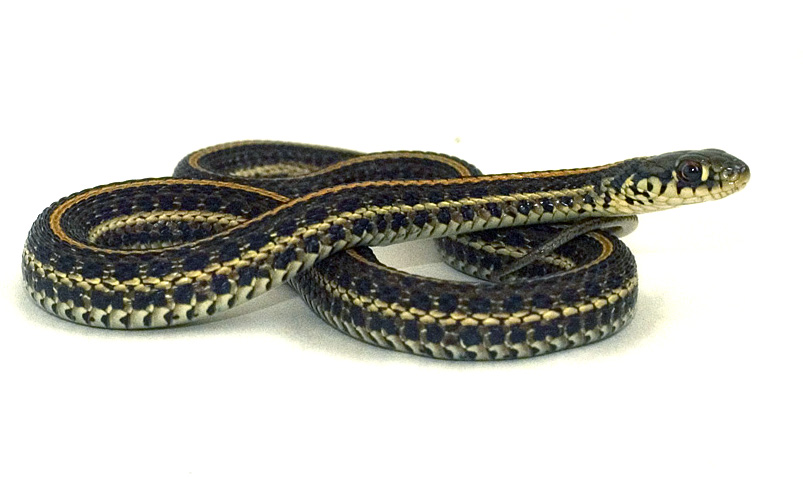
The species has three yellow to orange longitudinal stripes against an olive-brown to black background. The lateral stripes are centered on the third scale row above the ventral scales and overlap the second and fourth rows.[1][2]
Its head is unusually small compared with other garter snakes. Its belly is pale green or yellow with black spots along the edges, and its scales are keeled.[3][4][5]
Adults average 38–51 cm in total length, including the tail, and can reach 73.7 cm. Males are slightly smaller than females and have slightly longer tails.[6][7][8]
Newborn individuals measure 12.5–18.5 cm in length.[9]
Habitat
The species inhabits moist grassy areas with open canopies, including meadows, wet prairies, marshes, savannas, and grasslands. It can also occur in grassy vacant lots in suburban and residential areas.[10][11]
Diet
Earthworms constitute the main food of the species. It also eats leeches, salamanders, and frogs.[12][13][14]
Behaviour
The species is generally solitary but congregates at hibernation sites. It hibernates communally, sometimes alongside other garter snake species.[15][16]
Individuals are generally active from late March until October or November. They may become nocturnal during summer.[17][18]
Individuals are docile and shy and generally flee when approached. When harassed, they may release a foul-smelling substance, and when suddenly surprised, they thrash their bodies violently from side to side.[19][20][21]
Wild individuals form social communities assortatively by sex and age. Older females often occupy central positions within the species' social networks.[22][23]
Female sociability tends to increase with age, whereas male sociability tends to decrease.[24]
Reproduction and life cycle
The species is ovoviviparous, with eggs developing and hatching inside the female. Mating takes place in late March and early April.[25][26]
Females give birth in June or July to broods of four to fourteen offspring. They can store sperm from previous matings and use it for spring fertilization.[27][28]
Conservation
The species is listed as endangered in Indiana and Ontario. It is classified as a species of special concern in Wisconsin.[29][30][31]
Habitat fragmentation caused by human habitat destruction contributes to the isolation of populations.[32]
Classification of the Butler's Garter Snake
| Kingdom | Animalia |
|---|---|
| Phylum | Chordata |
| Subphylum | Vertebrata |
| Infraphylum | Gnathostomata |
| Parvphylum | Osteichthyes |
| Megaclass | Tetrapoda |
| Class | Reptilia (Reptile) |
| Order | Squamata (Snakes) |
| Suborder | Serpentes (Snakes) |
| Infraorder | Alethinophidia |
| Family | Colubridae (Colubrid) |
| Subfamily | Natricinae |
| Genus | Thamnophis (Garter Snake) |
| Species | Thamnophis butleri (Cope, 1889) |
Where the Butler's Garter Snake is found
Checklists and occurrence records place Thamnophis butleri in 2 countries across North America. GBIF holds 1,713 georeferenced records of it.
Countries
Regions and cities with the most records
- Michigan, United States 475
- LaSalle, Canada 184
- Dearborn, United States 177
- Lincoln Park, United States 170
- Wisconsin, United States 169
- Allen Park, United States 164
- Wyandotte, United States 158
- Southgate, United States 154
- Ann Arbor, United States 147
- Ypsilanti, United States 147
- Brookfield, United States 140
- Wauwatosa, United States 139
- Taylor, United States 138
- West Allis, United States 138
- Dearborn Heights, United States 135
- Greenfield, United States 134
- Milwaukee, United States 126
- Detroit, United States 123
- Windsor, Canada 123
- New Berlin, United States 122
- Trenton, United States 122
- Inkster, United States 120
- Garden City, United States 111
- Redford, United States 111
- Hamtramck, United States 110
- Redford DUPLICATE OF https://www.geonames.org/5006917/redford.html, United States 109
- Mequon, United States 104
- Menomonee Falls, United States 103
- Ohio, United States 100
- Canton, United States 96
- Franklin, United States 96
- Cudahy, United States 95
- Muskego, United States 95
- Waukesha, United States 93
- Livonia, United States 92
- Wayne, United States 92
Range as the checklists state it
USA (NE Indiana, Ohio, Michigan, SE Wisconsin), Canada (S Ontario)
A number beside a place is its count of GBIF occurrence records. A place without a number comes from a checklist alone. Records show where a species has been observed or collected, which can include escapes and vagrants.
Common names
English
- Butler's Garter Snake
Names in 7 other languages
- Chinese
- 巴氏帶蛇
- French
- couleuvre à petite tête
- German
- Butlers Strumpfbandnatter
- Portuguese
- Cobra-liga-de-Butler
- Russian
- Подвязочная змея Батлера
- moh
- Butler Otsinonhyahré:na
- oji
- Butler Wenda Gnebikonmun
Synonyms
One other scientific name has been used for this species and is now treated as a synonym of Thamnophis butleri.
- Eutaenia butleri Cope, 1889
Related species
-
 Common Garter SnakeThamnophis sirtalis
-
 Common Ribbon SnakeThamnophis saurita
-
 Checkered Garter SnakeThamnophis marcianus
-
 Plains Garter SnakeThamnophis radix
-
 Western Ribbon SnakeThamnophis proximus
-
 Western Terrestrial Garter SnakeThamnophis elegans
-
 Giant Garter SnakeThamnophis gigas
-
 Mexican Garter SnakeThamnophis eques
Compare
Questions and answers
What is the scientific name of the Butler's Garter Snake?
The scientific name of the Butler's Garter Snake is Thamnophis butleri. Written with its author, the full name is Thamnophis butleri (Cope, 1889).
Which family does the Butler's Garter Snake belong to?
Thamnophis butleri belongs to the family Colubridae, in the order Squamata and the class Reptilia.
Where is the Butler's Garter Snake found?
Checklists and occurrence records place Thamnophis butleri in 2 countries: United States and Canada.
What is the conservation status of the Butler's Garter Snake?
The IUCN Red List category recorded for Thamnophis butleri is Least Concern (LC).
Sources
Passages the profile rests on
- The species has three yellow to orange longitudinal stripes against an olive-brown to black background. Source passage: “with three yellow to orange stripes along the length of its body. The background color can range from olive-brown to black” — English Wikipedia
- The lateral stripes are centered on the third scale row above the ventral scales and overlap the second and fourth rows. Source passage: “the lateral stripes are centered on the third scale row up from the ventral scales, and they also overlap the adjacent second and fourth scale rows.” — English Wikipedia
- The species has an unusually small head compared with other garter snakes. Source passage: “The head is unusually small for a garter snake” — English Wikipedia
- Its belly is pale green or yellow with black spots along the edges. Source passage: “Their belly color is pale green or yellow with black spots running along the edges.” — animaldiversity.org
- Its scales are keeled. Source passage: “their scales are keeled (with a ridge along the length of the scale).” — animaldiversity.org
- Adults average 38–51 cm in total length, including the tail. Source passage: “averaging 38–51 cm (15–20 in) in total length (tail included)” — English Wikipedia
- Adults can reach a total length of 73.7 cm. Source passage: “Adults reach a total length of from 38 to 73.7 cm.” — animaldiversity.org
- Male individuals are slightly smaller than females and have slightly longer tails. Source passage: “Male snakes are slightly smaller than females, and have slightly longer tails.” — animaldiversity.org
- Newborn individuals measure 12.5–18.5 cm in length. Source passage: “Young Butler's garter snakes are born at from 12.5 to 18.5 cm.” — animaldiversity.org
- The species inhabits moist grassy areas with open canopies, including meadows, wet prairies, marshes, savannas, and grasslands. Source passage: “inhabits moist, grassy, open canopy areas, such as meadows, wet prairies, marshes, savannas, and grasslands.” — English Wikipedia
- The species can occur in grassy vacant lots in suburban and residential areas. Source passage: “it may also be found in grassy vacant lots in suburban and residential areas.” — English Wikipedia
- Earthworms constitute the main food of the species. Source passage: “It subsists on a diet of mainly earthworms” — English Wikipedia
- The species also eats leeches, salamanders, and frogs. Source passage: “but it may also eat leeches, salamanders, and frogs.” — English Wikipedia
- The species feeds primarily on earthworms but also consumes leeches, small frogs, and salamanders. Source passage: “They will also eat leeches , small frogs , and salamanders .” — animaldiversity.org
- The species hibernates communally, sometimes alongside other garter snake species. Source passage: “The species hibernates communally, often with other garter snake species.” — English Wikipedia
- The species is generally solitary but congregates at hibernation sites. Source passage: “Butler's garter snakes are mostly solitary, though they congregate at hibernation sites.” — animaldiversity.org
- Individuals are generally active from late March until October or November. Source passage: “Butler's garter snakes are active generally from late March to October or November of each year.” — animaldiversity.org
- Individuals may become nocturnal during summer. Source passage: “They are most often seen in spring and fall and may become nocturnal during the summer months.” — animaldiversity.org
- Individuals are docile and shy and generally flee when approached. Source passage: “These are docile and shy animals. They most readily flee when approached” — animaldiversity.org
- When harassed, individuals may release a foul-smelling substance. Source passage: “If harassed, though, they will exude a foul-smelling substance.” — animaldiversity.org
- When suddenly surprised, individuals thrash their bodies violently from side to side. Source passage: “If they are suddenly surprised they will thrash their bodies violently from side to side” — animaldiversity.org
- Wild individuals form social communities assortatively by sex and age. Source passage: “The social structures of Butler’s Gartersnakes comprise sex- and age-assorted intra-species communities” — pmc.ncbi.nlm.nih.gov
- Older females often occupy central positions within the species' social networks. Source passage: “with older females often central” — pmc.ncbi.nlm.nih.gov
- Female sociability tends to increase with age, whereas male sociability tends to decrease. Source passage: “females tended to increase in sociability as they aged while the opposite occurred in males.” — pmc.ncbi.nlm.nih.gov
- The species is ovoviviparous, with eggs developing and hatching inside the female. Source passage: “Eggs are fertilized within the female's body and develop and hatch within her.” — animaldiversity.org
- Mating takes place in late March and early April. Source passage: “Mating takes place in late March and early April.” — English Wikipedia
- Females give birth in June or July to broods of four to fourteen offspring. Source passage: “The young are born in June or July, in broods of four to 14.” — English Wikipedia
- Females can store sperm from previous matings and use it for spring fertilization. Source passage: “Female Butler's garter snakes are capable of storing sperm from previous matings (perhaps occurring in the fall) and using that sperm in the spring.” — animaldiversity.org
- The species is listed as endangered in Indiana. Source passage: “In Indiana, Butler's garter snake is listed as an endangered species.” — English Wikipedia
- The species is listed as endangered in Ontario. Source passage: “In Ontario, the species is also listed as endangered.” — English Wikipedia
- The species is classified as a species of special concern in Wisconsin. Source passage: “In Wisconsin, Butler's garter snake is listed as a species of special concern.” — English Wikipedia
- Habitat fragmentation caused by human habitat destruction contributes to the isolation of populations. Source passage: “preferred habitats are increasingly fragmented by human habitat destruction.” — animaldiversity.org
Data
- Catalogue of Life, 2026-10-16 XR cc by
- Global Biodiversity Information Facility CC BY 4.0
- Wikidata CC0
- GeoNames CC BY 4.0
- Wikimedia Commons per image; credit shown with each image
- Within the Catalogue of Life, this name comes from The Reptile Database cc by
References
- Cope, E. D. (1888). On the Eutaenia of Southeastern Indiana. Proc. US Natl. Mus. 11: 399-400 [1889].
- Stejneger, L. (1894). Notes on Butler’s Garter Snake. Proc. US Natl. Mus. 17: 593-594.
- Ruthven, A. G. (1908). Variations and genetic relationships of the garter-snakes. Bull. US Natl. Mus. 61: 201 Pp.
- Ruthven, A. G. (1915). The Gestation Period in Thamnophis butleri (Cope). Copeia 15: 3-4.
- Davis, & Dwight, D. (1932). Occurence of Thamnophis butleri Cope in Wisconsin. Copeia 1932 (3): 113-118.
- Conant, & Roger. (1938). The Reptiles of Ohio. American Midland Naturalist 20 (1): 1-200.
- Logier, & Shelley, E. B. (1939). Butler’s Garter-Snake, Thamnophis butleri, in Ontario. Copeia, 1939(1), 20-23.
- Smith, A. G. (1945). The status of Thamnophis butleri COPE, and a redescription of Thamnophis brachystoma (COPE). Proc. Biol. Soc. Washington 58: 147-154.
- Finneran, L. C. (1949). A Sexual Aggregation of the Garter Snake Thamnophis butleri (Cope). Copeia 1949 (2): 141-144.
- Conant, & Roger. (1950). On the taxonomic status of Thamnophis butleri (Cope). Bulletin of the Chicago Academy of Sciences 9 (4): 71-77.
- Ferguson, Gary W. (1977). Display and Communications in Reptiles: An Historical Perspective. American Zoologist 17: 167-176.
- Minton S A. (1980). Thamnophis butleri (Cope). Butler’s garter snake. Catalogue of American Amphibians and Reptiles ( 258: 1-2.
- Ford, N.B. & D.W. Killebrew. (1983). Reproductive Tactics and Female Body Size in Butler’s Garter Snake, Thamnophis butleri. Journal of Herpetology 17 (3): 271-275.
- Strathemann, U. (1986). Erfahrungen mit Thamnophis butleri während ganzjähriger Freilandhaltung. Sauria 8 (1): 5-6.
- Strathemann, & Udo. (1989). Erfahrungen mit Thamnophis butleri während ganzjahriger Freilandhaltung. Litteratura Serpentium 9 (3): 135.
- Ernst, C.H., & Barbour, R.W. (1989). Snakes of eastern North America. George Mason Univ. Press, Fairfax, VA 282 Pp.
- Conant, R., & Collins, J. T. (1991). A Field Guide to Reptiles and Amphibians of Eastern/Central North America, 3rd ed. Houghton Mifflin (Boston/New York), Xx + 450 P.
- Strathemann, U. (1995). Freilandhaltung nordamerikanischer Wassernattern der Gattung Thamnophis und Nerodia. Teil. 2: Erfahrungen mit Thamnophis und Nerodia. Sauria 17 (2): 15-23.
- Rossman, Douglas A.; Ford, Neil B. & Seigel, Richard A. (1996). The Garter Snakes: Evolution and Ecology. University of Oklahoma Press, Norman, OK, Xx + 332 + Pp.
- King, Richard B.; Oldham, Michael J.; Weller, Wayne F.; Wynn, Douglas. (1997). Historic and current amphibian and reptile distributions in the Island Region of Western Lake Erie. American Midland Naturalist 138(1):153-173.
- Tennant, A., & Bartlett, R. D. (2000). Snakes of North America - Eastern and Central Regions. Gulf Publishing, Houston, TX, 588 Pp.
- Hallmen, M., & Chlebowy, J. (2001). Strumpfbandnattern. Natur Und Tier Verlag (Münster), 192 Pp.
- Bourguignon, T. (2002). Strumpfbandnattern: Herkunft - Pflege - Arten. E. Ulmer Verlag, 125 Pp.
- Queiroz, Alan de; Robin Lawson and Julio A. Lemos-Espinal. (2002). Phylogenetic Relationships of North American Garter Snakes (Thamnophis) Based on Four Mitochondrial Genes: How Much DNA Sequence Is Enough? Molecular Phylogenetics and Evolution 22: 315-329.
- Tennant, A. (2003). Snakes of North America - Eastern and Central Regions, revised edition. Lone Star Books, 605 Pp.
This species in other databases
Page built on 27 November 2026. See how the catalog is made and all sources and licences.
Cite this page
ScientificNames.org. (2026). Thamnophis butleri (Butler's Garter Snake). Retrieved November 27, 2026, from https://scientificnames.org/species/thamnophis-butleri
“Thamnophis butleri (Butler's Garter Snake).” ScientificNames.org, 2026, scientificnames.org/species/thamnophis-butleri. Accessed 27 Nov. 2026.
ScientificNames.org. “Thamnophis butleri (Butler's Garter Snake).” Accessed November 27, 2026. https://scientificnames.org/species/thamnophis-butleri.
@misc{scientificnames_thamnophis_butleri_butlers_garter_snake,
  author = {{ScientificNames.org}},
  title = {Thamnophis butleri (Butler's Garter Snake)},
  year = {2026},
  url = {https://scientificnames.org/species/thamnophis-butleri},
  note = {Accessed 2026-11-27}
}