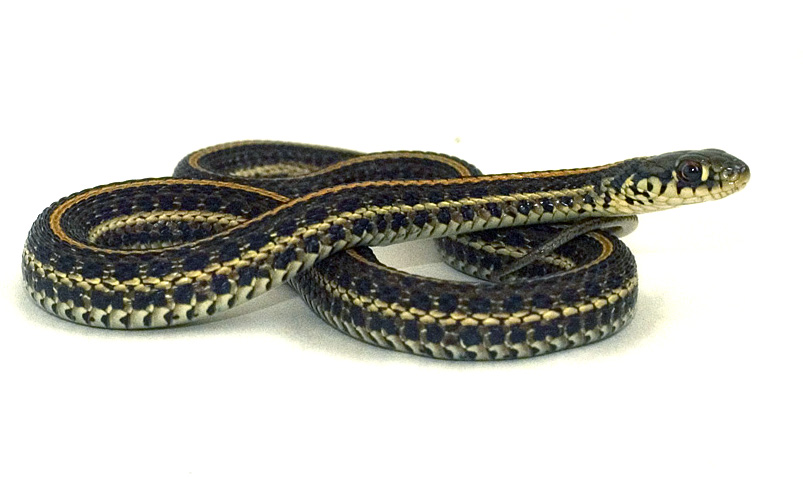
| Appearance | - The species has keeled scales and typically displays a yellow dorsal stripe accompanied by two yellow lateral stripes. English Wikipedia
- Some individuals exhibit unstriped checkered patterns. English Wikipedia
- Individuals may have well-separated dorsal spots and a dull yellow, cream, or orange dorsal stripe. esrp.csustan.edu
- The ventral surface may be olive-brown, cream, orange, or pale blue. esrp.csustan.edu
- Ventral markings may be absent or present. esrp.csustan.edu
- Individuals in the southern part of the known range may lack a dorsal stripe entirely. esrp.csustan.edu
| |
|---|
| Size | | No checked fact yet |
|---|
| Habitat | - The species historically inhabited freshwater marshes, particularly tule marshes. English Wikipedia
- The species predominantly occupies artificial wetlands associated with rice agriculture. English Wikipedia
- The species prefers stagnant or slow-moving water with emergent vegetation. English Wikipedia
- Rice fields provide habitat with food, water, and protective cover. English Wikipedia
- Suitable habitat includes deep and shallow pools that persist throughout the seasonal activity cycle. esrp.csustan.edu
- Suitable habitat includes dense emergent vegetation that provides protection from predators. esrp.csustan.edu
- Upland habitat with structures suitable for hibernation and flood escape is part of the species' ideal habitat. esrp.csustan.edu
- The species uses small mammal burrows, crevices, and surface objects as nocturnal retreats after emerging from hibernation. esrp.csustan.edu
| - The species inhabits meadows and prairies near marshes, streams, and ponds. English Wikipedia
- It occurs in grasslands near ponds, streams, marshes, and sloughs. animaldiversity.org
- The species can inhabit swampy areas and riverbanks. animaldiversity.org
- It can occur in vacant lots in suburban and urban areas. animaldiversity.org
- In the Chicago area, individuals have been observed in abandoned buildings, trash heaps, and vacant lots. English Wikipedia
- Individuals may use drier habitats when they occur alongside common garter snakes. animaldiversity.org
- The species hibernates in burrows and rock crevices. animaldiversity.org
- Hibernation sites can include rodent burrows, ant mounds, crayfish burrows, and artificial crevices. animaldiversity.org
|
|---|
| Diet | | - Its diet includes earthworms, slugs, and small amphibians. English Wikipedia
- The species has been recorded eating frogs, toads, salamanders, fish, birds, small rodents, leeches, earthworms, and grasshoppers. animaldiversity.org
- Its recorded fish prey include mosquitofish, southern redbelly dace, and bluntnose minnows. animaldiversity.org
- Recorded bird prey include bank swallows and eastern meadowlarks. animaldiversity.org
|
|---|
| Behaviour | - The species is active during daylight from spring through late autumn. English Wikipedia
- The species overwinters in terrestrial environments and emerges the following spring. English Wikipedia
- The species is active when water temperatures reach at least 20 °C. English Wikipedia
- Individuals become dormant underground when aquatic habitat temperatures fall below 20 °C. English Wikipedia
- The species can release foul-smelling musk from its cloaca when threatened or disturbed. English Wikipedia
- Individuals use rapid diving behaviour to avoid predatory birds. English Wikipedia
- Individuals typically emerge from subterranean retreats in April, depending on local weather. esrp.csustan.edu
| - The species is active during the day when temperatures are warm. animaldiversity.org
- Its daytime activity generally occurs at air temperatures between 21 and 29 degrees Celsius. animaldiversity.org
- It switches to nighttime activity when air temperatures exceed 31 degrees Celsius. animaldiversity.org
- Individuals may emerge from hibernation to bask during warm winter days. English Wikipedia
- The species is active from March to November, depending on its geographic region. animaldiversity.org
- Individuals are generally solitary except during mating interactions and communal hibernation. animaldiversity.org
- Individuals may move no more than 76 meters over periods exceeding one year. animaldiversity.org
- The species uses chemical trails to locate prey, mates, and hibernation sites. animaldiversity.org
- When threatened, individuals may bite, release foul-smelling musk, or defecate. animaldiversity.org
- The species is described as mildly venomous, with venom that is not toxic to humans. English Wikipedia
|
|---|
| Reproduction | | |
|---|
| Distribution | | - The species occurs across the central United States, extending north into Canada and south to Texas. English Wikipedia
- Its documented Canadian range includes southern Alberta, Saskatchewan, and Manitoba. animaldiversity.org
- Its documented United States range includes the Oklahoma panhandle, northern Texas, northeastern New Mexico, Minnesota, Wisconsin, and Indiana. animaldiversity.org
- The species occurs at elevations from 400 to 7,500 feet. English Wikipedia
- The species generally prefers elevations below 6,000 feet. English Wikipedia
|
|---|
| Conservation | - The species is listed as endangered by state and federal governments. English Wikipedia
- The species has been extirpated from 98% of its former San Joaquin Valley habitat. English Wikipedia
- Habitat loss and fragmentation are major threats to the species. English Wikipedia
- The isolation of existing populations may threaten the species through stochastic events and genetic processes. esrp.csustan.edu
| |
|---|
| Similar species | No checked fact yet | - The species shares portions of its habitat with the common garter snake. English Wikipedia
- The plains garter snake and common garter snake may hybridize where their ranges overlap. English Wikipedia
|
|---|