Species · Reptiles
Giant Garter Snake Thamnophis gigas
The scientific name of the Giant Garter Snake is Thamnophis gigas. It is a species of reptile in the family Colubridae (colubrid), order Squamata. The name dates from 1940.
- Scientific name
- Thamnophis gigas Fitch, 1940
- Common name
- Giant Garter Snake
- Genus
- Thamnophis
- Family
- Colubridae (Colubrid)
- Order
- Squamata
- Class
- Reptilia
- Red List category
- VU Vulnerable
- Recorded in
- 1 country
- Name status
- accepted in the Catalogue of Life

Overview
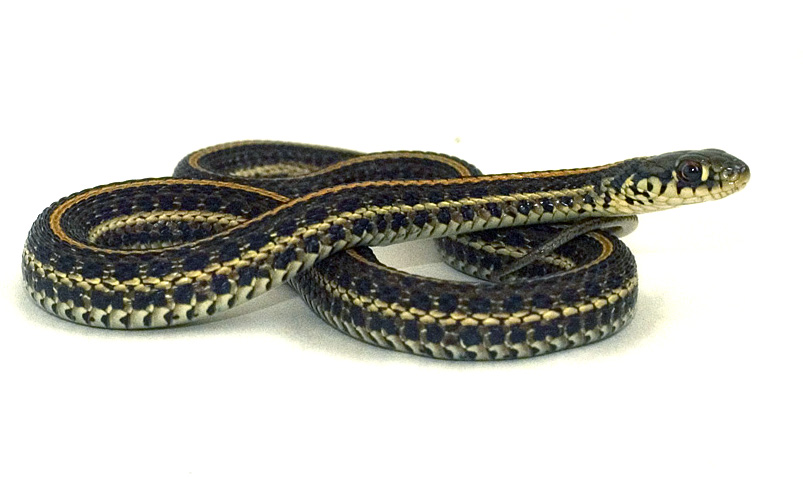
The species is endemic to California's Central Valley. It typically has keeled scales, a yellow dorsal stripe, and two yellow lateral stripes, although some individuals have unstriped checkered patterns.
Written 26 November 2026 from the sources listed below. Each statement was checked against the passage it cites; statements that could not be supported were removed.
Conservation
The Giant Garter Snake is listed as endangered by state and federal governments. It has been extirpated from 98% of its former San Joaquin Valley habitat.[1][2]
Habitat loss and fragmentation are major threats to the species. Isolation of existing populations may also threaten it through stochastic events and genetic processes.[3][4]
Appearance
The species has keeled scales and typically displays a yellow dorsal stripe accompanied by two yellow lateral stripes. Some individuals exhibit unstriped checkered patterns.[5][6]
Individuals may have well-separated dorsal spots and a dull yellow, cream, or orange dorsal stripe. Individuals in the southern part of the known range may lack a dorsal stripe entirely.[7][8]
The ventral surface may be olive-brown, cream, orange, or pale blue. Ventral markings may be absent or present.[9][10]
Adult individuals measure approximately 94–165 cm in length. Females tend to be longer and larger than males, and individuals often reach at least 1.2 m in length.[11][12][13]
Habitat
The species historically inhabited freshwater marshes, particularly tule marshes. It predominantly occupies artificial wetlands associated with rice agriculture.[14][15]
The species prefers stagnant or slow-moving water with emergent vegetation. Rice fields provide food, water, and protective cover.[16][17]
Suitable habitat includes deep and shallow pools that persist throughout the seasonal activity cycle, as well as dense emergent vegetation that provides protection from predators.[18][19]
Upland habitat with structures suitable for hibernation and flood escape is part of the species' ideal habitat. After emerging from hibernation, individuals use small mammal burrows, crevices, and surface objects as nocturnal retreats.[20][21]
Diet
The species preys on fish, frogs, and tadpoles. Typical fish prey includes carp, minnows, and mosquitofish.[22][23]
Pacific tree frogs and bullfrogs are among its typical prey. Historically, it also preyed upon the thick-tailed chub and the California red-legged frog.[24][25][26]
Behaviour
The species is active during daylight from spring through late autumn. It overwinters in terrestrial environments and emerges the following spring.[27][28]
The species is active when water temperatures reach at least 20 °C. Individuals become dormant underground when aquatic habitat temperatures fall below 20 °C.[29][30]
Individuals typically emerge from subterranean retreats in April, depending on local weather. When threatened or disturbed, the species can release foul-smelling musk from its cloaca.[31][32]
Individuals use rapid diving behaviour to avoid predatory birds.[33]
Reproduction and life cycle
Males begin searching for females between March and mid-May. A secondary breeding season has been documented in September.[34][35]
Females give birth to live young after carrying eggs internally. Births generally occur from mid-July to early October.[36][37]
The average litter size is 17 young, and females have been recorded giving birth to between 10 and 46 young. Larger females tend to produce more offspring than smaller females.[38][39][40]
Males typically reach breeding potential at approximately three years of age, while females typically reach breeding potential at approximately five years of age.[41][42]
Classification of the Giant Garter Snake
| Kingdom | Animalia |
|---|---|
| Phylum | Chordata |
| Subphylum | Vertebrata |
| Infraphylum | Gnathostomata |
| Parvphylum | Osteichthyes |
| Megaclass | Tetrapoda |
| Class | Reptilia (Reptile) |
| Order | Squamata (Snakes) |
| Suborder | Serpentes (Snakes) |
| Infraorder | Alethinophidia |
| Family | Colubridae (Colubrid) |
| Subfamily | Natricinae |
| Genus | Thamnophis (Garter Snake) |
| Species | Thamnophis gigas Fitch, 1940 |
Where the Giant Garter Snake is found
Checklists and occurrence records place Thamnophis gigas in 1 country. GBIF holds 599 georeferenced records of it.
Countries
Regions and cities with the most records
- California, United States 178
- West Sacramento, United States 39
- Sacramento, United States 37
- Rio Linda, United States 32
- Arden-Arcade, United States 26
- North Highlands, United States 26
- Foothill Farms, United States 22
- Los Banos, United States 22
- Antelope, United States 21
- Woodland, United States 16
- Oroville, United States 15
- Davis, United States 14
- Roseville, United States 13
- Florin, United States 12
- Carmichael, United States 11
- Rosemont, United States 10
- Dixon, United States 7
- Lodi, United States 7
- South Yuba City, United States 7
- Vineyard, United States 7
- Yuba City, United States 7
- Citrus Heights, United States 6
- Elk Grove, United States 6
- Rancho Cordova, United States 6
- Stockton, United States 6
- Lathrop, United States 5
- Oakley, United States 5
- Chico, United States 3
- Clovis, United States 3
- Fair Oaks, United States 3
- Fresno, United States 3
- Galt, United States 3
- Linda, United States 3
- Orangevale, United States 3
Range as the checklists state it
USA (California: Central VAlley from Delevan National Wildlife Refuge, Colus acounty, to Los Banos Creek and Mud Slough in San Joaquin Valley).
A number beside a place is its count of GBIF occurrence records. A place without a number comes from a checklist alone. Records show where a species has been observed or collected, which can include escapes and vagrants.
Common names
English
- Giant Garter Snake
Names in 4 other languages
- Chinese
- 巨帶蛇
- German
- Riesen-Strumpfbandnatter
- Japanese
- オオガーターヘビ
- Portuguese
- Cobra-liga-gigante
Synonyms
One other scientific name has been used for this species and is now treated as a synonym of Thamnophis gigas.
- Thamnophis elegans gigas Fitch, 1940
Related species
-
 Common Garter SnakeThamnophis sirtalis
-
 Common Ribbon SnakeThamnophis saurita
-
 Checkered Garter SnakeThamnophis marcianus
-
 Plains Garter SnakeThamnophis radix
-
 Western Ribbon SnakeThamnophis proximus
-
 Western Terrestrial Garter SnakeThamnophis elegans
-
 Mexican Garter SnakeThamnophis eques
-
 Northwestern Garter SnakeThamnophis ordinoides
Compare
Questions and answers
What is the scientific name of the Giant Garter Snake?
The scientific name of the Giant Garter Snake is Thamnophis gigas. Written with its author, the full name is Thamnophis gigas Fitch, 1940.
Which family does the Giant Garter Snake belong to?
Thamnophis gigas belongs to the family Colubridae, in the order Squamata and the class Reptilia.
Where is the Giant Garter Snake found?
Checklists and occurrence records place Thamnophis gigas in 1 country: United States.
What is the conservation status of the Giant Garter Snake?
The IUCN Red List category recorded for Thamnophis gigas is Vulnerable (VU).
What do giant garter snakes eat?
They prey on fish, frogs, and tadpoles. Typical prey includes carp, minnows, mosquitofish, Pacific tree frogs, and bullfrogs.[22][23][24]
What type of habitat do garter snakes live in?
The Giant Garter Snake predominantly occupies artificial wetlands associated with rice agriculture and prefers stagnant or slow-moving water with emergent vegetation.[15][16]
Sources
Passages the profile rests on
- The species is listed as endangered by state and federal governments. Source passage: “this species is listed as endangered by the state and federal governments.” — English Wikipedia
- The species has been extirpated from 98% of its former San Joaquin Valley habitat. Source passage: “It has been extirpated from 98% of the former San Joaquin habitat.” — English Wikipedia
- Habitat loss and fragmentation are major threats to the species. Source passage: “In addition to habitat loss and fragmentation, introduced predators such as the American bullfrog and the northern water snake may also be suppressing recovery.” — English Wikipedia
- The isolation of existing populations may threaten the species through stochastic events and genetic processes. Source passage: “these populations are isolated from one another and stochastic events as well as genetic processes may prove to be major threats to the giant garter snake's continued existence.” — esrp.csustan.edu
- The species has keeled scales and typically displays a yellow dorsal stripe accompanied by two yellow lateral stripes. Source passage: “The snakes have keeled scales, with a yellow dorsal stripe against two additional yellow stripes on either side that run the length of its body.” — English Wikipedia
- Some individuals exhibit unstriped checkered patterns. Source passage: “Although, some unstriped checkered patterns have been observed.” — English Wikipedia
- Individuals may have well-separated dorsal spots and a dull yellow, cream, or orange dorsal stripe. Source passage: “They may be recognized by well-separated spots on the dorsal surface, a dull yellow, cream or orange dorsal stripe” — esrp.csustan.edu
- Individuals in the southern part of the known range may lack a dorsal stripe entirely. Source passage: “Individuals in the southern portion of their known range (the San Joaquin Valley) may lack the dorsal stripe entirely.” — esrp.csustan.edu
- The ventral surface may be olive-brown, cream, orange, or pale blue. Source passage: “olive-brown, cream orange or pale blue coloration on the ventral surface.” — esrp.csustan.edu
- Ventral markings may be absent or present. Source passage: “Ventral markings may or may not be evident.” — esrp.csustan.edu
- Adult individuals measure approximately 94–165 cm in length. Source passage: “with the adult snakes ranging from 94–165 cm (37.0–65.0 in) in length.” — English Wikipedia
- Females tend to be longer and larger than males. Source passage: “the female giant garter snakes tend to be longer and larger than the males.” — English Wikipedia
- Individuals often reach at least 1.2 m in length. Source passage: “Giant garter snakes often reach 1.2 m (4 ft) or more in length.” — esrp.csustan.edu
- The species historically inhabited freshwater marshes, particularly tule marshes. Source passage: “The snake historically inhabited wetland habitats, particularly tule marshes” — English Wikipedia
- The species predominantly occupies artificial wetlands associated with rice agriculture. Source passage: “it is now predominantly found in artificial wetlands associated with rice agriculture.” — English Wikipedia
- The species prefers stagnant or slow-moving water with emergent vegetation. Source passage: “Giant garter snakes prefer to inhabit stagnant or slow-moving water bodies with emergent vegetation” — English Wikipedia
- Rice fields provide habitat with food, water, and protective cover. Source passage: “as they provide good habitat for the snakes with plentiful food, water, and cover.” — English Wikipedia
- Suitable habitat includes deep and shallow pools that persist throughout the seasonal activity cycle. Source passage: “deep and shallow pools of water (which persist throughout the seasonal cycle of activity)” — esrp.csustan.edu
- Suitable habitat includes dense emergent vegetation that provides protection from predators. Source passage: “dense emergent vegetation for escape from predation” — esrp.csustan.edu
- Upland habitat with structures suitable for hibernation and flood escape is part of the species' ideal habitat. Source passage: “upland habitat with access to structures suitable for hibernation and escape from flooding.” — esrp.csustan.edu
- The species uses small mammal burrows, crevices, and surface objects as nocturnal retreats after emerging from hibernation. Source passage: “they utilize small mammal burrows, crevices, and other surface objects for nocturnal retreats.” — esrp.csustan.edu
- The species preys on fish, frogs, and tadpoles. Source passage: “giant garter snakes prey upon fish, frogs, and tadpoles.” — English Wikipedia
- Typical prey includes carp, minnows, and mosquitofish. Source passage: “Typical prey includes carp, minnows, mosquitofish, Pacific tree frogs, and bullfrogs.” — esrp.csustan.edu
- Pacific tree frogs and bullfrogs are among the species' typical prey. Source passage: “Typical prey includes carp, minnows, mosquitofish, Pacific tree frogs, and bullfrogs.” — esrp.csustan.edu
- The species historically preyed upon the thick-tailed chub. Source passage: “Historically they preyed upon thick-tailed chub (Gila crassicauda, now extinct)” — esrp.csustan.edu
- The species historically preyed upon the California red-legged frog. Source passage: “and the California red-legged frog (which has been extirpated from the Central Valley floor.” — esrp.csustan.edu
- The species is active during daylight from spring through late autumn. Source passage: “Giant garter snakes are active during the day from spring to late fall” — English Wikipedia
- The species overwinters in terrestrial environments and emerges the following spring. Source passage: “will over-winter in terrestrial environments before emerging the following spring.” — English Wikipedia
- The species is active when water temperatures reach at least 20 °C. Source passage: “it is active when water temperatures are at 68 °F (20 °C) or more” — English Wikipedia
- Individuals become dormant underground when aquatic habitat temperatures fall below 20 °C. Source passage: “is dormant underground when its aquatic habitat is below this temperature.” — English Wikipedia
- Individuals typically emerge from subterranean retreats in April, depending on local weather. Source passage: “typically emerge to forage and breed in April dependent on local weather conditions.” — esrp.csustan.edu
- The species can release foul-smelling musk from its cloaca when threatened or disturbed. Source passage: “the giant garter snake can release a foul-smelling musk from its cloaca if threatened or disturbed.” — English Wikipedia
- Individuals use rapid diving behaviour to avoid predatory birds. Source passage: “have evolved a fast diving behaviour to avoid them.” — English Wikipedia
- Males begin searching for females between March and mid-May. Source passage: “Starting in March to mid May, male giant garter snakes emerge from hibernation search for a female to mate with.” — English Wikipedia
- A secondary breeding season has been documented in September. Source passage: “a secondary breeding season has been known to occur during September.” — esrp.csustan.edu
- Females give birth to live young after carrying eggs internally. Source passage: “Giant garter snakes are ovoviviparous, meaning they carry eggs internally but give live birth.” — English Wikipedia
- Births generally occur from mid-July to early October. Source passage: “birthing occurs from mid July to early October” — English Wikipedia
- The average litter size is 17 young. Source passage: “with average litter size of 17 young.” — English Wikipedia
- Females have been recorded giving birth to between 10 and 46 young. Source passage: “Females are viviparous and bear 10 to 46 young” — esrp.csustan.edu
- Larger females tend to produce more offspring than smaller females. Source passage: “Larger female snakes tend to produce more offspring compared to smaller females” — English Wikipedia
- Males typically reach breeding potential at approximately three years of age. Source passage: “Breeding potential is reached at about 3 years for males” — esrp.csustan.edu
- Females typically reach breeding potential at approximately five years of age. Source passage: “and 5 years for females.” — esrp.csustan.edu
- The species is endemic to California's Central Valley. Source passage: “Giant garter snakes are endemic to the Central Valley of California.” — esrp.csustan.edu
- The current distribution comprises 13 separate populations. Source passage: “Current distribution is limited to 13 separate populations:” — esrp.csustan.edu
Data
- Catalogue of Life, 2026-10-16 XR cc by
- Global Biodiversity Information Facility CC BY 4.0
- Wikidata CC0
- GeoNames CC BY 4.0
- Wikimedia Commons per image; credit shown with each image
- Within the Catalogue of Life, this name comes from The Reptile Database cc by
References
- Fitch, H. C. (1940). A biogeographical study of the ordinoides artenkreis of garter snakes (genus Thamnophis). Univ. California Publ. Zool. 44: 1-150.
- Stebbins, R. C. (1985). A Field Guide to Western Reptiles and Amphibians, 2nd ed. Houghton Mifflin, Boston.
- Rossman, Douglas A.; Ford, Neil B. & Seigel, Richard A. (1996). The Garter Snakes: Evolution and Ecology. University of Oklahoma Press, Norman, OK, Xx + 332 + Pp.
- Hallmen, M., & Chlebowy, J. (2001). Strumpfbandnattern. Natur Und Tier Verlag (Münster), 192 Pp.
- Bourguignon, T. (2002). Strumpfbandnattern: Herkunft - Pflege - Arten. E. Ulmer Verlag, 125 Pp.
- Queiroz, Alan de; Robin Lawson and Julio A. Lemos-Espinal. (2002). Phylogenetic Relationships of North American Garter Snakes (Thamnophis) Based on Four Mitochondrial Genes: How Much DNA Sequence Is Enough? Molecular Phylogenetics and Evolution 22: 315-329.
- Rodríguez-Robles, Javier A., Good, David A., Wake, David B. (2003). Brief History of Herpetology in the Museum of Vertebrate Zoology, University of California, Berkeley, with a List of Type Specimens of Recent Amphibians and Reptiles. UC Publications in Zoology, 119 Pp.
- Halstead, B.J., G.D. Wylie & M.L. Casazza. (2010). Habitat Suitability and Conservation of the Giant Gartersnake (Thamnophis gigas) in the Sacramento Valley of California. Copeia 2010 (4): 591-599.
- Wylie, Glenn D.; Michael L. Casazza, Christopher J. Gregory, and Brian J. Halstead. (2010). Abundance and Sexual Size Dimorphism of the Giant Gartersnake (Thamnophis gigas) in the Sacramento Valley of California. Journal of Herpetology 44 (1): 94–103.
- Crother, B. I. (ed.). (2012). Standard Common and Current Scientific Names for North American Amphibians, Turtles, Reptiles, and Crocodilians, Seventh Edition. Herpetological Circular 39: 1-92.
- Wallach, Van; Kenneth L. Williams, Jeff Boundy. (2014). Snakes of the World: A Catalogue of Living and Extinct Species. [type catalogue]. Taylor and Francis, CRC Press, 1237 Pp.
- Hansen, Eric C., Rick D. Scherer, Gary C. White, Brett G. Dickson and Erica Fleishman. (2015). Estimates of Survival Probability from Two Populations of Giant Gartersnakes in California’s Great Central Valley. Copeia 103 (4): 1026-1036.
- Hansen, Eric C.; Rick D. Scherer, Erica Fleishman, Brett G. Dickson, and Dave Krolick. (2017). Relations between Environmental Attributes and Contemporary Occupancy of Threatened Giant Gartersnakes (Thamnophis gigas). Journal of Herpetology 51 (2): 274-283.
- Fulton, A M & Muñoz, D A; (2018). Thamnophis gigas (Giant Gartersnake) Diet. Herpetological Review 49 (4): 764-765.
- O’Shea, M. (2018). The Book of Snakes. Ivy Press / Quarto Publishing, London,.
- Rose, Jonathan P.; Julia S.M. Ersan, Glenn D. Wylie, Michael L. Casazza, and Brian J. Halstead. (2018). Reproductive Frequency and Size-dependence of Fecundity in the Giant Gartersnake (Thamnophis gigas). Herp. Cons. Biol. 13 (1): 80–90.
- HALLAS, JOSHUA M.; THOMAS L. PARCHMAN & CHRIS R. FELDMAN. (2021). Phylogenomic analyses resolve relationships among garter snakes (Thamnophis: Natricinae: Colubridae) and elucidate biogeographic history and morphological evolution. Molecular Phylogenetics and Evolution 107374. [2022 in Print].
- Pilliod, D., Jeffries, M., Arkle, R. and Olson, D. (2024). Climate Futures for Lizards and Snakes in Western North America May Result in New Species Management Issues. Ecol Evol, 14: E70379.
- Heptinstall, Tucker C.; Ramses A. Rosales-Garcia, Rhett M. Rautsaw, Erich P. Hofmann, Alan De Queiroz, Luis Canseco-Márquez & Christopher L. Parkinson. (2024). Size Doesn’t Matter: Body Size is Not Linked to Diet Specialization in Garter Snakes (Squamata: Natricidae: Thamnophis). Journal of Herpetology 58 (2): 122-134.
- Hansen, Robert and Jackson D. Shedd. (2025). California Amphibians and Reptiles. Princeton University Press, 528 Pp., ISBN9780691249087 (Ebook).
This species in other databases
Page built on 26 November 2026. See how the catalog is made and all sources and licences.
Cite this page
ScientificNames.org. (2026). Thamnophis gigas (Giant Garter Snake). Retrieved November 26, 2026, from https://scientificnames.org/species/thamnophis-gigas
“Thamnophis gigas (Giant Garter Snake).” ScientificNames.org, 2026, scientificnames.org/species/thamnophis-gigas. Accessed 26 Nov. 2026.
ScientificNames.org. “Thamnophis gigas (Giant Garter Snake).” Accessed November 26, 2026. https://scientificnames.org/species/thamnophis-gigas.
@misc{scientificnames_thamnophis_gigas_giant_garter_snake,
  author = {{ScientificNames.org}},
  title = {Thamnophis gigas (Giant Garter Snake)},
  year = {2026},
  url = {https://scientificnames.org/species/thamnophis-gigas},
  note = {Accessed 2026-11-26}
}