Comparison

Checkered Garter Snake vs Plains Garter Snake

Checkered Garter Snake (Thamnophis marcianus) and Plains Garter Snake (Thamnophis radix) both belong to the genus Thamnophis (garter snake) and part ways below it. Both are recorded in 1 country.

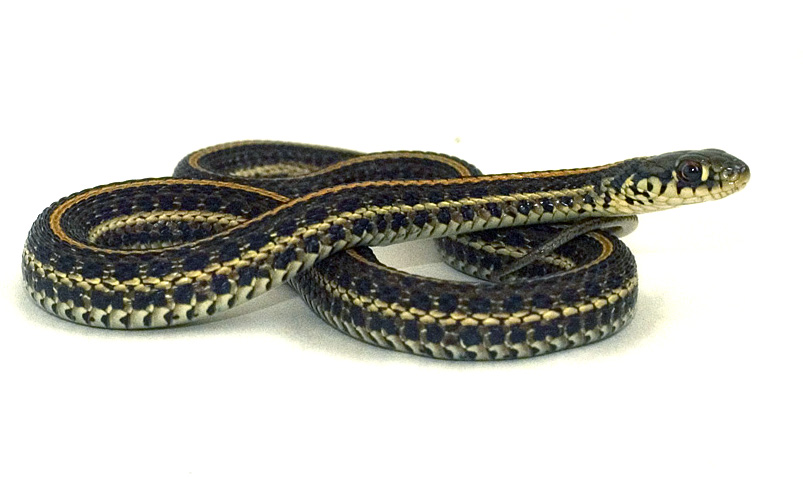
Checkered Garter Snake

Checkered Garter Snake

Thamnophis marcianus

Nick Loveland, CC0, via Wikimedia Commons

Plains Garter Snake

Plains Garter Snake

Thamnophis radix

Thamnophis, CC BY-SA 3.0, via Wikimedia Commons

Side by side

Checkered Garter SnakePlains Garter Snake
Scientific nameThamnophis marcianus (Baird & Girard, 1853)Thamnophis radix (Baird & Girard, 1853)
English nameCheckered Garter SnakePlains Garter Snake
GroupReptilesReptiles
ClassReptilia ReptileReptilia Reptile
OrderSquamata SnakesSquamata Snakes
FamilyColubridae ColubridColubridae Colubrid
GenusThamnophis Garter SnakeThamnophis Garter Snake
Named in18531853
Red List categoryLeast ConcernLeast Concern
Countries on record8 countries2 countries
GBIF occurrence records11,563 records14,658 records

Rows where the two agree are shown in grey.

Where each is found

Both recorded in 1 country

Only Checkered Garter Snake (7)

Only Plains Garter Snake (1)

From Catalogue of Life checklists and GBIF occurrence records. A country missing from a list means no record is held, which is not proof of absence.

Checked facts

Checkered Garter SnakePlains Garter Snake
Appearance
Habitat
  • The species inhabits deserts, grasslands, shrublands, and forests, generally near water. English Wikipedia
  • The species occurs across elevations from sea level to approximately 2,200 m. English Wikipedia
  • Its habitats range from wetlands, including moist tropical forests, to drylands such as deserts and dry forests. animaldiversity.org
  • The species occurs near rivers, ponds, springs, irrigation ditches, and lakes. animaldiversity.org
  • In grasslands, individuals commonly shelter beneath rocks, logs, and dense vegetation. animaldiversity.org
  • The species also occurs in residential backyards and gardens. animaldiversity.org
  • The species inhabits meadows and prairies near marshes, streams, and ponds. English Wikipedia
  • It occurs in grasslands near ponds, streams, marshes, and sloughs. animaldiversity.org
  • The species can inhabit swampy areas and riverbanks. animaldiversity.org
  • It can occur in vacant lots in suburban and urban areas. animaldiversity.org
  • In the Chicago area, individuals have been observed in abandoned buildings, trash heaps, and vacant lots. English Wikipedia
  • Individuals may use drier habitats when they occur alongside common garter snakes. animaldiversity.org
  • The species hibernates in burrows and rock crevices. animaldiversity.org
  • Hibernation sites can include rodent burrows, ant mounds, crayfish burrows, and artificial crevices. animaldiversity.org
Diet
  • Its diet includes earthworms, slugs, and small amphibians. English Wikipedia
  • The species has been recorded eating frogs, toads, salamanders, fish, birds, small rodents, leeches, earthworms, and grasshoppers. animaldiversity.org
  • Its recorded fish prey include mosquitofish, southern redbelly dace, and bluntnose minnows. animaldiversity.org
  • Recorded bird prey include bank swallows and eastern meadowlarks. animaldiversity.org
Behaviour
  • The species is partially nocturnal compared with most other garter snakes. English Wikipedia
  • Individuals are mainly active during daylight, although populations in southern habitats are active at night. animaldiversity.org
  • Individuals are normally solitary but hibernate in groups averaging approximately 100 snakes. animaldiversity.org
  • Hibernation generally occurs from October through March. animaldiversity.org
  • Individuals sometimes emerge to bask on warmer winter days. animaldiversity.org
  • The species uses vibrations to detect nearby prey, snakes, and other animals. animaldiversity.org
  • Individuals use smell and touch to communicate during the breeding season. animaldiversity.org
  • Individuals can distinguish pheromone trails belonging to their own species from those of other species. animaldiversity.org
  • When threatened, individuals release a foul-smelling liquid from the cloaca. English Wikipedia
  • The species is active during the day when temperatures are warm. animaldiversity.org
  • Its daytime activity generally occurs at air temperatures between 21 and 29 degrees Celsius. animaldiversity.org
  • It switches to nighttime activity when air temperatures exceed 31 degrees Celsius. animaldiversity.org
  • Individuals may emerge from hibernation to bask during warm winter days. English Wikipedia
  • The species is active from March to November, depending on its geographic region. animaldiversity.org
  • Individuals are generally solitary except during mating interactions and communal hibernation. animaldiversity.org
  • Individuals may move no more than 76 meters over periods exceeding one year. animaldiversity.org
  • The species uses chemical trails to locate prey, mates, and hibernation sites. animaldiversity.org
  • When threatened, individuals may bite, release foul-smelling musk, or defecate. animaldiversity.org
  • The species is described as mildly venomous, with venom that is not toxic to humans. English Wikipedia
Reproduction
Distribution
  • The species is native to the southwestern United States, Mexico, and Central America. English Wikipedia
  • In the United States, documented occurrences include southwestern California, southwestern Arizona, and southern New Mexico. animaldiversity.org
  • In Central America, documented localities include Honduras, Nicaragua, Costa Rica, Guatemala, and Belize. animaldiversity.org
  • Mexican records include Veracruz, Tabasco, and the central Yucatan Peninsula. animaldiversity.org
  • The species occurs across the central United States, extending north into Canada and south to Texas. English Wikipedia
  • Its documented Canadian range includes southern Alberta, Saskatchewan, and Manitoba. animaldiversity.org
  • Its documented United States range includes the Oklahoma panhandle, northern Texas, northeastern New Mexico, Minnesota, Wisconsin, and Indiana. animaldiversity.org
  • The species occurs at elevations from 400 to 7,500 feet. English Wikipedia
  • The species generally prefers elevations below 6,000 feet. English Wikipedia
ConservationNo checked fact yet
Similar speciesNo checked fact yet
  • The species shares portions of its habitat with the common garter snake. English Wikipedia
  • The plains garter snake and common garter snake may hybridize where their ranges overlap. English Wikipedia
Other
  • The species was historically considered nonvenomous, but subsequent discoveries identified production of mild neurotoxic venom. English Wikipedia
No checked fact yet

In brief

Checkered Garter Snake

Thamnophis marcianus is native to the southwestern United States, Mexico, and Central America. It typically has a greenish body marked by a black checkerboard pattern along its back. Full profile

Plains Garter Snake

Thamnophis radix occurs across the central United States, extending north into Canada and south to Texas. It is distinguished by a yellow or orange stripe running along the middle of its back and distinctive black bars on its lips. Full profile

Compare something else

Page built on 27 November 2026 from the data on the two species pages, where every source is listed.

Cite this page

ScientificNames.org. (2026). Checkered Garter Snake vs Plains Garter Snake. Retrieved November 27, 2026, from https://scientificnames.org/compare/checkered-garter-snake-vs-plains-garter-snake