Species · Reptiles
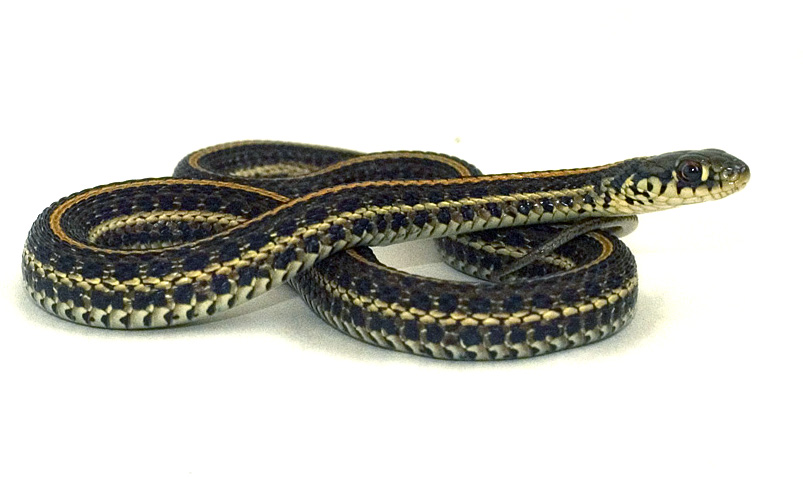
Checkered Garter Snake Thamnophis marcianus
The scientific name of the Checkered Garter Snake is Thamnophis marcianus. It is a species of reptile in the family Colubridae (colubrid), order Squamata. The name dates from 1853.
- Scientific name
- Thamnophis marcianus (Baird & Girard, 1853)
- Common name
- Checkered Garter Snake
- Genus
- Thamnophis
- Family
- Colubridae (Colubrid)
- Order
- Squamata
- Class
- Reptilia
- Red List category
- LC Least Concern
- Recorded in
- 8 countries
- Name status
- accepted in the Catalogue of Life

Overview
Thamnophis marcianus is native to the southwestern United States, Mexico, and Central America. It typically has a greenish body marked by a black checkerboard pattern along its back.
Written 26 November 2026 from the sources listed below. Each statement was checked against the passage it cites; statements that could not be supported were removed.
Appearance
The species typically has a greenish body with black and light-grey checkerboard spots. Both sexes exhibit the same body pattern. Pale-yellow stripes run along the spine and sides, and the underside is cream-colored.[1][2][3][4]
The head is olive-green with a single thick black line on the neck. A pale-yellow crescent marking occurs on the head immediately before the neck. Body coloration can also include grey, brown, olive, tan, or albino forms.[5][6][7]
The species has 21 rows of keeled dorsal scales. Its tongue has a black tip and a vibrant red remainder.[8][9]
Habitat
The species inhabits deserts, grasslands, shrublands, and forests, generally near water. Its habitats range from wetlands, including moist tropical forests, to drylands such as deserts and dry forests. It occurs across elevations from sea level to approximately 2,200 m.[10][11][12]
Individuals occur near rivers, ponds, springs, irrigation ditches, and lakes. In grasslands, they commonly shelter beneath rocks, logs, and dense vegetation. The species also occurs in residential backyards and gardens.[13][14][15]
Diet
The documented natural diet includes small frogs, toads, small fish, and earthworms. Captive individuals can be trained to accept live or thawed mice and can also accept fish fillets.[16][17][18]
Behaviour
Individuals are mainly active during daylight, although populations in southern habitats are active at night. The species is partially nocturnal compared with most other garter snakes.[19][20]
Individuals are normally solitary but hibernate in groups averaging approximately 100 snakes. Hibernation generally occurs from October through March, and individuals sometimes emerge to bask on warmer winter days.[21][22][23]
The species uses vibrations to detect nearby prey, snakes, and other animals. During the breeding season, individuals use smell and touch to communicate and can distinguish pheromone trails belonging to their own species from those of other species. When threatened, they release a foul-smelling liquid from the cloaca.[24][25][26][27]
Reproduction and life cycle
The species is ovoviviparous and gives birth to live young. Mating generally begins in late March and continues into early April. The gestation period normally lasts 80–105 days.[28][29][30]
Females typically produce one clutch of 6–35 young between July and September. They can store sperm after mating or fertilize eggs immediately. Males reach sexual maturity at approximately 1.5 years, whereas females mature at approximately two years.[31][32][33]
Newborn individuals are independent immediately after birth. Females provide no parental care after giving birth.[34][35]
Classification of the Checkered Garter Snake
| Kingdom | Animalia |
|---|---|
| Phylum | Chordata |
| Subphylum | Vertebrata |
| Infraphylum | Gnathostomata |
| Parvphylum | Osteichthyes |
| Megaclass | Tetrapoda |
| Class | Reptilia (Reptile) |
| Order | Squamata (Snakes) |
| Suborder | Serpentes (Snakes) |
| Infraorder | Alethinophidia |
| Family | Colubridae (Colubrid) |
| Subfamily | Natricinae |
| Genus | Thamnophis (Garter Snake) |
| Species | Thamnophis marcianus (Baird & Girard, 1853) |
Where the Checkered Garter Snake is found
Checklists and occurrence records place Thamnophis marcianus in 8 countries across North America. GBIF holds 11,563 georeferenced records of it.
Countries
- Belize 14
- Costa Rica 15
- El Salvador
- Guatemala 3
- Honduras 11
- Mexico 1,218
- Nicaragua 111
- United States 10,191
Regions and cities with the most records
- Texas, United States 6,373
- Arizona, United States 907
- New Mexico, United States 741
- Live Oak, United States 343
- Austin, United States 339
- Converse, United States 313
- San Antonio, United States 306
- Universal City, United States 301
- Schertz, United States 282
- Cibolo, United States 266
- Chihuahua, Mexico 218
- Kyle, United States 201
- Tamaulipas, Mexico 185
- San Marcos, United States 184
- Oklahoma, United States 178
- New Braunfels, United States 151
- Oaxaca, Mexico 151
- Flowing Wells, United States 147
- Casas Adobes, United States 144
- Catalina Foothills, United States 134
- Pflugerville, United States 131
- Tucson, United States 128
- Cedar Park, United States 124
- Coahuila, Mexico 123
- Oro Valley, United States 120
- Nuevo León, Mexico 117
- Brushy Creek, United States 110
- Canyon Lake, United States 110
- Santo Domingo Tehuantepec, Mexico 107
- Corpus Christi, United States 106
- Round Rock, United States 106
- Scottsdale, United States 101
- Tempe, United States 101
- Tempe Junction, United States 100
- Drexel Heights, United States 91
- Mesa, United States 86
Range as the checklists state it
SW USA (incl. S Kansas, New Mexico, Arizona, California, Oklahoma, Texas), Mexico (Baja California, Campeche, Tamaulipas, Coahuila, Nuevo León, San Luis Potosí, Chiapas, Hidalgo, Sonora, Durango, Veracruz, Zacatecas etc.), Belize, Guatemala ?, El Salvador ?,
A number beside a place is its count of GBIF occurrence records. A place without a number comes from a checklist alone. Records show where a species has been observed or collected, which can include escapes and vagrants.
Common names
English
- Checkered Garter Snake
Names in 7 other languages
- Chinese
- 格紋帶蛇
- Czech
- užovka kostkovaná
- Danish
- Skakbrætstrømpebåndssnog
- German
- Karierte Strumpfbandnatter
- Portuguese
- Cobra-liga-quadriculada
- Russian
- Шахматный садовый уж
- Spanish
- Culebra-listonada manchada, Sochuate, culebra listonada manchada
Synonyms
9 other scientific names have been used for this species and are now treated as synonyms of Thamnophis marcianus.
- Eutaenia marcianus Baird & Girard, 1853
- Eutaenia nigrilatus Cope, 1892
- Eutaenia praeocularis Bocourt, 1892
- Eutainia marciana Baird & Girard, 1853
- Thamnophis arabdotus Andrews, 1937
- Thamnophis bovalli Dunn, 1940
- Thamnophis marcianus nigrolateris Brown, 1889
- Thamnophis rozellae Smith, 1940
- Thamnophis ruthveni Hartweg & Oliver, 1938
Subspecies and varieties
- Thamnophis marcianus marcianus (Checkered Garter Snake) subspecies
- Thamnophis marcianus praeocularis (Yucatan Checkered Garter Snake) subspecies
Related species
-
 Common Garter SnakeThamnophis sirtalis
-
 Common Ribbon SnakeThamnophis saurita
-
 Plains Garter SnakeThamnophis radix
-
 Western Ribbon SnakeThamnophis proximus
-
 Western Terrestrial Garter SnakeThamnophis elegans
-
 Giant Garter SnakeThamnophis gigas
-
 Mexican Garter SnakeThamnophis eques
-
 Northwestern Garter SnakeThamnophis ordinoides
Compare
Questions and answers
What is the scientific name of the Checkered Garter Snake?
The scientific name of the Checkered Garter Snake is Thamnophis marcianus. Written with its author, the full name is Thamnophis marcianus (Baird & Girard, 1853).
Which family does the Checkered Garter Snake belong to?
Thamnophis marcianus belongs to the family Colubridae, in the order Squamata and the class Reptilia.
Where is the Checkered Garter Snake found?
Checklists and occurrence records place Thamnophis marcianus in 8 countries, including United States, Mexico, Nicaragua, Costa Rica, Belize and Honduras.
What is the conservation status of the Checkered Garter Snake?
The IUCN Red List category recorded for Thamnophis marcianus is Least Concern (LC).
Is a checkered garter snake poisonous?
The species produces mild neurotoxic venom. It was historically considered nonvenomous.[36]
What is the diet of a garter snake?
The documented natural diet of the Checkered Garter Snake includes small frogs, toads, small fish, and earthworms.[16]
What type of habitat do garter snakes live in?
The Checkered Garter Snake inhabits deserts, grasslands, shrublands, and forests, generally near water. Its habitats include wetlands, moist tropical forests, deserts, and dry forests.[10][12]
What does a checkered garter snake eat?
Its documented natural diet includes small frogs, toads, small fish, and earthworms. Captive individuals can also accept live or thawed mice and fish fillets.[16][17][18]
Where do checkered garter snakes live?
The species is native to the southwestern United States, Mexico, and Central America. Documented United States occurrences include southwestern California, southwestern Arizona, and southern New Mexico. Central American localities include Honduras, Nicaragua, Costa Rica, Guatemala, and Belize, while Mexican records include Veracruz, Tabasco, and the central Yucatan Peninsula.[37][38][39][40]
Sources
Passages the profile rests on
- The species typically has a greenish body marked by a black checkerboard pattern along its back. Source passage: “The checkered garter snake is typically greenish in color, with a distinct, black checkerboard pattern down its back.” — English Wikipedia
- Individuals have black and light-grey checkerboard spots along their bodies. Source passage: “Checkered garter snakes get their common name from the checkered pattern of black and light-grey spots along their bodies.” — animaldiversity.org
- Both sexes exhibit the same body pattern. Source passage: “Both females and males have the same pattern.” — animaldiversity.org
- The species has pale-yellow stripes along its spine and sides, with a cream-colored underside. Source passage: “They have a pale-yellow stripes along their spines and their sides, while their ventral sides are cream.” — animaldiversity.org
- The head is olive-green and has a single thick black line on the neck. Source passage: “Their heads are an olive-green color with a single thick black line on their necks.” — animaldiversity.org
- Body coloration can include grey, brown, olive, tan, or albino forms. Source passage: “Their bodies can be grey, brown, olive, tan or albino.” — animaldiversity.org
- A pale-yellow crescent marking occurs on the head immediately before the neck. Source passage: “On their heads they have a pale-yellow crescent before their necks.” — animaldiversity.org
- The species has 21 rows of keeled dorsal scales. Source passage: “They have 21 keeled, dorsal scale rows.” — animaldiversity.org
- The tongue has a black tip and a vibrant red remainder. Source passage: “The tips of their tongues are black and the rest is a vibrant red.” — animaldiversity.org
- The species inhabits deserts, grasslands, shrublands, and forests, generally near water. Source passage: “The preferred natural habitats of Thamnophis marcianus are desert, grassland, shrubland, and forest, usually close to water” — English Wikipedia
- The species occurs across elevations from sea level to approximately 2,200 m. Source passage: “at altitudes from sea level to 2,200 m (7,200 ft).” — English Wikipedia
- Its habitats range from wetlands, including moist tropical forests, to drylands such as deserts and dry forests. Source passage: “They can be found in a variety of habitats from wetlands (e.g. wet, moist tropical forest) to drylands (deserts and dry forest).” — animaldiversity.org
- The species occurs near rivers, ponds, springs, irrigation ditches, and lakes. Source passage: “They are found at or near water sources such as rivers, ponds, springs, irrigation ditches, and lakes.” — animaldiversity.org
- In grasslands, individuals commonly shelter beneath rocks, logs, and dense vegetation. Source passage: “When they are in grasslands they tend to burrow under rocks, logs and in thick vegetation.” — animaldiversity.org
- The species also occurs in residential backyards and gardens. Source passage: “They can also be found in backyards and gardens.” — animaldiversity.org
- The documented natural diet includes small frogs, toads, small fish, and earthworms. Source passage: “The diet of Thamnophis marcianus includes small frogs, toads, small fish, and earthworms.” — English Wikipedia
- Captive individuals can be trained to accept live or thawed mice. Source passage: “If kept as a pet, it can be trained on live or freeze-thawed mice” — English Wikipedia
- Captive individuals can also accept fish fillets. Source passage: “It can be trained to accept mice or fish fillets as food.” — English Wikipedia
- The species is partially nocturnal compared with most other garter snakes. Source passage: “Unlike most garter snakes, the checkered garter snake is partially nocturnal.” — English Wikipedia
- Individuals are mainly active during daylight, although populations in southern habitats are active at night. Source passage: “Checkered garter snakes are mainly active during the day, but in southern habitats they are active at night.” — animaldiversity.org
- Individuals are normally solitary but hibernate in groups averaging approximately 100 snakes. Source passage: “They are normally solitary and hibernate in large groups of approximately 100.” — animaldiversity.org
- Hibernation generally occurs from October through March. Source passage: “They hibernate from October to March” — animaldiversity.org
- Individuals sometimes emerge to bask on warmer winter days. Source passage: “but sometimes come out to bask on warmer winter days.” — animaldiversity.org
- The species uses vibrations to detect nearby prey, snakes, and other animals. Source passage: “They use vibrations to detect prey, other snakes, or other animals around them.” — animaldiversity.org
- Individuals use smell and touch to communicate during the breeding season. Source passage: “Checkered garter snakes communicate using smell and touch duirng breeding season.” — animaldiversity.org
- Individuals can distinguish pheromone trails belonging to their own species from those of other species. Source passage: “Ford and O'Bleness (1986) found that they can distinguish between the pheromone trails of other checkered garter snakes and other species.” — animaldiversity.org
- When threatened, individuals release a foul-smelling liquid from the cloaca. Source passage: “Thamnophis marcianus will release a foul-smelling liquid from its cloaca onto attackers.” — English Wikipedia
- The species is ovoviviparous and gives birth to live young. Source passage: “They are ovoviviparous, meaning feritlized eggs hatch within the bodies of females, so babies are born live.” — animaldiversity.org
- Mating generally begins in late March and continues into early April. Source passage: “Checkered garter snakes begin mating in spring - as soon as they emerge from hibernation in late March - through early April.” — animaldiversity.org
- The gestation period normally lasts 80–105 days. Source passage: “Their gestation period is normally 80 to 105 days.” — animaldiversity.org
- Females typically produce one clutch of 6–35 young between July and September. Source passage: “Females give birth to one clutch ranging from 6 to 35 young between the months of July to September.” — animaldiversity.org
- Females can store sperm after mating or fertilize eggs immediately. Source passage: “When they finish mating, females can either store sperm or fertilize immediately after mating.” — animaldiversity.org
- Males reach sexual maturity at approximately 1.5 years, whereas females mature at approximately two years. Source passage: “Males reach sexual maturity at 1.5 years, while females reach sexual maturity at 2 years.” — animaldiversity.org
- Newborn individuals are independent immediately after birth. Source passage: “As soon as checkered garter snakes are born, they are independent.” — animaldiversity.org
- Females provide no parental care after giving birth. Source passage: “Once checkered garter snakes are born, mothers provide no further parental care.” — animaldiversity.org
- The species was historically considered nonvenomous, but subsequent discoveries identified production of mild neurotoxic venom. Source passage: “Thamnophis marcianus was long thought to be nonvenomous, but recent discoveries have revealed that it does in fact produce a mild neurotoxic venom.” — English Wikipedia
- The species is native to the southwestern United States, Mexico, and Central America. Source passage: “The species is native to the southwestern United States, Mexico, and Central America.” — English Wikipedia
- In the United States, documented occurrences include southwestern California, southwestern Arizona, and southern New Mexico. Source passage: “In the United States, they are found in southwest California, southwestern Arizona and southern New Mexico.” — animaldiversity.org
- In Central America, documented localities include Honduras, Nicaragua, Costa Rica, Guatemala, and Belize. Source passage: “In Central America, they have been found by Tegucigalpa, Honduras; Lake Nicaragua and Managua, Nicaragua; northeast Costa Rica; El Estro, Guatemala and Orange Walk, Belize.” — animaldiversity.org
- Mexican records include Veracruz, Tabasco, and the central Yucatan Peninsula. Source passage: “In Mexico, they have been found as disjunct populations by the Rio Grande River, Veracruz, Juchitan de Zaragoza, Tabasco and central Yucatan Peninsula.” — animaldiversity.org
Data
- Catalogue of Life, 2026-10-16 XR cc by
- Global Biodiversity Information Facility CC BY 4.0
- Wikidata CC0
- GeoNames CC BY 4.0
- Wikimedia Commons per image; credit shown with each image
- Within the Catalogue of Life, this name comes from The Reptile Database cc by
References
- Baird, S. F. and C. Girard. (1853). Catalogue of North American Reptiles in the Museum of the Smithsonian Institution. Part 1.-Serpents. Smithsonian Inst., Washington, Xvi + 172 Pp.
- Garman, S. (1887). Reptiles and batrachians from Texas and Mexico. Bull. Essex Institute 19: 119-138.
- Bocourt, M. F. (1892). Note sur un Ophidien appartenant au genre Eutaenia. Le Naturaliste (Paris) (2) 14: 278.
- Boulenger, G. A. (1893). Catalogue of the snakes in the British Museum (Nat. Hist.) I. London (Taylor & Francis), 448 Pp.
- Garnier, J. H. (1894). The snakes of Ontario. The Empire, October 6: 16 [See Bauer 2025 for Synonymies].
- McLain, & Robert Baird. (1899). Critical notes on a collection of reptiles from the Western Coast of the United States. Privately Published, Wheeling, WV: 1-13 (SSAR Misc. Publ. Reprint).
- Cope, E. D. (1900). The crocodilians, lizards and snakes of North America. Ann. Rep. U.S. Natl. Mus. 1898: 153-1270.
- Ruthven, A. G. (1907). A collection of reptiles and amphibians from southern New Mexico and Arizona. Bull. Amer. Mus. Nat. Hist. (23): 483-604.
- Van Denburgh, & John. (1912). Notes on a collection of reptiles from Southern California and Arizona. Proc. Cal. Acad. Sci. 3: 147-154.
- Van Denburgh, John and Joseph R. Slevin. (1913). A list of the amphibians and reptiles of Arizona, with notes on the species in the collection of the Academy. Proc. Cal. Acad. Sci. 3 (13): 391-454.
- Taylor, E. H. (1929). A revised checklist of the snakes of Kansas. Univ. Kansas Sci. Bull. 19 (5): 53-62.
- Burt, Charles E. (1935). Further records of the ecology and distribution of amphibians and reptiles in the middle west. American Midland Naturalist 16 (3): 311-336.
- Andrews, & Wyllys, E. (1937). Notes on snakes from the Yucatan Peninsula. Zoological Series of Field Museum of Natural History 20 (25): 355-359.
- Hartweg, N., & OLIVER, J. A. (1938). A contribution to the herpetology of the isthmus of Tehuantepec. III. Three new snakes from the Pacific slope. Occ. Pap. Mus. Zool. Univ. Michigan (390): 1-8.
- Smith, H. M. (1940). Descriptions of new lizards and snakes from México and Guatemala. Proc. Biol. Soc. Washington 53: 55-64.
- Dunn, E. R. (1940). Notes on some American lizards and snakes in the Museum at Goteborg. Herpetologica 1: 189-194.
- Smith, Hobart M. (1942). The synonymy of the garter snakes (Thamnophis), with notes on Mexican and Central American species. Zoologica, Scientific Contributions of the New York Zoological Society 27 (3 and 4): 97-123.
- Bogert, Charles M.; Oliver, James A. (1945). A preliminary analysis of the herpetofauna of Sonora. Bull. Amer. Mus. Nat. Hist. 83 (6): 297-426.
- Smith, Albert G. (1946). Notes on the secondary sex characters of Thamnophis ruthveni. Copeia 1946 (2): 106.
- Mittleman, M. B. (1949). Geographic variation in Marcy’s garter snake Thamnophis marcianus (Baird and Girard). Bulletin of the Chicago Academy of Sciences 8 (10): 235-249.
- Taylor, E. H. (1949). A preliminary account of the herpetology of the state of San Luis Potosi, Mexico. Univ. Kansas Sci. Bull. 33 (2): 169-215. Link
- Jameson, David H.;Flury, Alvin G. (1949). The reptiles and amphibians of the Sierra Vieja Range of southwestern Texas. Texas Journal of Science 1 (2): 54-77.
- Shannon, Frederick A.;Smith, Hobart M. (1949). Herpetological results of the University of Illinois field expedition, Spring 1949. I. Introduction, Testudines, Serpentes. Transactions of the Kansas Academy of Science 52 (4): 494-509.
- Woodin, W.H., III. (1950). Notes on Arizona Species of Thamnophis. Herpetologica 6 (2): 39-40.
- Klein, T.A., Jr. (1958). The Snake Thamnophis marcianus in Veracruz, Mexico. Herpetologica 14 (2): 124.
This species in other databases
Page built on 26 November 2026. See how the catalog is made and all sources and licences.
Cite this page
ScientificNames.org. (2026). Thamnophis marcianus (Checkered Garter Snake). Retrieved November 26, 2026, from https://scientificnames.org/species/thamnophis-marcianus
“Thamnophis marcianus (Checkered Garter Snake).” ScientificNames.org, 2026, scientificnames.org/species/thamnophis-marcianus. Accessed 26 Nov. 2026.
ScientificNames.org. “Thamnophis marcianus (Checkered Garter Snake).” Accessed November 26, 2026. https://scientificnames.org/species/thamnophis-marcianus.
@misc{scientificnames_thamnophis_marcianus_checkered_garter_snake,
  author = {{ScientificNames.org}},
  title = {Thamnophis marcianus (Checkered Garter Snake)},
  year = {2026},
  url = {https://scientificnames.org/species/thamnophis-marcianus},
  note = {Accessed 2026-11-26}
}