Comparison

Yellow-throated Garter Snake vs Plains Garter Snake

Yellow-throated Garter Snake (Thamnophis pulchrilatus) and Plains Garter Snake (Thamnophis radix) both belong to the genus Thamnophis (garter snake) and part ways below it.

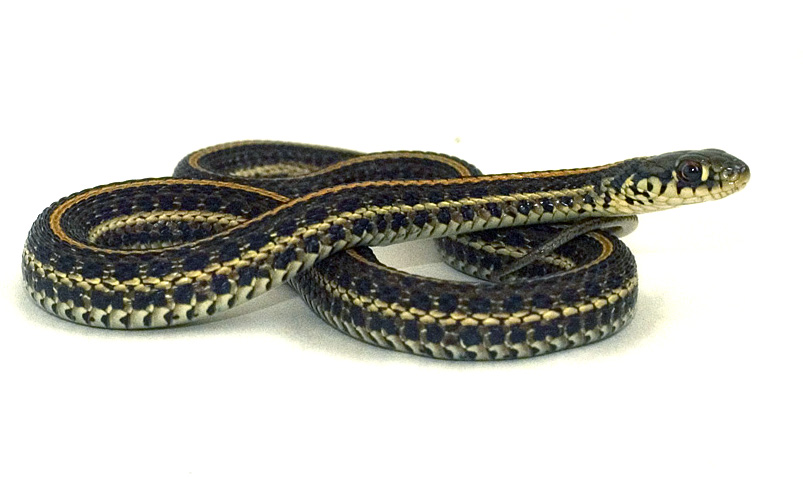
Yellow-throated Garter Snake

Yellow-throated Garter Snake

Thamnophis pulchrilatus

NS777, CC BY-SA 4.0, via Wikimedia Commons

Plains Garter Snake

Plains Garter Snake

Thamnophis radix

Thamnophis, CC BY-SA 3.0, via Wikimedia Commons

Side by side

Yellow-throated Garter SnakePlains Garter Snake
Scientific nameThamnophis pulchrilatus (Cope, 1885)Thamnophis radix (Baird & Girard, 1853)
English nameYellow-throated Garter SnakePlains Garter Snake
GroupReptilesReptiles
ClassReptilia ReptileReptilia Reptile
OrderSquamata SnakesSquamata Snakes
FamilyColubridae ColubridColubridae Colubrid
GenusThamnophis Garter SnakeThamnophis Garter Snake
Named in18851853
Red List categoryLeast ConcernLeast Concern
Countries on record1 country2 countries
GBIF occurrence records425 records14,658 records

Rows where the two agree are shown in grey.

Where each is found

Only Yellow-throated Garter Snake (1)

Only Plains Garter Snake (2)

From Catalogue of Life checklists and GBIF occurrence records. A country missing from a list means no record is held, which is not proof of absence.

Checked facts

Yellow-throated Garter SnakePlains Garter Snake
Appearance
  • The species has a dark brown or black dorsal surface with a yellow to light green stripe running along its spine. English Wikipedia
  • The species has a checkered yellow and black pattern along its sides. English Wikipedia
  • The species has a bright yellow throat. English Wikipedia
  • The species has a relatively slender and light build. English Wikipedia
SizeNo checked fact yet
Habitat
  • The species inhabits meadows and prairies near marshes, streams, and ponds. English Wikipedia
  • It occurs in grasslands near ponds, streams, marshes, and sloughs. animaldiversity.org
  • The species can inhabit swampy areas and riverbanks. animaldiversity.org
  • It can occur in vacant lots in suburban and urban areas. animaldiversity.org
  • In the Chicago area, individuals have been observed in abandoned buildings, trash heaps, and vacant lots. English Wikipedia
  • Individuals may use drier habitats when they occur alongside common garter snakes. animaldiversity.org
  • The species hibernates in burrows and rock crevices. animaldiversity.org
  • Hibernation sites can include rodent burrows, ant mounds, crayfish burrows, and artificial crevices. animaldiversity.org
Diet
  • Its diet includes earthworms, slugs, and small amphibians. English Wikipedia
  • The species has been recorded eating frogs, toads, salamanders, fish, birds, small rodents, leeches, earthworms, and grasshoppers. animaldiversity.org
  • Its recorded fish prey include mosquitofish, southern redbelly dace, and bluntnose minnows. animaldiversity.org
  • Recorded bird prey include bank swallows and eastern meadowlarks. animaldiversity.org
Behaviour
  • Some individuals respond defensively to blocked escape by forming body rings and tucking their heads away. English Wikipedia
  • Some individuals move the tips of their tails back and forth in the air during defensive displays. English Wikipedia
  • One observed individual flattened its body against the ground for approximately thirty seconds before attempting to escape. English Wikipedia
  • The species is active during the day when temperatures are warm. animaldiversity.org
  • Its daytime activity generally occurs at air temperatures between 21 and 29 degrees Celsius. animaldiversity.org
  • It switches to nighttime activity when air temperatures exceed 31 degrees Celsius. animaldiversity.org
  • Individuals may emerge from hibernation to bask during warm winter days. English Wikipedia
  • The species is active from March to November, depending on its geographic region. animaldiversity.org
  • Individuals are generally solitary except during mating interactions and communal hibernation. animaldiversity.org
  • Individuals may move no more than 76 meters over periods exceeding one year. animaldiversity.org
  • The species uses chemical trails to locate prey, mates, and hibernation sites. animaldiversity.org
  • When threatened, individuals may bite, release foul-smelling musk, or defecate. animaldiversity.org
  • The species is described as mildly venomous, with venom that is not toxic to humans. English Wikipedia
Reproduction
  • The species is ovoviviparous and gives birth to live young after the eggs hatch inside the mother. English Wikipedia
  • A documented pregnant female had a clutch of 15 eggs. English Wikipedia
  • The documented number of young produced in a reproductive event ranges from 7 to 15. English Wikipedia
Distribution
  • The species occurs across the central United States, extending north into Canada and south to Texas. English Wikipedia
  • Its documented Canadian range includes southern Alberta, Saskatchewan, and Manitoba. animaldiversity.org
  • Its documented United States range includes the Oklahoma panhandle, northern Texas, northeastern New Mexico, Minnesota, Wisconsin, and Indiana. animaldiversity.org
  • The species occurs at elevations from 400 to 7,500 feet. English Wikipedia
  • The species generally prefers elevations below 6,000 feet. English Wikipedia
Conservation
  • Habitat loss is identified as the main threat to the species. English Wikipedia
  • Urban development in the species' woodland and grassland habitats is identified as a cause of habitat loss. English Wikipedia
  • Deforestation and logging are identified as threats to the species' ecosystem. English Wikipedia
  • Agricultural development is also identified as a potential threat to the species. English Wikipedia
  • The species is listed as Least Concern by the IUCN. English Wikipedia
Similar species
  • The species has previously been treated as a synonym of Thamnophis cyrtopsis. English Wikipedia
  • The species has previously been treated as a synonym of Thamnophis eques. English Wikipedia
  • The species shares portions of its habitat with the common garter snake. English Wikipedia
  • The plains garter snake and common garter snake may hybridize where their ranges overlap. English Wikipedia
OtherNo checked fact yet

In brief

Yellow-throated Garter Snake

The Yellow-throated Garter Snake is a reptile in the family Colubridae, order Squamata, and class Reptilia. The species occurs in Mexico, mainly in wooded habitats, including oak and pine forests at high elevations. It is distinguished by a bright yellow throat, a yellow to light green dorsal stripe, and checkered yellow and black sides. Full profile

Plains Garter Snake

Thamnophis radix occurs across the central United States, extending north into Canada and south to Texas. It is distinguished by a yellow or orange stripe running along the middle of its back and distinctive black bars on its lips. Full profile

Compare something else

Page built on 29 November 2026 from the data on the two species pages, where every source is listed.

Cite this page

ScientificNames.org. (2026). Yellow-throated Garter Snake vs Plains Garter Snake. Retrieved November 29, 2026, from https://scientificnames.org/compare/yellow-throated-garter-snake-vs-plains-garter-snake