Species · Reptiles
Yellow-throated Garter Snake Thamnophis pulchrilatus
The scientific name of the Yellow-throated Garter Snake is Thamnophis pulchrilatus. It is a species of reptile in the family Colubridae (colubrid), order Squamata. The name dates from 1885.
- Scientific name
- Thamnophis pulchrilatus (Cope, 1885)
- Common name
- Yellow-throated Garter Snake
- Genus
- Thamnophis
- Family
- Colubridae (Colubrid)
- Order
- Squamata
- Class
- Reptilia
- Red List category
- LC Least Concern
- Recorded in
- 1 country
- Name status
- accepted in the Catalogue of Life

Overview
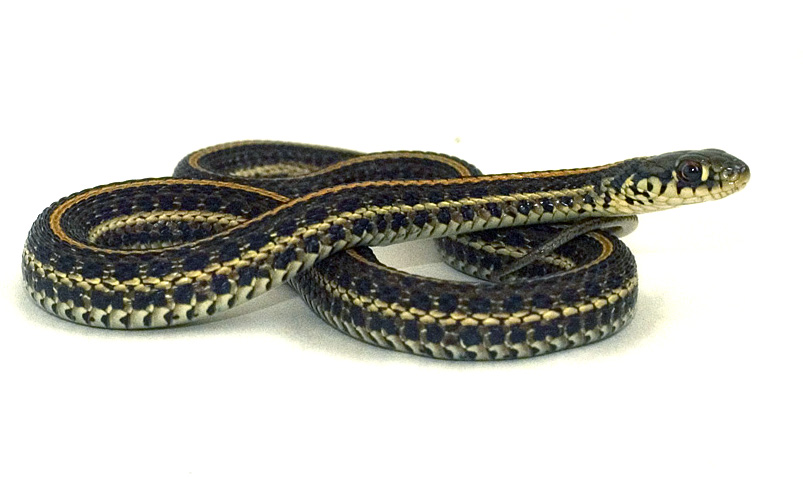
The Yellow-throated Garter Snake is a reptile in the family Colubridae, order Squamata, and class Reptilia. The species occurs in Mexico, mainly in wooded habitats, including oak and pine forests at high elevations. It is distinguished by a bright yellow throat, a yellow to light green dorsal stripe, and checkered yellow and black sides.
Written 27 November 2026 from the sources listed below. Each statement was checked against the passage it cites; statements that could not be supported were removed.
Similar species
The Yellow-throated Garter Snake has previously been treated as a synonym of Thamnophis cyrtopsis and Thamnophis eques.[1][2]
Appearance
The dorsal surface is dark brown or black, with a yellow to light green stripe running along the spine. The sides have a checkered yellow and black pattern, and the throat is bright yellow.[3][4][5]
The species has a relatively slender and light build. Recorded individuals have reached lengths of 46–91 cm.[6][7]
Habitat
The species occurs mainly in wooded habitats, including oak and pine forests at high elevations. It has occasionally been found in grassy fields.[8][9][10]
Diet
The species is believed to consume small fish, lizards, frogs, toads, and worms.[11][12][13][14][15]
A captured female regurgitated a mountain tree frog (Dryophytes eximius). Another captured individual was found to have eaten a Bell's false brook salamander (Isthmura belli).[16][17]
Behaviour
Some individuals respond defensively to blocked escape by forming body rings and tucking their heads away. Some also move the tips of their tails back and forth in the air during defensive displays.[18][19]
One observed individual flattened its body against the ground for approximately thirty seconds before attempting to escape.[20]
Reproduction and life cycle
The species is ovoviviparous, giving birth to live young after the eggs hatch inside the mother.[21]
A documented pregnant female had a clutch of 15 eggs. The documented number of young produced in a reproductive event ranges from 7 to 15.[22][23]
Conservation
The species is listed as Least Concern by the IUCN. Habitat loss is identified as its main threat.[24][25]
Urban development in woodland and grassland habitats, deforestation, and logging are identified as threats. Agricultural development is also identified as a potential threat.[26][27][28]
Classification of the Yellow-throated Garter Snake
| Kingdom | Animalia |
|---|---|
| Phylum | Chordata |
| Subphylum | Vertebrata |
| Infraphylum | Gnathostomata |
| Parvphylum | Osteichthyes |
| Megaclass | Tetrapoda |
| Class | Reptilia (Reptile) |
| Order | Squamata (Snakes) |
| Suborder | Serpentes (Snakes) |
| Infraorder | Alethinophidia |
| Family | Colubridae (Colubrid) |
| Subfamily | Natricinae |
| Genus | Thamnophis (Garter Snake) |
| Species | Thamnophis pulchrilatus (Cope, 1885) |
Where the Yellow-throated Garter Snake is found
Checklists and occurrence records place Thamnophis pulchrilatus in 1 country across North America. GBIF holds 425 georeferenced records of it.
Countries
Regions and cities with the most records
- México, Mexico 102
- Michoacán, Mexico 51
- Magdalena Contreras, Mexico 46
- Coyoacán, Mexico 44
- Tlalpan, Mexico 43
- San Miguel Ajusco, Mexico 42
- San Miguel Topilejo, Mexico 41
- Xochimilco, Mexico 41
- Benito Juarez, Mexico 39
- Delegación Cuajimalpa de Morelos, Mexico 37
- Jesús del Monte, Mexico 36
- Huixquilucan, Mexico 32
- Miguel Hidalgo, Mexico 32
- San Pablo Oztotepec, Mexico 32
- Azcapotzalco, Mexico 30
- Iztapalapa, Mexico 30
- Cuauhtémoc, Mexico 28
- Durango, Mexico 27
- Aguascalientes, Mexico 26
- Melchor Ocampo, Mexico 26
- Mexico City, Mexico 25
- Naucalpan de Juárez, Mexico 25
- Cuautitlán Izcalli, Mexico 24
- Jalisco, Mexico 24
- Cuautitlán, Mexico 23
- Gustavo Adolfo Madero, Mexico 23
- Iztacalco, Mexico 23
- Tultepec, Mexico 23
- Buenavista, Mexico 22
- Santiago Teyahualco, Mexico 22
- Tultitlán de Mariano Escobedo, Mexico 22
- Ciudad López Mateos, Mexico 21
- Fuentes del Valle, Mexico 21
- Tlalnepantla, Mexico 21
- Ampliación San Mateo, Mexico 20
- Puebla, Mexico 20
Range as the checklists state it
Mexico (Quéretaro, Durango, Nuevo León, Tamaulipas, Jalisco, Nayarit, Hidalgo, Oaxaca, Guanajuato, Michoacan, Puebla, Aguascalientes, Veracruz, Zacatecas)
A number beside a place is its count of GBIF occurrence records. A place without a number comes from a checklist alone. Records show where a species has been observed or collected, which can include escapes and vagrants.
Common names
English
- Yellow-throated Garter Snake
- Mexican Highlands Garter Snake
- Yellow-throated Gartersnake
Names in 4 other languages
- Danish
- Gulstrubet Strømpebåndssnog
- German
- Gelbhals-Strumpfbandnatter
- Portuguese
- Cobra-liga-de-garganta-amarela
- Spanish
- Culebra listonada de tierras altas Mexicana, Culebra-listonada de tierras altas-mexicana, Jarretera Mexicana del Altiplano, culebra semiacuática de garganta amarilla
Synonyms
One other scientific name has been used for this species and is now treated as a synonym of Thamnophis pulchrilatus.
- Eutaenia pulchrilatus Cope, 1885
Related species
-
 Common Garter SnakeThamnophis sirtalis
-
 Common Ribbon SnakeThamnophis saurita
-
 Checkered Garter SnakeThamnophis marcianus
-
 Plains Garter SnakeThamnophis radix
-
 Western Ribbon SnakeThamnophis proximus
-
 Western Terrestrial Garter SnakeThamnophis elegans
-
 Giant Garter SnakeThamnophis gigas
-
 Mexican Garter SnakeThamnophis eques
Compare
Questions and answers
What is the scientific name of the Yellow-throated Garter Snake?
The scientific name of the Yellow-throated Garter Snake is Thamnophis pulchrilatus. Written with its author, the full name is Thamnophis pulchrilatus (Cope, 1885).
Which family does the Yellow-throated Garter Snake belong to?
Thamnophis pulchrilatus belongs to the family Colubridae, in the order Squamata and the class Reptilia.
Where is the Yellow-throated Garter Snake found?
Checklists and occurrence records place Thamnophis pulchrilatus in 1 country: Mexico.
What is the conservation status of the Yellow-throated Garter Snake?
The IUCN Red List category recorded for Thamnophis pulchrilatus is Least Concern (LC).
What other names does the Yellow-throated Garter Snake have?
Thamnophis pulchrilatus is also known in English as Mexican Highlands Garter Snake and Yellow-throated Gartersnake.
What type of habitat do garter snakes live in?
The Yellow-throated Garter Snake occurs mainly in wooded habitats, including oak and pine forests at high elevations. It has occasionally been found in grassy fields.[8][9][10]
Sources
Passages the profile rests on
- The species has previously been treated as a synonym of Thamnophis cyrtopsis. Source passage: “This species has been considered a synonym of Thamnophis cyrtopsis or of Thamnophis eques.” — English Wikipedia
- The species has previously been treated as a synonym of Thamnophis eques. Source passage: “This species has been considered a synonym of Thamnophis cyrtopsis or of Thamnophis eques.” — English Wikipedia
- The species has a dark brown or black dorsal surface with a yellow to light green stripe running along its spine. Source passage: “having a dark brown or black dorsal side accented with a yellow to light green stripe along the spine.” — English Wikipedia
- The species has a checkered yellow and black pattern along its sides. Source passage: “A checkered yellow and black pattern can be observed along the sides” — English Wikipedia
- The species has a bright yellow throat. Source passage: “the throat of the snake is bright yellow.” — English Wikipedia
- The species has a relatively slender and light build. Source passage: “Thamnophis pulchrilatus are relatively slender and light snakes.” — English Wikipedia
- Recorded individuals have reached lengths of 46–91 cm. Source passage: “it has been observed to reach lengths of 18–36 in (46–91 cm).” — English Wikipedia
- The species occurs mainly in wooded habitats. Source passage: “It is found mainly in wooded areas” — English Wikipedia
- The species inhabits oak and pine forests at high elevations. Source passage: “specifically oak and pine forests at high elevations” — English Wikipedia
- The species has occasionally been found in grassy fields. Source passage: “but has occasionally been found in grassy fields as well.” — English Wikipedia
- The species is believed to consume small fish. Source passage: “These snakes are believed to eat small fish, lizards, frogs, toads, and even worms.” — English Wikipedia
- The species is believed to consume lizards. Source passage: “These snakes are believed to eat small fish, lizards, frogs, toads, and even worms.” — English Wikipedia
- The species is believed to consume frogs. Source passage: “These snakes are believed to eat small fish, lizards, frogs, toads, and even worms.” — English Wikipedia
- The species is believed to consume toads. Source passage: “These snakes are believed to eat small fish, lizards, frogs, toads, and even worms.” — English Wikipedia
- The species is believed to consume worms. Source passage: “These snakes are believed to eat small fish, lizards, frogs, toads, and even worms.” — English Wikipedia
- A captured female regurgitated a mountain tree frog (Dryophytes eximius). Source passage: “the first involved a captured female that regurgitated a mountain tree frog (Dryophytes eximius)” — English Wikipedia
- A captured individual was found to have eaten a Bell's false brook salamander (Isthmura belli). Source passage: “the second was a captured snake that was discovered to have eaten a Bell's false brook salamander (Isthmura belli).” — English Wikipedia
- Some individuals respond defensively to blocked escape by forming body rings and tucking their heads away. Source passage: “which involved forming rings with the body and tucking the head away” — English Wikipedia
- Some individuals move the tips of their tails back and forth in the air during defensive displays. Source passage: “while moving the tip of the tail back and forth in the air.” — English Wikipedia
- One observed individual flattened its body against the ground for approximately thirty seconds before attempting to escape. Source passage: “A third individual flattened its body to the ground for around thirty seconds before making a dash for escape.” — English Wikipedia
- The species is ovoviviparous and gives birth to live young after the eggs hatch inside the mother. Source passage: “They are known to be ovoviviparous, meaning the young hatch from their eggs inside the mother and are birthed live.” — English Wikipedia
- A documented pregnant female had a clutch of 15 eggs. Source passage: “capture a pregnant female and determine that her clutch consisted of 15 eggs” — English Wikipedia
- The documented number of young produced in a reproductive event ranges from 7 to 15. Source passage: “the known amount of young hatched at a time to reach from 7-15.” — English Wikipedia
- Habitat loss is identified as the main threat to the species. Source passage: “The main threat that the yellow-throated garter snake faces is habitat loss through a variety of different avenues.” — English Wikipedia
- The species is listed as Least Concern by the IUCN. Source passage: “they are currently listed as Least Concern by the IUCN.” — English Wikipedia
- Urban development in the species' woodland and grassland habitats is identified as a cause of habitat loss. Source passage: “One way is urban development of the woodlands and grasslands where they live.” — English Wikipedia
- Deforestation and logging are identified as threats to the species' ecosystem. Source passage: “Another is deforestation and logging of their ecosystem.” — English Wikipedia
- Agricultural development is also identified as a potential threat to the species. Source passage: “Agricultural development can also cause issues for these snakes” — English Wikipedia
Data
- Catalogue of Life, 2026-10-16 XR cc by
- Global Biodiversity Information Facility CC BY 4.0
- Wikidata CC0
- GeoNames CC BY 4.0
- Wikimedia Commons per image; credit shown with each image
- Within the Catalogue of Life, this name comes from The Reptile Database cc by
References
- Cope, E. D. (1885). Twelfth contribution to the herpetology of tropical America. Proc. Amer. Philos. Soc. 22: 167-194 [1884].
- Cope, E. D. (1900). The crocodilians, lizards and snakes of North America. Ann. Rep. U.S. Natl. Mus. 1898: 153-1270.
- Webb, R. G. (1984). Herpetogeography in the Mazatlán-Durango Region of the Sierra Madre Occidental, Mexico. Vetrebrate Ecology and Systematics - A Ribute to Henry S. Fitch; Museum of Natural History, University of Kansas, Lawrence, Pp. 217-241.
- Rossman, Douglas A.; Ford, Neil B. & Seigel, Richard A. (1996). The Garter Snakes: Evolution and Ecology. University of Oklahoma Press, Norman, OK, Xx + 332 + Pp.
- Liner, Ernest A. (2007). A CHECKLIST OF THE AMPHIBIANS AND REPTILES OF MEXICO. Louisiana State University Occasional Papers of the Museum of Natural Science 80: 1-60.
- Dixon, James R. and Julio A. Lemos-Espinal. (2010). Amphibians and reptiles of the state of Queretaro, Mexico. Tlalnepantla UNAM, 428 Pp.
- Valdez-Lares, R.; R. Muñiz-Martínez; E.Gadsden; G. Aguirre-León; G. Castañeda-Gaytán; R. Gonzalez-Trápaga. (2013). Checklist of amphibians and reptiles of the state of Durango, México. Check List 9 (4):714-724.
- Wallach, Van; Kenneth L. Williams, Jeff Boundy. (2014). Snakes of the World: A Catalogue of Living and Extinct Species. [type catalogue]. Taylor and Francis, CRC Press, 1237 Pp.
- Carbajal-Márquez, Rubén A., Zaira Y. González-Saucedo and Gustavo E. Quintero-Díaz. (2014). Thamnophis pulchrilatus (yellow-throated gartersnake) diet and defensive behavior. Herpetological Review 45 (2): 344-345.
- Woolrich-Piña, Guillermo A, Paulino Ponce-Campos, Jesús Loc-Barragán, Juan Pablo Ramírez-Silva, Vicente Mata-Silva, Jerry D. Johnson, Elí García-Padilla and Larry David Wilson. (2016). The herpetofauna of Nayarit, Mexico: composition, distribution, and conservation status. Mesoamerican Herpetology 3 (2): 376-448.
- Lemos-Espinal JA, Smith GR, & Cruz A. (2016). Amphibians and Reptiles of the state of Nuevo León, Mexico. ZooKeys 594: 123-141, Doi: 10.3897/Zookeys.594.8289.
- Terán-Juárez, Sergio A., Elí García Padilla, Vicente Mata-Silva, Jerry D. Johnson and Larry David Wilson. (2016). The herpetofauna of Tamaulipas, Mexico: composition, distribution, and conservation status. Mesoamerican Herpetology 3 (1): 43–113.
- Fernández-Badillo, Leonardo, Cristián R. Olvera-Olvera, Sharon Y. Valdez-Rentería, Ferdinand Torres-Ángeles and Irene Goyenechea. (2016). New records of Thamnophis pulchrilatus (Squamata: Natricidae) from the state of Hidalgo, Mexico. Mesoamerican Herpetology 3 (2): 519-523.
- Nevárez-de-los-Reyes, Manuel, David Lazcano, Elí García-Padilla, Vicente Mata-Silva, Jerry D. Johnson and Larry David Wilson. (2016). The Herpetofauna of Nuevo León, Mexico: Composition, Distribution, and Conservation. Mesoamerican Herpetology 3 (3): 558–638.
- Carbajal-Márquez, Rubén A. and Gustavo E. Quintero-Díaz. (2016). The Herpetofauna of Aguascalientes, México. Revista Mexicana de Herpetología 2(1):
- Heimes, P. (2016). Snakes of Mexico. Chimaira, Frankfurt, 572 Pp.
- Woolrich-Piña, G. A., E. García-Padilla, D. L. DeSantis, J. D. Johnson, V. Mata-Silva, and L. D. Wilson. (2017). The herpetofauna of Puebla, Mexico: composition, distribution, and conservation status. Mesoamerican Herpetology 4 (4): 791–884.
- Fernández-Badillo, L., J. L. Jiménez-Villegas, G. T. González-Bonilla, N. Morales-Capellán, A. H. Tepango-Benítez, M. B. Ramírez-Cruz, and D. A. Hernández-Silva. (2017). Thamnophis pulchrilatus (Cope, 1885). Mexico, Hidalgo. Mesoamerican Herpetology 4 (4): 966–967.
- Lemos-Espinal JA, Smith GR, Gadsden-Esparza H, Valdez-Lares R, & Woolrich-Piña GA. (2018). Amphibians and reptiles of the state of Durango, Mexico, with comparisons with adjoining states. ZooKeys 748: 65-87.
- Fraustros-Sandoval, Armando de Jesús; Aldo Dávalos-Martínez, Verónica Carolina Rosas-Espinoza, Ana Luisa Santiago-Pérez, Paulino Ponce-Campos, Eliezer Iñiguez-Ochoa. (2019). First record of the predation on Bell’s False Brook Salamander Isthmura belli (Gray, 1850) by the Yellow-throated Gartersnake Thamnophis pulchrilatus (Cope, 1885) in Western Mexico. Herpetology Notes 12: 721-723.
- Lemos-Espinal JA, & Smith GR. (2020). A conservation checklist of the amphibians and reptiles of the State of Mexico, Mexico with comparisons with adjoining states. ZooKeys 953: 137-159.
- Lemos-Espinal JA, & Smith GR. (2020). A conservation checklist of the amphibians and reptiles of Mexico City, with comparisons with adjoining states. ZooKeys 951: 109-131.
- Torres-Hernández, LA, Ramírez-Bautista A, Cruz-Elizalde R, Hernández-Salinas U, Berriozabal-Islas C, DeSantis DL, Johnson JD, Rocha A, García-Padilla E, Mata-Silva V, Fucsko LA, and Wilson LD. (2021). The herpetofauna of Veracruz, Mexico: composition, distribution, and conservation status. Amphibian & Reptile Conservation 15(2) [General Section]: 72–155.
- HALLAS, JOSHUA M.; THOMAS L. PARCHMAN & CHRIS R. FELDMAN. (2021). Phylogenomic analyses resolve relationships among garter snakes (Thamnophis: Natricinae: Colubridae) and elucidate biogeographic history and morphological evolution. Molecular Phylogenetics and Evolution 107374. [2022 in Print].
- Leyte-Manrique A, Mata-Silva V, Báez-Montes O, Fucsko LA, DeSantis DL, García-Padilla E, Rocha A, Johnson JD, Porras LW, Wilson LD. (2022). The herpetofauna of Guanajuato, Mexico: composition, distribution, and conservation status. Amphibian & Reptile Conservation 16(2) [General Section: 133–180 (E321).
This species in other databases
Page built on 28 November 2026. See how the catalog is made and all sources and licences.
Cite this page
ScientificNames.org. (2026). Thamnophis pulchrilatus (Yellow-throated Garter Snake). Retrieved November 28, 2026, from https://scientificnames.org/species/thamnophis-pulchrilatus
“Thamnophis pulchrilatus (Yellow-throated Garter Snake).” ScientificNames.org, 2026, scientificnames.org/species/thamnophis-pulchrilatus. Accessed 28 Nov. 2026.
ScientificNames.org. “Thamnophis pulchrilatus (Yellow-throated Garter Snake).” Accessed November 28, 2026. https://scientificnames.org/species/thamnophis-pulchrilatus.
@misc{scientificnames_thamnophis_pulchrilatus_yellow_throated_garter_snake,
  author = {{ScientificNames.org}},
  title = {Thamnophis pulchrilatus (Yellow-throated Garter Snake)},
  year = {2026},
  url = {https://scientificnames.org/species/thamnophis-pulchrilatus},
  note = {Accessed 2026-11-28}
}