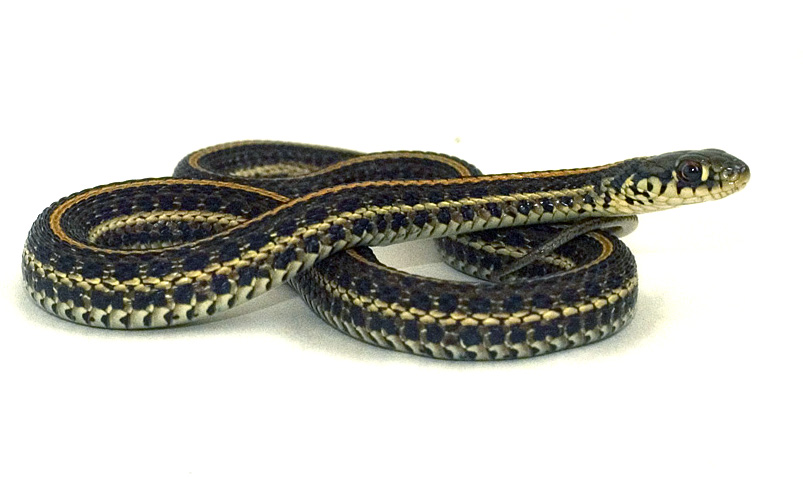
| Appearance | | - The species has a slender body and a very long tail. English Wikipedia
- The tail accounts for approximately one-third of the snake's total length. English Wikipedia
- Its dorsal coloration can be blackish, brown, or olive, with three light-colored stripes. English Wikipedia
- Its underside is greenish-white or yellowish-white. English Wikipedia
- Its upper lip scales are whitish and unmarked, contrasting with the dark upper and lateral surfaces of its head. English Wikipedia
- The scales on its back have a raised ridge along their middle. herpneb.unl.edu
- A light stripe runs along each side of its body from head to tail, across the third and fourth scale rows above the belly scales. herpneb.unl.edu
- Its lip scales lack black stripes. herpneb.unl.edu
- A thin orange stripe extends along the middle of its back from head to tail. herpneb.unl.edu
|
|---|
| Size | No checked fact yet | |
|---|
| Habitat | - The species inhabits meadows and prairies near marshes, streams, and ponds. English Wikipedia
- It occurs in grasslands near ponds, streams, marshes, and sloughs. animaldiversity.org
- The species can inhabit swampy areas and riverbanks. animaldiversity.org
- It can occur in vacant lots in suburban and urban areas. animaldiversity.org
- In the Chicago area, individuals have been observed in abandoned buildings, trash heaps, and vacant lots. English Wikipedia
- Individuals may use drier habitats when they occur alongside common garter snakes. animaldiversity.org
- The species hibernates in burrows and rock crevices. animaldiversity.org
- Hibernation sites can include rodent burrows, ant mounds, crayfish burrows, and artificial crevices. animaldiversity.org
| - It occurs in brush-heavy habitats near streams, ponds, and lakes. animaldiversity.org
- It can inhabit sandy, relatively dry areas provided they are close to water. animaldiversity.org
- Individuals have been observed basking on rocks and flat vegetation. animaldiversity.org
- The species can occur from sea level to elevations approaching 2,500 m. English Wikipedia
- It can inhabit roadside and agricultural ditches that retain water for extended periods. herpneb.unl.edu
|
|---|
| Diet | - Its diet includes earthworms, slugs, and small amphibians. English Wikipedia
- The species has been recorded eating frogs, toads, salamanders, fish, birds, small rodents, leeches, earthworms, and grasshoppers. animaldiversity.org
- Its recorded fish prey include mosquitofish, southern redbelly dace, and bluntnose minnows. animaldiversity.org
- Recorded bird prey include bank swallows and eastern meadowlarks. animaldiversity.org
| - Its documented prey includes earthworms, crayfish, lizards, fish, and frogs. English Wikipedia
- Amphibians account for approximately 80–92% of its diet in reported studies. animaldiversity.org
- Its additional food items include fish, snails, eggs, crustaceans, and occasionally small mammals. animaldiversity.org
- The size of prey consumed varies with the snake's body size. animaldiversity.org
|
|---|
| Behaviour | - The species is active during the day when temperatures are warm. animaldiversity.org
- Its daytime activity generally occurs at air temperatures between 21 and 29 degrees Celsius. animaldiversity.org
- It switches to nighttime activity when air temperatures exceed 31 degrees Celsius. animaldiversity.org
- Individuals may emerge from hibernation to bask during warm winter days. English Wikipedia
- The species is active from March to November, depending on its geographic region. animaldiversity.org
- Individuals are generally solitary except during mating interactions and communal hibernation. animaldiversity.org
- Individuals may move no more than 76 meters over periods exceeding one year. animaldiversity.org
- The species uses chemical trails to locate prey, mates, and hibernation sites. animaldiversity.org
- When threatened, individuals may bite, release foul-smelling musk, or defecate. animaldiversity.org
- The species is described as mildly venomous, with venom that is not toxic to humans. English Wikipedia
| - The species is most active during daylight or warm periods. animaldiversity.org
- It can remain active at temperatures ranging from 4 to 42 degrees Celsius, with a preferred range of 22–26 degrees Celsius. animaldiversity.org
- When disturbed, individuals may dive into water or hide in thick brush and crevices. animaldiversity.org
- Individuals in areas with changeable seasons may hibernate in rocky outcroppings, sometimes alongside other species. animaldiversity.org
|
|---|
| Reproduction | | |
|---|
| Distribution | - The species occurs across the central United States, extending north into Canada and south to Texas. English Wikipedia
- Its documented Canadian range includes southern Alberta, Saskatchewan, and Manitoba. animaldiversity.org
- Its documented United States range includes the Oklahoma panhandle, northern Texas, northeastern New Mexico, Minnesota, Wisconsin, and Indiana. animaldiversity.org
- The species occurs at elevations from 400 to 7,500 feet. English Wikipedia
- The species generally prefers elevations below 6,000 feet. English Wikipedia
| - The species occurs in the central and southern United States, Mexico, and Central America as far south as central Costa Rica. English Wikipedia
|
|---|
| Conservation | | - The species is listed as a State Endangered Species in Wisconsin. apps.dnr.wi.gov
|
|---|
| Uses | No checked fact yet | - The species helps control pest populations by consuming insects and amphibians. animaldiversity.org
|
|---|
| Similar species | - The species shares portions of its habitat with the common garter snake. English Wikipedia
- The plains garter snake and common garter snake may hybridize where their ranges overlap. English Wikipedia
| - The Western Ribbon Snake is frequently confused with the Eastern Ribbon Snake because of their similar appearance and coloration. animaldiversity.org
- The Western Ribbon Snake differs from the Eastern Ribbon Snake in having reduced or absent broad brown ventrolateral stripes. animaldiversity.org
- The Western Ribbon Snake has larger paired parietal spots and a longer muzzle and tail than the Eastern Ribbon Snake. animaldiversity.org
|
|---|
| Other | No checked fact yet | |
|---|