Species · Reptiles
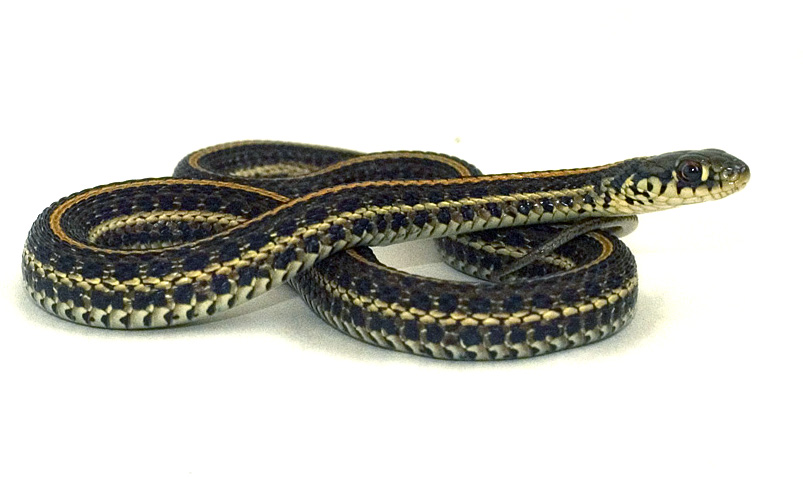
Western Ribbon Snake Thamnophis proximus
The scientific name of the Western Ribbon Snake is Thamnophis proximus. It is a species of reptile in the family Colubridae (colubrid), order Squamata. The name dates from 1823.
- Scientific name
- Thamnophis proximus (Say, 1823)
- Common name
- Western Ribbon Snake
- Genus
- Thamnophis
- Family
- Colubridae (Colubrid)
- Order
- Squamata
- Class
- Reptilia
- Red List category
- LC Least Concern
- Recorded in
- 8 countries
- Name status
- accepted in the Catalogue of Life

Overview
Thamnophis proximus occurs in the central and southern United States, Mexico, and Central America as far south as central Costa Rica. It has a slender body, a very long tail, and three light-colored stripes on its back and sides.
Written 26 November 2026 from the sources listed below. Each statement was checked against the passage it cites; statements that could not be supported were removed.
Appearance
The Western ribbon snake has a slender body and a very long tail that accounts for approximately one-third of its total length. Adults measure approximately 43–127 cm in total length, including the tail, and newborn individuals measure approximately 20 cm.[1][2][3][4]
Its dorsal coloration can be blackish, brown, or olive, with three light-colored stripes. A thin orange stripe runs along the middle of its back, while a light stripe extends along each side from head to tail across the third and fourth scale rows above the belly scales.[5][6][7]
Its underside is greenish-white or yellowish-white. The upper lip scales are whitish and unmarked, contrasting with the dark upper and lateral surfaces of the head, and the lip scales lack black stripes. The scales on its back have a raised ridge along their middle.[8][9][10][11]
Habitat
The Western ribbon snake occurs in brush-heavy habitats near streams, ponds, and lakes. It can also inhabit sandy, relatively dry areas provided they are close to water.[12][13]
It can inhabit roadside and agricultural ditches that retain water for extended periods. Its occurrence ranges from sea level to elevations approaching 2,500 m.[14][15]
Individuals have been observed basking on rocks and flat vegetation.[16]
Diet
Documented prey includes earthworms, crayfish, lizards, fish, and frogs. Additional food items include snails, eggs, crustaceans, and occasionally small mammals.[17][18]
Amphibians account for approximately 80–92% of its diet in reported studies. The size of prey consumed varies with the snake's body size.[19][20]
Behaviour
The Western ribbon snake is most active during daylight or warm periods. It can remain active at temperatures ranging from 4 to 42 degrees Celsius, with a preferred range of 22–26 degrees Celsius.[21][22]
When disturbed, individuals may dive into water or hide in thick brush and crevices. In areas with changeable seasons, they may hibernate in rocky outcroppings, sometimes alongside other species.[23][24]
Reproduction and life cycle
The Western ribbon snake gives birth to live young. Its reproductive activity is greatest during spring, although the precise breeding season is unknown.[25][26]
Males follow females using their scent before copulation. Females may be gravid as early as April, and births generally occur between June and mid-September.[27][28][29]
Females produce between three and 21 offspring per birth. Offspring have a reported mean length ranging from 16 to 28 cm.[30][31]
Similar species
The Western ribbon snake is frequently confused with the Eastern Ribbon Snake because of their similar appearance and coloration. It differs in having reduced or absent broad brown ventrolateral stripes.[32][33]
The Western ribbon snake has larger paired parietal spots and a longer muzzle and tail than the Eastern Ribbon Snake.[34]
Conservation
The Western ribbon snake is listed as a State Endangered Species in Wisconsin.[35]
Uses
The Western ribbon snake helps control pest populations by consuming insects and amphibians.[36]
Classification of the Western Ribbon Snake
| Kingdom | Animalia |
|---|---|
| Phylum | Chordata |
| Subphylum | Vertebrata |
| Infraphylum | Gnathostomata |
| Parvphylum | Osteichthyes |
| Megaclass | Tetrapoda |
| Class | Reptilia (Reptile) |
| Order | Squamata (Snakes) |
| Suborder | Serpentes (Snakes) |
| Infraorder | Alethinophidia |
| Family | Colubridae (Colubrid) |
| Subfamily | Natricinae |
| Genus | Thamnophis (Garter Snake) |
| Species | Thamnophis proximus (Say, 1823) |
Where the Western Ribbon Snake is found
Checklists and occurrence records place Thamnophis proximus in 8 countries. GBIF holds 25,874 georeferenced records of it.
Countries
- Belize 37
- Costa Rica 52
- El Salvador 8
- Guatemala 32
- Honduras 59
- Mexico 1,954
- Nicaragua 46
- United States 23,686
Regions and cities with the most records
- Texas, United States 12,754
- Louisiana, United States 2,200
- Oklahoma, United States 1,653
- Kansas, United States 780
- Austin, United States 748
- Missouri City, United States 699
- Stafford, United States 699
- Mission Bend, United States 585
- Sugar Land, United States 568
- Arkansas, United States 556
- Pecan Grove, United States 520
- Grapevine, United States 502
- Shenandoah, United States 494
- New Territory, United States 477
- Brushy Creek, United States 419
- Baton Rouge, United States 393
- Rosenberg, United States 388
- Southlake, United States 384
- Cedar Park, United States 376
- Round Rock, United States 375
- Houston, United States 373
- Highland Village, United States 367
- Cinco Ranch, United States 362
- Estelle, United States 362
- Marrero, United States 355
- Euless, United States 352
- Harvey, United States 348
- Haltom City, United States 347
- Little Elm, United States 344
- Colleyville, United States 341
- Bedford, United States 339
- Central, United States 338
- Corinth, United States 337
- New Orleans, United States 336
- Gretna, United States 335
- Terrytown, United States 335
Range as the checklists state it
C USA (incl. Illinois, Iowa, Indiana, Oklahoma, Wisconsin, Kansas, Tennessee, Nebraska, Louisiana, Mississippi, Colorado, New Mexico),
A number beside a place is its count of GBIF occurrence records. A place without a number comes from a checklist alone. Records show where a species has been observed or collected, which can include escapes and vagrants.
Common names
English
- Western Ribbon Snake
- Western Ribbonsnake
Names in 10 other languages
- Chinese
- 西部束帶蛇
- Danish
- Vestlig Båndssnog
- French
- Couleuvre mince de l’Ouest
- German
- Westliche Bänder-Strumpfbandnatter, Westliche Bändernatter, Westliche Streifenstrumpfbandnatter
- Italian
- Serpente giarrettiera occidentale
- Norwegian Bokmål
- rødsidet strømpebandsnok
- Portuguese
- Cobra-fita-ocidental
- Russian
- Западная подвязочная змея Сая
- Spanish
- Culebra acuática centroamericana, Culebra-listonada occidental, Jarretera Occidental, culebra listonada occidental
- Swedish
- rödsidig strumpebandssnok, västlig sidenbandssnok
Synonyms
4 other scientific names have been used for this species and are now treated as synonyms of Thamnophis proximus.
- Coluber proximus Say, 1823
- Eutaenia rutiloris Cope, 1885
- Eutainia faireyi Baird & Girard, 1853
- Thamnophis sauritus proximus (Say in James, 1823)
Subspecies and varieties
- Thamnophis proximus alpinus (Chiapas Highland Ribbon Snake) subspecies
- Thamnophis proximus diabolicus (Arid Land Ribbon Snake) subspecies
- Thamnophis proximus orarius (Gulf Coast Ribbon Snake) subspecies
- Thamnophis proximus proximus (Western Ribbon Snake) subspecies
- Thamnophis proximus rubrilineatus (Redstripe Ribbon Snake) subspecies
- Thamnophis proximus rutiloris (Central American Ribbon Snake) subspecies
Related species
-
 Common Garter SnakeThamnophis sirtalis
-
 Common Ribbon SnakeThamnophis saurita
-
 Checkered Garter SnakeThamnophis marcianus
-
 Plains Garter SnakeThamnophis radix
-
 Western Terrestrial Garter SnakeThamnophis elegans
-
 Giant Garter SnakeThamnophis gigas
-
 Mexican Garter SnakeThamnophis eques
-
 Northwestern Garter SnakeThamnophis ordinoides
Compare
Questions and answers
What is the scientific name of the Western Ribbon Snake?
The scientific name of the Western Ribbon Snake is Thamnophis proximus. Written with its author, the full name is Thamnophis proximus (Say, 1823).
Which family does the Western Ribbon Snake belong to?
Thamnophis proximus belongs to the family Colubridae, in the order Squamata and the class Reptilia.
Where is the Western Ribbon Snake found?
Checklists and occurrence records place Thamnophis proximus in 8 countries, including United States, Mexico, Honduras, Costa Rica, Nicaragua and Belize.
What is the conservation status of the Western Ribbon Snake?
The IUCN Red List category recorded for Thamnophis proximus is Least Concern (LC).
What other names does the Western Ribbon Snake have?
Thamnophis proximus is also known in English as Western Ribbonsnake.
How poisonous is a ribbon snake?
The Western ribbon snake is non-venomous and is not lethal to humans.[37]
What do western ribbon snakes eat?
Their documented prey includes earthworms, crayfish, lizards, fish, and frogs. They also eat snails, eggs, crustaceans, and occasionally small mammals.[17][18]
What to feed a ribbon snake?
Documented food items include earthworms, crayfish, lizards, fish, frogs, snails, eggs, and crustaceans.[17][18]
Where are ribbon snakes native to?
The Western ribbon snake occurs in the central and southern United States, Mexico, and Central America as far south as central Costa Rica.[38]
Is Western Ribbon Snake venomous?
The Western ribbon snake is non-venomous and is not lethal to humans.[37]
Sources
Passages the profile rests on
- The species has a slender body and a very long tail. Source passage: “T. proximus is a slender snake with a very long tail” — English Wikipedia
- The tail accounts for approximately one-third of the snake's total length. Source passage: “approximately one-third of the total length of the body.” — English Wikipedia
- Adults measure approximately 43–127 cm in total length, including the tail. Source passage: “Adults measure 17–50 in (43–127 cm) in total length (including the tail).” — English Wikipedia
- Newborn individuals measure approximately 20 cm in length. Source passage: “which are relatively small compared to adults (around 20 cm).” — animaldiversity.org
- Its dorsal coloration can be blackish, brown, or olive, with three light-colored stripes. Source passage: “Dorsally, T. proximus is blackish, brown, or olive with three light-colored stripes.” — English Wikipedia
- A light stripe runs along each side of its body from head to tail, across the third and fourth scale rows above the belly scales. Source passage: “Lightly colored stripe on each side of the snake that runs head to tail on the 3rd and 4th scale rows above the belly scales (ventral scales)” — herpneb.unl.edu
- A thin orange stripe extends along the middle of its back from head to tail. Source passage: “Thin orange stripe extending from the head to the tail down the middle of the back” — herpneb.unl.edu
- Its underside is greenish-white or yellowish-white. Source passage: “Ventrally, it is greenish-white or yellowish-white.” — English Wikipedia
- Its upper lip scales are whitish and unmarked, contrasting with the dark upper and lateral surfaces of its head. Source passage: “The upper labials are whitish and unmarked, contrasting with the dark top and sides of the head.” — English Wikipedia
- The scales on its back have a raised ridge along their middle. Source passage: “Scales on the back have a ridge in the middle (keeled)” — herpneb.unl.edu
- Its lip scales lack black stripes. Source passage: “Lacks black stripes on the lip scales (labial scales)” — herpneb.unl.edu
- It occurs in brush-heavy habitats near streams, ponds, and lakes. Source passage: “usually around brush-heavy areas with bodies of water like streams, ponds, lakes, etc.” — animaldiversity.org
- It can inhabit sandy, relatively dry areas provided they are close to water. Source passage: “or in sandy, drier areas that are also close to water.” — animaldiversity.org
- The species can occur from sea level to elevations approaching 2,500 m. Source passage: “It can be found from sea level to nearly 2,500 m (8,200 ft).” — English Wikipedia
- It can inhabit roadside and agricultural ditches that retain water for extended periods. Source passage: “Roadside and agricultural ditches if they hold water for extended periods” — herpneb.unl.edu
- Individuals have been observed basking on rocks and flat vegetation. Source passage: “basking on rocks or flat vegetation” — animaldiversity.org
- Its documented prey includes earthworms, crayfish, lizards, fish, and frogs. Source passage: “It feeds on a range of invertebrates (earthworms, crayfish) and small vertebrates (lizards, fishes, and frogs, including tadpoles).” — English Wikipedia
- Its additional food items include fish, snails, eggs, crustaceans, and occasionally small mammals. Source passage: “Thamnophis proximus will consume fish, snails, eggs that they find, crustaceans, and rarely small mammals.” — animaldiversity.org
- Amphibians account for approximately 80–92% of its diet in reported studies. Source passage: “studies reporting them to be between 80-92% of their diet.” — animaldiversity.org
- The size of prey consumed varies with the snake's body size. Source passage: “Larger than average snakes will catch larger prey, while smaller snakes with smaller mouths and body capacities will eat smaller prey.” — animaldiversity.org
- The species is most active during daylight or warm periods. Source passage: “most active during the day or during warm periods.” — animaldiversity.org
- It can remain active at temperatures ranging from 4 to 42 degrees Celsius, with a preferred range of 22–26 degrees Celsius. Source passage: “They prefer warmer temperatures, but can be active between 4 and 42 degrees Celsius, with 22-26 their preference.” — animaldiversity.org
- When disturbed, individuals may dive into water or hide in thick brush and crevices. Source passage: “They will dive into water if disturbed, or hide themselves in thick brush or within crevices.” — animaldiversity.org
- Individuals in areas with changeable seasons may hibernate in rocky outcroppings, sometimes alongside other species. Source passage: “the Western Ribbon Snake will hibernate in rocky outcroppings, sometimes with other species.” — animaldiversity.org
- The species gives birth to live young. Source passage: “Thamnophis proximus births live young” — animaldiversity.org
- Its reproductive activity is greatest during spring, although the precise breeding season is unknown. Source passage: “Thamnophis proximus is most reproductively active during the spring, but the exact season in which breeding occurs is unknown.” — animaldiversity.org
- Males follow females using their scent before copulation. Source passage: “Males will trail females by following their scent in order to copulate.” — animaldiversity.org
- Females may be gravid as early as April. Source passage: “Female western ribbon snakes can be gravid as early as April” — animaldiversity.org
- Births generally occur between June and mid-September. Source passage: “births usually occur between June and mid-September.” — animaldiversity.org
- Females produce between three and 21 offspring per birth. Source passage: “have live births of between 3 and 21 offspring.” — animaldiversity.org
- Offspring have a reported mean length ranging from 16 to 28 cm. Source passage: “The offspring's mean length can be 16 to 28cm” — animaldiversity.org
- The Western Ribbon Snake is frequently confused with the Eastern Ribbon Snake because of their similar appearance and coloration. Source passage: “The Western Ribbon Snake is often confused with the Eastern Ribbon Snake , which has a very similar look and coloration.” — animaldiversity.org
- The Western Ribbon Snake differs from the Eastern Ribbon Snake in having reduced or absent broad brown ventrolateral stripes. Source passage: “A few distinguishing characteristics include the reduction or absence of a broad, brown ventro-lateral stripe found on the Eastern species.” — animaldiversity.org
- The Western Ribbon Snake has larger paired parietal spots and a longer muzzle and tail than the Eastern Ribbon Snake. Source passage: “The large paired parietal spots, longer muzzle and tail on the Western Ribbon Snake are also a distinguishing features.” — animaldiversity.org
- The species is listed as a State Endangered Species in Wisconsin. Source passage: “Western Ribbonsnake (Thamnophis proximus), a State Endangered Species” — apps.dnr.wi.gov
- The species helps control pest populations by consuming insects and amphibians. Source passage: “Thamnophis proximus eats pests and helps control prey populations that can be pests, including insects and amphibians.” — animaldiversity.org
- The species is non-venomous and is not lethal to humans. Source passage: “this species of snake is non-venomous, and not lethal to humans.” — animaldiversity.org
- The species occurs in the central and southern United States, Mexico, and Central America as far south as central Costa Rica. Source passage: “The species is found in the central and southern United States, Mexico, and Central America south to central Costa Rica.” — English Wikipedia
Data
- Catalogue of Life, 2026-10-16 XR cc by
- Global Biodiversity Information Facility CC BY 4.0
- Wikidata CC0
- GeoNames CC BY 4.0
- Wikimedia Commons per image; credit shown with each image
- Within the Catalogue of Life, this name comes from The Reptile Database cc by
References
- James, 1823 where the name was published
- Say, T. (1823). In James, E. Account of an expedition from Pittsburgh to the Rocky Mountains, performed in the years 1819, ’20, by order of the Hon. J. C. Calhoun, Secretary of War, under the command of Major Stephen H. Long. Vol. 1. Philadelphia, H. C. Carey & I. Lea.
- Baird, S. F. and C. Girard. (1853). Catalogue of North American Reptiles in the Museum of the Smithsonian Institution. Part 1.-Serpents. Smithsonian Inst., Washington, Xvi + 172 Pp.
- Cope, E. D. (1885). A contribution to the herpetology of Mexico. Proc. Amer. Philos. Soc. 22: 379-404.
- Garman, S. (1887). Reptiles and batrachians from Texas and Mexico. Bull. Essex Institute 19: 119-138.
- Garman, S. (1892). On Texas reptiles colected by Mr. F.W. Wamsley for Professor J.W.P. Jenks. Bull. Essex Institute 24: 98-109.
- Cope, E. D. (1900). The crocodilians, lizards and snakes of North America. Ann. Rep. U.S. Natl. Mus. 1898: 153-1270.
- Barbour, T., and L. J. Cole. (1906). Vertebrata from Yucatan. Reptilia, Amphibia and Pisces. Bull. Mus. Comp. Zool. Harvard 50: 146-159.
- Allen, Morrow J. (1932). A survey of the Amphibians and reptiles of Harrison County, Mississippi. American Museum Novitates (542): 1-20.
- Smith, Hobart M.;Leonard, Arthur B. (1934). Distributional records of reptiles and amphibians in Oklahoma. American Midland Naturalist 15: 190-196.
- Burt, Charles E. (1935). Further records of the ecology and distribution of amphibians and reptiles in the middle west. American Midland Naturalist 16 (3): 311-336.
- Grant, & Chapman. (1937). Herpetological notes from Central Kansas. American Midland Naturalist 18 (3): 370-372.
- Smith, Hobart M. (1942). The synonymy of the garter snakes (Thamnophis), with notes on Mexican and Central American species. Zoologica, Scientific Contributions of the New York Zoological Society 27 (3 and 4): 97-123.
- Smith, Hobart M. (1943). Summary of the collections of snakes and crocodilians made in Mexico under the Walter Rathbone Bacon Traveling Scholarship. Proceeding of the U. S. National Museum, 93 (3169): 393-504. Link
- Smith, Hobart M. (1944). Snakes of the Hoogstraal Expeditions to northern Mexico. Zoological Series of Field Museum of Natural History 29 (8): 135-152.
- Shannon, Frederick A.;Smith, Hobart M. (1949). Herpetological results of the University of Illinois field expedition, Spring 1949. I. Introduction, Testudines, Serpentes. Transactions of the Kansas Academy of Science 52 (4): 494-509.
- Smith, Hobart M.; Nixon, C. William; Smith, Philip W. (1950). Mexican and Central American garter snakes (Thamnophis) in the British Museum (Natural History). Zool. J. Linnean Soc. 41 (282): 571-584. Link
- Rossman, Douglas A. (1962). Thamnophis proximus (Say), a valid subspecies of garter snake. Copeia 1962 (4): 741-748.
- Rossman, D. A. (1963). The colubrid snake genus Thamnophis: A revision of the sauritus group. Bulletin of the Florida State Museum 7: 99-178.
- Liner, Ernest A. (1969). Notes on reptiles and amphibians from southern Guerrero and Oaxaca, Mexico. Southwestern Naturalist 14 (1): 129-134.
- Peters, James A.; Donoso-Barros, Roberto & Orejas-Miranda, Braulio. (1970). Catalogue of the Neotropical Squamata: Part I Snakes. Bull. US Natl. Mus. 297: 347 Pp.
- Rossman, D. A. (1970). Thamnophis proximus. Catalogue of American Amphibians and Reptiles ( 98: 1-2.
- Gilbert, Carter R. (1974). Catalogue of type specimens in the Department of Natural Sciences, Florida State Museum. Bulletin of the Florida State Museum Biological Sciences 18 (2): 102-120.
- Brown, Lauren E.; Funk, Richard S.; Moll, Don; Tucker, John K. (1975). Distributional notes on reptiles in Illinois. Herpetological Review 6 (3): 78-79.
- Meerman, J. C. (1978). De westelijke lintslang Thamnophis sauritus proximus in het terrarium. Lacerta 37 (3): 45-49.
This species in other databases
Page built on 26 November 2026. See how the catalog is made and all sources and licences.
Cite this page
ScientificNames.org. (2026). Thamnophis proximus (Western Ribbon Snake). Retrieved November 26, 2026, from https://scientificnames.org/species/thamnophis-proximus
“Thamnophis proximus (Western Ribbon Snake).” ScientificNames.org, 2026, scientificnames.org/species/thamnophis-proximus. Accessed 26 Nov. 2026.
ScientificNames.org. “Thamnophis proximus (Western Ribbon Snake).” Accessed November 26, 2026. https://scientificnames.org/species/thamnophis-proximus.
@misc{scientificnames_thamnophis_proximus_western_ribbon_snake,
  author = {{ScientificNames.org}},
  title = {Thamnophis proximus (Western Ribbon Snake)},
  year = {2026},
  url = {https://scientificnames.org/species/thamnophis-proximus},
  note = {Accessed 2026-11-26}
}