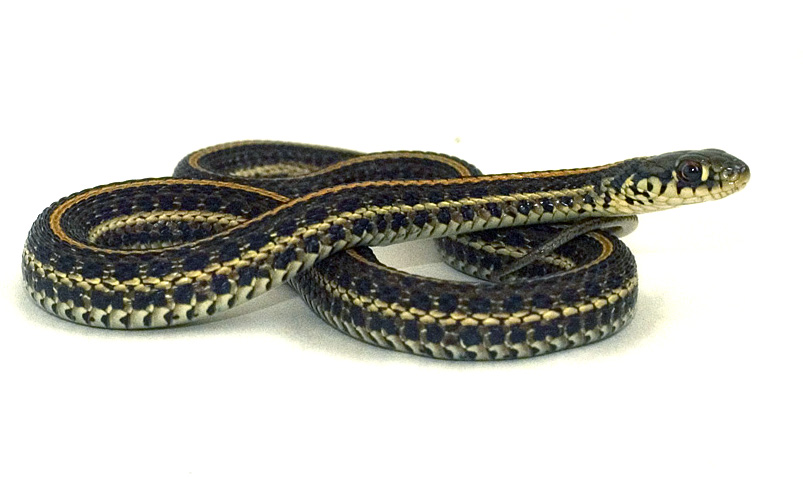
| Appearance | | - The common garter snake typically has yellow longitudinal stripes against a black, brown, or green background. English Wikipedia
- The species exhibits coloration including green, blue, yellow, gold, red, orange, brown, and black. English Wikipedia
- The species has a slender body. English Wikipedia
- Typical individuals have three light longitudinal stripes on a brown, tan, or olive background. in.gov
- Some individuals have red or orange pigmentation visible on their sides. in.gov
- Some individuals have a checkered color pattern. in.gov
- The belly often has two rows of dark spots. in.gov
- The species has a red tongue with a black tip. in.gov
|
|---|
| Size | No checked fact yet | |
|---|
| Habitat | - The species inhabits meadows and prairies near marshes, streams, and ponds. English Wikipedia
- It occurs in grasslands near ponds, streams, marshes, and sloughs. animaldiversity.org
- The species can inhabit swampy areas and riverbanks. animaldiversity.org
- It can occur in vacant lots in suburban and urban areas. animaldiversity.org
- In the Chicago area, individuals have been observed in abandoned buildings, trash heaps, and vacant lots. English Wikipedia
- Individuals may use drier habitats when they occur alongside common garter snakes. animaldiversity.org
- The species hibernates in burrows and rock crevices. animaldiversity.org
- Hibernation sites can include rodent burrows, ant mounds, crayfish burrows, and artificial crevices. animaldiversity.org
| - The species occupies forests, fields, prairies, streams, wetlands, meadows, marshes, and ponds. English Wikipedia
- The species is frequently found near water. English Wikipedia
- The species occurs at elevations ranging from sea level to mountainous areas. English Wikipedia
- The species is most frequently found in wet, open, grassy habitats. in.gov
- Its habitats include old fields, stream and pond borders, woodland edges, and wetland margins. in.gov
|
|---|
| Diet | - Its diet includes earthworms, slugs, and small amphibians. English Wikipedia
- The species has been recorded eating frogs, toads, salamanders, fish, birds, small rodents, leeches, earthworms, and grasshoppers. animaldiversity.org
- Its recorded fish prey include mosquitofish, southern redbelly dace, and bluntnose minnows. animaldiversity.org
- Recorded bird prey include bank swallows and eastern meadowlarks. animaldiversity.org
| - The species primarily consumes amphibians and earthworms. English Wikipedia
- Additional prey includes leeches, slugs, snails, insects, crayfish, fish, lizards, other snakes, small birds, and rodents. English Wikipedia
- The species can effectively capture fast-moving prey such as fish and tadpoles. English Wikipedia
- The species also consumes invertebrates, minnows, mice, and carrion. in.gov
|
|---|
| Behaviour | - The species is active during the day when temperatures are warm. animaldiversity.org
- Its daytime activity generally occurs at air temperatures between 21 and 29 degrees Celsius. animaldiversity.org
- It switches to nighttime activity when air temperatures exceed 31 degrees Celsius. animaldiversity.org
- Individuals may emerge from hibernation to bask during warm winter days. English Wikipedia
- The species is active from March to November, depending on its geographic region. animaldiversity.org
- Individuals are generally solitary except during mating interactions and communal hibernation. animaldiversity.org
- Individuals may move no more than 76 meters over periods exceeding one year. animaldiversity.org
- The species uses chemical trails to locate prey, mates, and hibernation sites. animaldiversity.org
- When threatened, individuals may bite, release foul-smelling musk, or defecate. animaldiversity.org
- The species is described as mildly venomous, with venom that is not toxic to humans. English Wikipedia
| - The species is primarily active during daylight hours. English Wikipedia
- During summer, activity is greatest in the morning and late afternoon. English Wikipedia
- In cooler seasons or climates, activity is generally restricted to warm afternoons. English Wikipedia
- Individuals in warmer southern regions remain active throughout the year. English Wikipedia
- The species hibernates communally, sometimes in large aggregations. English Wikipedia
- Individuals may emerge from winter dens on warm afternoons to bask in sunlight. English Wikipedia
- The species is more cold-tolerant than other snake species. in.gov
- The species may become nocturnal during hot weather. in.gov
- When cornered, individuals may flatten their heads and bodies, coil, and strike. in.gov
- When handled or restrained, individuals may release a foul-smelling secretion. English Wikipedia
- When grabbed, individuals may release foul-smelling musk. in.gov
|
|---|
| Reproduction | | - Mating aggregations may consist of one or two females surrounded by ten or more males. English Wikipedia
- Females can store sperm internally from autumn mating until spring fertilization. English Wikipedia
- Females may produce between 12 and 40 young per reproductive event. English Wikipedia
- Births may occur between July and October. English Wikipedia
|
|---|
| Distribution | - The species occurs across the central United States, extending north into Canada and south to Texas. English Wikipedia
- Its documented Canadian range includes southern Alberta, Saskatchewan, and Manitoba. animaldiversity.org
- Its documented United States range includes the Oklahoma panhandle, northern Texas, northeastern New Mexico, Minnesota, Wisconsin, and Indiana. animaldiversity.org
- The species occurs at elevations from 400 to 7,500 feet. English Wikipedia
- The species generally prefers elevations below 6,000 feet. English Wikipedia
| No checked fact yet |
|---|
| Conservation | | - The common garter snake is classified as Least Concern by the IUCN Red List. English Wikipedia
- Water contamination, urban expansion, and residential and industrial development are identified as threats to the species. English Wikipedia
|
|---|
| Similar species | - The species shares portions of its habitat with the common garter snake. English Wikipedia
- The plains garter snake and common garter snake may hybridize where their ranges overlap. English Wikipedia
| No checked fact yet |
|---|
| Other | No checked fact yet | |
|---|