Species · Reptiles
Common Garter Snake Thamnophis sirtalis
The scientific name of the Common Garter Snake is Thamnophis sirtalis. It is a species of reptile in the family Colubridae (colubrid), order Squamata. The name dates from 1758.
- Scientific name
- Thamnophis sirtalis (Linnaeus, 1758)
- Common name
- Common Garter Snake
- Genus
- Thamnophis
- Family
- Colubridae (Colubrid)
- Order
- Squamata
- Class
- Reptilia
- Red List category
- LC Least Concern
- Environment
- terrestrial
- Recorded in
- 5 countries
- Name status
- accepted in the Catalogue of Life

Overview
Thamnophis sirtalis occupies forests, fields, prairies, streams, wetlands, meadows, marshes, and ponds, and is frequently found near water. It typically has three light longitudinal stripes, a slender body, and coloration that varies among individuals.
Written 26 November 2026 from the sources listed below. Each statement was checked against the passage it cites; statements that could not be supported were removed.
Appearance
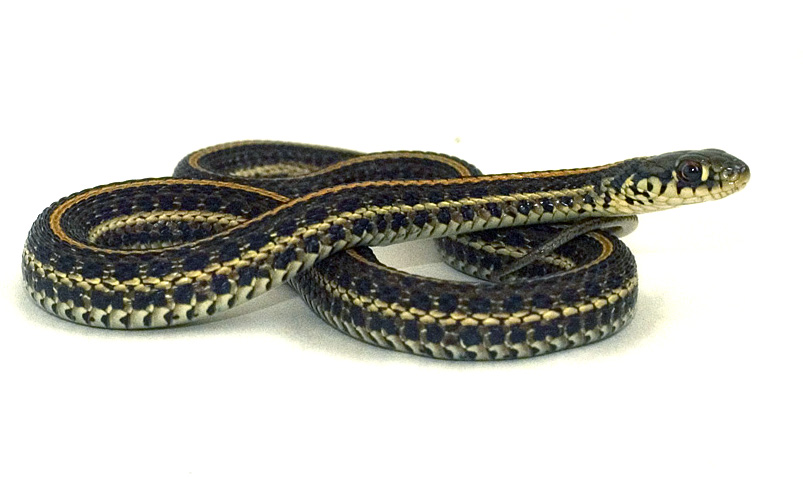
The Common Garter Snake has a slender body and typically displays three light longitudinal stripes against a brown, tan, or olive background. Yellow stripes may also occur against black, brown, or green backgrounds.[1][2][3]
Its coloration includes green, blue, yellow, gold, red, orange, brown, and black. Some individuals have red or orange pigmentation on their sides or a checkered color pattern.[4][5][6]
The belly often has two rows of dark spots. The tongue is red with a black tip.[7][8]
The average total length, including the tail, is approximately 55 cm, and the maximum recorded total length is approximately 137 cm. The average body mass is approximately 150 g.[9][10][11]
Habitat
The Common Garter Snake occupies forests, fields, prairies, streams, wetlands, meadows, marshes, and ponds. It is most frequently found in wet, open, grassy habitats and often occurs near water.[12][13][14]
Its habitats include old fields, stream and pond borders, woodland edges, and wetland margins. It occurs at elevations ranging from sea level to mountainous areas.[15][16]
Diet
The Common Garter Snake primarily consumes amphibians and earthworms. Its additional prey includes leeches, slugs, snails, insects, crayfish, fish, lizards, other snakes, small birds, and rodents.[17][18]
It also consumes invertebrates, minnows, mice, and carrion. It can effectively capture fast-moving prey such as fish and tadpoles.[19][20]
Behaviour
The Common Garter Snake is primarily active during daylight hours. During summer, activity is greatest in the morning and late afternoon, while in cooler seasons or climates it is generally restricted to warm afternoons.[21][22][23]
Individuals in warmer southern regions remain active throughout the year. The species may become nocturnal during hot weather and is more cold-tolerant than other snake species.[24][25][26]
The species hibernates communally, sometimes in large aggregations. Individuals may emerge from winter dens on warm afternoons to bask in sunlight.[27][28]
When cornered, individuals may flatten their heads and bodies, coil, and strike. When handled or restrained, they may release a foul-smelling secretion or musk.[29][30][31]
Reproduction and life cycle
Mating aggregations may consist of one or two females surrounded by ten or more males. Females can store sperm internally from autumn mating until spring fertilization.[32][33]
Females may produce between 12 and 40 young per reproductive event. Births may occur between July and October.[34][35]
Conservation
The Common Garter Snake is classified as Least Concern by the IUCN Red List. Water contamination, urban expansion, and residential and industrial development are identified as threats to the species.[36][37]
Uses
The Common Garter Snake is designated as the state reptile of Massachusetts.[38]
Classification of the Common Garter Snake
| Kingdom | Animalia |
|---|---|
| Phylum | Chordata |
| Subphylum | Vertebrata |
| Infraphylum | Gnathostomata |
| Parvphylum | Osteichthyes |
| Megaclass | Tetrapoda |
| Class | Reptilia (Reptile) |
| Order | Squamata (Snakes) |
| Suborder | Serpentes (Snakes) |
| Infraorder | Alethinophidia |
| Family | Colubridae (Colubrid) |
| Subfamily | Natricinae |
| Genus | Thamnophis (Garter Snake) |
| Species | Thamnophis sirtalis (Linnaeus, 1758) |
Where the Common Garter Snake is found
Checklists and occurrence records place Thamnophis sirtalis in 5 countries. GBIF holds 195,145 georeferenced records of it.
Countries
Regions and cities with the most records
- Ontario, Canada 31,609
- New York, United States 12,333
- California, United States 9,136
- Ohio, United States 8,716
- Pennsylvania, United States 8,546
- Massachusetts, United States 7,910
- Michigan, United States 6,511
- Oregon, United States 6,059
- Quebec, Canada 5,773
- British Columbia, Canada 5,139
- Virginia, United States 4,243
- Manitoba, Canada 4,147
- Washington, United States 4,018
- North Carolina, United States 3,949
- Vermont, United States 3,708
- Maryland, United States 3,447
- Minnesota, United States 3,382
- Wisconsin, United States 3,334
- Illinois, United States 3,273
- Maine, United States 3,272
- New Jersey, United States 3,140
- Florida, United States 2,799
- Nova Scotia, Canada 2,753
- Ottawa South, Canada 2,422
- Ottawa, Canada 2,418
- Newton, United States 2,405
- Waltham, United States 2,341
- Nepean, Canada 2,304
- Watertown, United States 2,283
- Aylmer, Canada 2,280
- Chestnut Hill, United States 2,274
- Gloucester, Canada 2,256
- Brighton, United States 2,211
- New Hampshire, United States 2,189
- Hudson, United States 2,175
- Belmont, United States 2,171
1 more country has a few records outside this range
These countries hold a few records of Thamnophis sirtalis but lie outside the range the checklists give for it. Such records are often zoo or garden specimens, museum material or vagrants, so the species is not counted as occurring there.
Range as the checklists state it
S Canada (incl. Northwest Territories, Manitoba, Alberta, Saskatchewan, New Brunswick, Ontario, Prince Edward Island),
A number beside a place is its count of GBIF occurrence records. A place without a number comes from a checklist alone. Records show where a species has been observed or collected, which can include escapes and vagrants.
Common names
English
- Common Garter Snake
- Garden Snake
- Lowe's Garter Snake
Names in 25 other languages
- Chinese
- 劍紋束帶蛇, 帶蛇
- Czech
- užovka proužkovaná
- Danish
- Strømpebåndssnog
- Dutch
- Gewone kousenbandslang
- Finnish
- sukkanauhakäärme
- French
- Serpent-jarretière, couleuvre rayée
- German
- Gewöhnliche Strumpfbandnatter
- Hungarian
- vörös szalagoskígyó
- Italian
- Serpente giarrettiera comune
- Japanese
- コモンガーターヘビ
- Korean
- 가터얼룩뱀
- Lithuanian
- Paprastoji raištinė gyvatė
- Norwegian
- Strømpebåndssnok
- Norwegian Bokmål
- amerikansk strømpebåndsnok
- Polish
- Ogrodowiec zwyczajny, Pończosznik prążkowany
- Portuguese
- Cobra-liga-comum
- Russian
- Обыкновенная подвязочная змея
- Scottish Gaelic
- nathair
- Serbian
- обична подвезичарка
- Spanish
- Culebra listonada común, Culebra-listonada común, Jarretera Comün, Serpiente de jarretera, culebra de agua
- Swedish
- strumpebandssnok
- Thai
- งูการ์เตอร์ธรรมดา
- Ukrainian
- Підв'язкова змія звичайна
- oji
- Wenjida Ginebig
- see
- Shanö́:ya:enë’
Synonyms
23 other scientific names have been used for this species and are now treated as synonyms of Thamnophis sirtalis.
- Coluber ibibe Daudin, 1803
- Coluber infemalis Blainville, 1835
- Coluber ordinatus Linnaeus, 1766
- Coluber parietalis Say, 1823
- Coluber sirtalis Linnaeus, 1758
- Coluber taenia Schoepf, 1788
- Eutaenia dorsalis Baird & Girard, 1853
- Eutaenia infernalis Girard, 1858
- Eutaenia sirtalis graminea Cope, 1889
- Eutaenia sirtalis melanota Higley, 1889
- Eutaenia sirtalis obscura Cope ex Yarrow, 1875
- Eutaenia sirtalis obscura Cope ex Wheeler, 1875
- Eutaenia sirtalis semiifasciata Cope, 1892
- Eutainia dorsalis Baird & Girard, 1853
- Eutainia pickeringii Baird & Girard, 1853
- Eutainia sirtalis Baird & Girard, 1853
- Eutainia sirtalis trilineata Cope, 1892
- Thamnophis sirtalis lowei Tanner, 1988
- Tropidonotus bipunctatus Schlegel, 1837
- Tropidonotus concinnus Hallowell, 1852
- Tropidonotus obalskii Mocquard, 1903
- Tropidonotus ordinatus (Linnaeus, 1766)
- Thamnophis sirtalis semifasciatus (Cope, 1892) ambiguous synonym
Subspecies and varieties
- Thamnophis sirtalis annectens (Texas Garter Snake) subspecies
- Thamnophis sirtalis concinnus (Red-spotted Garter Snake) subspecies
- Thamnophis sirtalis dorsalis (New Mexico Garter Snake) subspecies
- Thamnophis sirtalis fitchi (Valley Garter Snake) subspecies
- Thamnophis sirtalis infernalis (California Red-sided Garter Snake) subspecies
- Thamnophis sirtalis pallidulus (Maritime Garter Snake) subspecies
- Thamnophis sirtalis parietalis (Red-sided Garter Snake) subspecies
- Thamnophis sirtalis pickeringii (Puget Sound Garter Snake) subspecies
- Thamnophis sirtalis semifasciatus subspecies
- Thamnophis sirtalis similis (Bluestripe Garter Snake) subspecies
- Thamnophis sirtalis sirtalis (Eastern Garter Snake) subspecies
- Thamnophis sirtalis tetrataenia (San Francisco Garter Snake) subspecies
Related species
-
 Common Ribbon SnakeThamnophis saurita
-
 Checkered Garter SnakeThamnophis marcianus
-
 Plains Garter SnakeThamnophis radix
-
 Western Ribbon SnakeThamnophis proximus
-
 Western Terrestrial Garter SnakeThamnophis elegans
-
 Giant Garter SnakeThamnophis gigas
-
 Mexican Garter SnakeThamnophis eques
-
 Northwestern Garter SnakeThamnophis ordinoides
Compare
Questions and answers
What is the scientific name of the Common Garter Snake?
The scientific name of the Common Garter Snake is Thamnophis sirtalis. Written with its author, the full name is Thamnophis sirtalis (Linnaeus, 1758).
Which family does the Common Garter Snake belong to?
Thamnophis sirtalis belongs to the family Colubridae, in the order Squamata and the class Reptilia.
Where is the Common Garter Snake found?
Checklists and occurrence records place Thamnophis sirtalis in 5 countries: United States, Canada, Mexico, Martinique and Saint Barthelemy.
What is the conservation status of the Common Garter Snake?
The IUCN Red List category recorded for Thamnophis sirtalis is Least Concern (LC).
What other names does the Common Garter Snake have?
Thamnophis sirtalis is also known in English as Garden Snake and Lowe's Garter Snake.
What is the typical diet of a garter snake?
The Common Garter Snake primarily consumes amphibians and earthworms. It also eats leeches, slugs, snails, insects, crayfish, fish, lizards, other snakes, small birds, rodents, minnows, mice, and carrion.[17][18][20]
Sources
Passages the profile rests on
- The common garter snake typically has yellow longitudinal stripes against a black, brown, or green background. Source passage: “Most common garter snakes have a pattern of yellow stripes on a black, brown or green background” — English Wikipedia
- The species has a slender body. Source passage: “Common garter snakes are thin snakes.” — English Wikipedia
- Typical individuals have three light longitudinal stripes on a brown, tan, or olive background. Source passage: “The typical pattern is three light stripes running longitudinally down the body on a brown, tan or olive background.” — in.gov
- The species exhibits coloration including green, blue, yellow, gold, red, orange, brown, and black. Source passage: “Common garter snakes come in a wide range of colors, including green, blue, yellow, gold, red, orange, brown, and black.” — English Wikipedia
- Some individuals have red or orange pigmentation visible on their sides. Source passage: “Red or orange pigment may show through on the sides.” — in.gov
- Some individuals have a checkered color pattern. Source passage: “Some common gartersnakes have a checkered pattern.” — in.gov
- The belly often has two rows of dark spots. Source passage: “The belly often has two rows of dark spots.” — in.gov
- The species has a red tongue with a black tip. Source passage: “They have a red tongue with a black tip.” — in.gov
- The average total length, including the tail, is approximately 55 cm. Source passage: “their average total length (including tail) is about 55 cm (22 in)” — English Wikipedia
- The maximum recorded total length is approximately 137 cm. Source passage: “with a maximum total length of about 137 cm (54 in).” — English Wikipedia
- The average body mass is approximately 150 g. Source passage: “The average body mass is 150 g (5.3 oz).” — English Wikipedia
- The species occupies forests, fields, prairies, streams, wetlands, meadows, marshes, and ponds. Source passage: “The habitat of the common garter snake ranges from forests, fields, and prairies to streams, wetlands, meadows, marshes, and ponds” — English Wikipedia
- The species is frequently found near water. Source passage: “and it is often found near water.” — English Wikipedia
- The species is most frequently found in wet, open, grassy habitats. Source passage: “but are most often found in wet, open, grassy places.” — in.gov
- The species occurs at elevations ranging from sea level to mountainous areas. Source passage: “It is found at altitudes from sea level to mountains.” — English Wikipedia
- Its habitats include old fields, stream and pond borders, woodland edges, and wetland margins. Source passage: “They can often be found in old fields, borders of streams or ponds, edges of woodlands, and wetland margins.” — in.gov
- The species primarily consumes amphibians and earthworms. Source passage: “The diet of T. sirtalis consists mainly of amphibians and earthworms” — English Wikipedia
- Additional prey includes leeches, slugs, snails, insects, crayfish, fish, lizards, other snakes, small birds, and rodents. Source passage: “but also leeches, slugs, snails, insects, crayfish, fish, lizards, other snakes, small birds, and rodents.” — English Wikipedia
- The species can effectively capture fast-moving prey such as fish and tadpoles. Source passage: “Common garter snakes are effective at catching fast-moving creatures such as fish and tadpoles.” — English Wikipedia
- The species also consumes invertebrates, minnows, mice, and carrion. Source passage: “They also will eat invertebrates, minnows, mice and carrion.” — in.gov
- The species is primarily active during daylight hours. Source passage: “The common garter snake is a diurnal snake.” — English Wikipedia
- During summer, activity is greatest in the morning and late afternoon. Source passage: “In summer, it is most active in the morning and late afternoon” — English Wikipedia
- In cooler seasons or climates, activity is generally restricted to warm afternoons. Source passage: “in cooler seasons or climates, it restricts its activity to the warm afternoons.” — English Wikipedia
- Individuals in warmer southern regions remain active throughout the year. Source passage: “In warmer southern areas, the snake is active year-round” — English Wikipedia
- The species is more cold-tolerant than other snake species. Source passage: “Common gartersnakes are more cold tolerant than other snake species.” — in.gov
- The species may become nocturnal during hot weather. Source passage: “but are frequently nocturnal during hot weather.” — in.gov
- The species hibernates communally, sometimes in large aggregations. Source passage: “otherwise, it sleeps in common dens, sometimes in great numbers.” — English Wikipedia
- Individuals may emerge from winter dens on warm afternoons to bask in sunlight. Source passage: “On warm winter afternoons, some snakes have been observed emerging from their hibernacula to bask in the sun.” — English Wikipedia
- When cornered, individuals may flatten their heads and bodies, coil, and strike. Source passage: “When cornered, they will sometimes flatten their head and body, coil, and strike.” — in.gov
- When handled or restrained, individuals may release a foul-smelling secretion. Source passage: “garter snakes will secrete a foul-smelling fluid” — English Wikipedia
- When grabbed, individuals may release foul-smelling musk. Source passage: “If they are grabbed they will excrete a foul musk on the person or animal bothering them.” — in.gov
- Mating aggregations may consist of one or two females surrounded by ten or more males. Source passage: “one or two females are completely swamped by ten or more males.” — English Wikipedia
- Females can store sperm internally from autumn mating until spring fertilization. Source passage: “the female stores the sperm internally until spring, when she allows her eggs to be fertilized.” — English Wikipedia
- Females may produce between 12 and 40 young per reproductive event. Source passage: “The females may give birth ovoviviparously to 12 to 40 young” — English Wikipedia
- Births may occur between July and October. Source passage: “from July through October.” — English Wikipedia
- The common garter snake is classified as Least Concern by the IUCN Red List. Source passage: “The common garter snake is considered to be a least-concern species by the IUCN Red List” — English Wikipedia
- Water contamination, urban expansion, and residential and industrial development are identified as threats to the species. Source passage: “Water contamination, urban expansion, and residential and industrial development are all threats to the common garter snake.” — English Wikipedia
- The species is designated as the state reptile of Massachusetts. Source passage: “The common garter snake is the state reptile of Massachusetts.” — English Wikipedia
Data
- Catalogue of Life, 2026-10-16 XR cc by
- Global Biodiversity Information Facility CC BY 4.0
- Wikidata CC0
- GeoNames CC BY 4.0
- Wikimedia Commons per image; credit shown with each image
- Within the Catalogue of Life, this name comes from The Reptile Database cc by
References
- Linné, C. [= Linnaeus, C.]. (1758). Systema naturæ per regna tria naturæ, secundum classes, ordines, genera, species, cum characteribus, differentiis, synonymis, locis. Tomus I. Editio decima, reformata. Laurentii Salvii, Holmiæ. 10th Edition: 824 Pp.
- Gravenhorst, J. L. C. (1807). Vergleichende Übersicht des Linneischen und einiger neueren zoologischen Systeme, nebst dem eingeschalteten Verzeichnisse der zoologischen Sammlung des Verfassers und den Beschreibungen neuer Thierarten, die in derselben vorhanden sind. Heinrich Dietrich, Göttingen: I-Xvi + 1-476.
- Blainville, & Henri Marie Ducrotay de. (1835). Description de quelques espèces de reptiles de la Californie précédée de l’analyse d’un système général d’erpétologie et d’amphibiologie. Nouv. Ann. Mus. Hist. Nat. Paris 4: 233-296.
- Duméril, A.M.C., and G. Bibron. (1835). Erpétologie Générale ou Histoire Naturelle Complète des Reptiles, Vol. 2. Librairie Encyclopédique de Roret, Paris, Iv + 680 P.
- Hallowell, E. (1852). Descriptions of new species of reptiles from Oregon. Proc. Acad. Nat. Sci. Philadelphia 6: 182-183.
- Baird, S. F. and C. Girard. (1853). Catalogue of North American Reptiles in the Museum of the Smithsonian Institution. Part 1.-Serpents. Smithsonian Inst., Washington, Xvi + 172 Pp.
- Duméril, A.M.C., G. BIBRON & A.H.A. DUMÉRIL. (1854). Erpétologie générale ou Histoire Naturelle complète des Reptiles. Vol. 7 (partie 1). Paris, Xvi + 780 S.
- Cope, E. D. (1875). In Yarrow, H.C., Report upon the collections of batrachians and reptiles made in portions of Nevada, Utah, California, Colorado, New Mexico, and Arizona, during the years 871, 1872, 1873, and 1874, Chapter IV, L, pp. 509-584, In: Report upon geographical and geological explorations and surveys west of the the one hundredths meridian, ... Wheeler, Vol. 5, Zoology. Government Printing Office, Washington D.C.
- Wheeler. (1875). Expl. Surv. W. 100th Mer., part 5: 546. Westport, New York.
- Garman, & Samuel. (1884). The reptiles and batrachians of North America. Mem. Mus. Comp. Zool, Cambridge (Massachusetts), 8 (3): Xxxiv + 185 Pp. [1883] [CNAH Reprint 10].
- Brown, & Arthur Erwin. (1889). Description of a new species of Eutaenia. Proc. Acad. Nat. Sci. Philadelphia 1889: 421.
- Sharp, B. (1890). Remarks on the exuviae of snakes. Proc. Acad. Nat. Sci. Philadelphia 1890: 149.
- Sharp, B. (1890). Remarks on the exuviae of snakes. Ann. Mag. Nat. Hist. (6) 6: 124.
- Cope, E. D. (1892). A critical review of the characters and variations of the snakes of North America. Proc. US Natl. Mus. 14: 589-694. Link
- Cope, E. D. (1893). A contribution to the herpetology of British Columbia. Proc. Acad. Nat. Sci. Philadelphia 1893: 181-184.
- Stejneger, L. H. (1893). Annotated list of the reptiles and batrachians collected by the Death Valley Expedition in 1891, with descriptions of new species. North American Fauna, No. 7: 159-228 (+ 14 Plates + 4 Maps).
- Lönnberg, & Einar. (1894). Notes on reptiles and batrachians collected in Florida in 1892 and 1893. Proc. US Natl. Mus. 17 (1003): 317-339.
- Garnier, J. H. (1894). The snakes of Ontario. The Empire, October 6: 16 [See Bauer 2025 for Synonymies].
- Allen, G. M. (1899). Notes on the reptiles and amphibians of Intervale, New Hampshire. Proc. Boston Soc. Nat. Hist. 29: 63-75.
- de Grijs, P. (1899). Notes on the faculty of changing colour in reptiles. Ann. Mag. Nat. Hist. (7) 3: 396-402.
- Cope, E. D. (1900). The crocodilians, lizards and snakes of North America. Ann. Rep. U.S. Natl. Mus. 1898: 153-1270.
- Reagan, B. (1908). Säugetiere, Reptilien und Amphibien vom Rosebud-Indianer-Reservatgebiet in Süd-Dakota. Zool. Anz. 32: 31-32.
- Keim, T. D. (1914). Amphibians and Reptiles at Jennings, Maryland. Copeia 1914 (2): 2.
- Speck, F. G. (1916). Notes on Thamnophis sirtalis from Cape Ann, Massachusetts. Copeia 37: 91-92.
- Andersson, L. G. (1916). Notes on the reptiles and batrachians in the Zoological Museum at Gothenburg with an account of some new species. Göteborgs Kungliga Vetenskap Och Vitter Hets-Samnalles Hndlingar Sjatte Foljden (Series B, 4) 17 (5) [ = Meddelanden Fran Göteborgs Musei Zoologiska Afdelning, No. 9]: 1-41.
This species in other databases
- Catalogue of Life 563LK
- Wikidata Q911786
- iNaturalist 28362
- WoRMS urn:lsid:marinespecies.org:taxname:1481923
- ITIS 174136
Page built on 28 November 2026. See how the catalog is made and all sources and licences.
Cite this page
ScientificNames.org. (2026). Thamnophis sirtalis (Common Garter Snake). Retrieved November 28, 2026, from https://scientificnames.org/species/thamnophis-sirtalis
“Thamnophis sirtalis (Common Garter Snake).” ScientificNames.org, 2026, scientificnames.org/species/thamnophis-sirtalis. Accessed 28 Nov. 2026.
ScientificNames.org. “Thamnophis sirtalis (Common Garter Snake).” Accessed November 28, 2026. https://scientificnames.org/species/thamnophis-sirtalis.
@misc{scientificnames_thamnophis_sirtalis_common_garter_snake,
  author = {{ScientificNames.org}},
  title = {Thamnophis sirtalis (Common Garter Snake)},
  year = {2026},
  url = {https://scientificnames.org/species/thamnophis-sirtalis},
  note = {Accessed 2026-11-28}
}