Comparison

Wyoming Pocket Gopher vs Mazama Pocket Gopher

Wyoming Pocket Gopher (Thomomys clusius) and Mazama Pocket Gopher (Thomomys mazama) both belong to the genus Thomomys (western pocket gophers) and part ways below it. Both are recorded in 1 country.

Wyoming Pocket Gopher

Wyoming Pocket Gopher

Thomomys clusius

US Fish & Wildlife Service, Public domain, via Wikimedia Commons
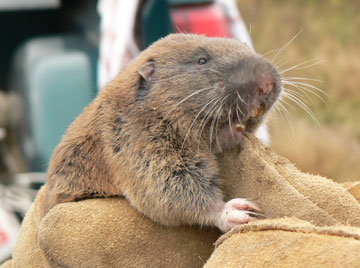
Mazama Pocket Gopher

Mazama Pocket Gopher

Thomomys mazama

Kim Flotlin, FWS., Public domain, via Wikimedia Commons

Side by side

Wyoming Pocket GopherMazama Pocket Gopher
Scientific nameThomomys clusius Coues, 1875Thomomys mazama Merriam, 1897
English nameWyoming Pocket GopherMazama Pocket Gopher
GroupMammalsMammals
ClassMammalia MammalMammalia Mammal
OrderRodentia RodentRodentia Rodent
FamilyGeomyidae Pocket GophersGeomyidae Pocket Gophers
GenusThomomys Western Pocket GophersThomomys Western Pocket Gophers
Named in18751897
Red List categoryLeast ConcernLeast Concern
Countries on record1 country1 country
GBIF occurrence records34 records3,181 records

Rows where the two agree are shown in grey.

Where each is found

Both recorded in 1 country

From Catalogue of Life checklists and GBIF occurrence records. A country missing from a list means no record is held, which is not proof of absence.

Checked facts

Wyoming Pocket GopherMazama Pocket Gopher
Appearance
  • The Wyoming pocket gopher has pale yellowish-grey fur on its upper body and most of its head, with white fur on its underparts, feet, and tail. English Wikipedia
  • The Wyoming pocket gopher has a nearly black snout. English Wikipedia
  • The Wyoming pocket gopher has strong front limbs equipped with digging claws, as well as small ears and eyes. English Wikipedia
  • The Wyoming pocket gopher has relatively large fur-lined cheek pouches extending approximately 44 mm behind its snout. English Wikipedia
No checked fact yet
Size
  • The Wyoming pocket gopher is the smallest species in the genus Thomomys. English Wikipedia
Habitat
  • The Wyoming pocket gopher inhabits relatively flat, well-drained areas. English Wikipedia
  • The Wyoming pocket gopher is often associated with greasewood vegetation. English Wikipedia
  • The Wyoming pocket gopher is often associated with Gardner's saltbush. English Wikipedia
  • The species inhabits prairies, meadows, orchards, and abandoned farms. animaldiversity.org
  • The species is not frequently found in dense forests. animaldiversity.org
  • The species occupies grasslands, glacial outwash prairies, pastures, subalpine meadows, and occasionally clearcuts and Christmas tree farms. wdfw.wa.gov
  • The species requires well-drained soil for burrowing and is most abundant in loamy sand soils. wdfw.wa.gov
  • The species is absent from areas with clay soil or seasonal flooding. wdfw.wa.gov
  • Common vegetation in its habitats includes bracken fern, Douglas fir, perennial grasses, red sorrel, and western strawberry. animaldiversity.org
DietNo checked fact yet
  • The species is herbivorous and consumes roots and above-ground plant material. wdfw.wa.gov
  • Perennial forbs are preferred over grasses. wdfw.wa.gov
  • Camas roots and bulbs are important foods when green vegetation is unavailable. wdfw.wa.gov
  • The species also consumes fungi and disperses their spores. wdfw.wa.gov
  • Grasses constitute the largest portion of the species' annual diet. animaldiversity.org
  • Woody plants such as ponderosa pine are consumed mainly during winter. animaldiversity.org
  • Roots are consumed mainly during autumn and spring. animaldiversity.org
  • Forbs are preferred when multiple food sources are available. animaldiversity.org
Behaviour
  • The Wyoming pocket gopher is thought to be solitary. English Wikipedia
  • The Wyoming pocket gopher lives in burrows that are significantly narrower than those of the northern pocket gopher. English Wikipedia
  • The species spends most of its time in underground burrow systems. animaldiversity.org
  • Individuals are generally solitary and share burrows during the mating season. animaldiversity.org
  • Burrow systems contain foraging tunnels and chambers used for nesting and food storage. wdfw.wa.gov
  • Burrows are generally 3.8–4.4 cm in diameter and lie 10–15 cm below the surface. animaldiversity.org
  • Average home ranges measure 97 square meters for females and 108 square meters for males. animaldiversity.org
ReproductionNo checked fact yet
  • Females produce one litter per year. wdfw.wa.gov
  • The average litter size is five young. wdfw.wa.gov
  • The breeding season extends from October through June. animaldiversity.org
  • Gestation lasts approximately one month and varies with environmental conditions. animaldiversity.org
  • Female offspring often establish nearby burrow systems after weaning, whereas male offspring disperse. wdfw.wa.gov
Distribution
  • The Wyoming pocket gopher is endemic to the United States. English Wikipedia
  • The Wyoming pocket gopher occurs only in a limited area of southern Wyoming. English Wikipedia
  • The Wyoming pocket gopher occurs in eastern Sweetwater County, Wyoming. English Wikipedia
  • The Wyoming pocket gopher occurs in southwestern Carbon County, Wyoming. English Wikipedia
  • The species occurs in Washington, Oregon, and California. animaldiversity.org
  • The species occurs in the Pacific Northwest of the United States. animaldiversity.org
  • In Washington, the species occurs west of the Cascade Range in Thurston, Pierce, Mason, and Clallam counties. wdfw.wa.gov
  • Other populations occur in western Oregon and northern California. wdfw.wa.gov
Conservation
  • The Wyoming pocket gopher was petitioned for listing under the Federal Endangered Species Act in 2007. wgfd.wyo.gov
  • All Washington subspecies are listed as state threatened. wdfw.wa.gov
  • Habitat loss caused by development, agriculture, and tree planting has reduced the species' historical distribution on south Puget Sound prairies. wdfw.wa.gov
  • Population trends are declining for subspecies in Thurston and Pierce counties. wdfw.wa.gov
  • High-density development likely causes local extirpation. wdfw.wa.gov
  • The species' burrows provide refuge for amphibians, reptiles, and invertebrates. wdfw.wa.gov
Similar species
  • The Wyoming pocket gopher was generally classified as a subspecies of the northern pocket gopher between 1915 and 1979. English Wikipedia
  • The Wyoming pocket gopher can be distinguished from the northern pocket gopher by its lack of dark ear patches. English Wikipedia
  • The Wyoming pocket gopher is smaller than the northern pocket gopher. English Wikipedia
  • The Wyoming pocket gopher has a diploid chromosome number of 46, compared with 48 in the northern pocket gopher. English Wikipedia
  • There is no documented evidence that the Wyoming pocket gopher and northern pocket gopher can interbreed. English Wikipedia
  • The Mazama pocket gopher is frequently confused with moles, but moles lack prominent teeth and produce dome-shaped soil mounds. wdfw.wa.gov
  • The species differs from the northern pocket gopher in fur color, tooth and skeletal characteristics, and the dark patch behind the ears. wdfw.wa.gov
OtherNo checked fact yet

In brief

Wyoming Pocket Gopher

Thomomys clusius occurs only in a limited area of southern Wyoming, including eastern Sweetwater County and southwestern Carbon County. It is the smallest species in the genus Thomomys, with pale yellowish-grey upper fur, white underparts, and a nearly black snout. Full profile

Mazama Pocket Gopher

Thomomys mazama occurs in Washington, Oregon, and California. Full profile

Compare something else

Page built on 28 November 2026 from the data on the two species pages, where every source is listed.

Cite this page

ScientificNames.org. (2026). Wyoming Pocket Gopher vs Mazama Pocket Gopher. Retrieved November 28, 2026, from https://scientificnames.org/compare/wyoming-pocket-gopher-vs-mazama-pocket-gopher