Comparison

Thomomys helleri vs Mazama Pocket Gopher

Thomomys helleri (Thomomys helleri) and Mazama Pocket Gopher (Thomomys mazama) both belong to the genus Thomomys (western pocket gophers) and part ways below it.
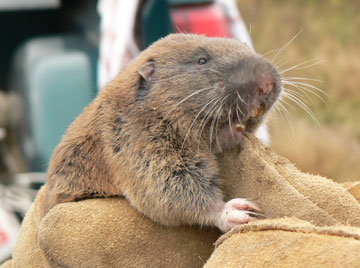
Mazama Pocket Gopher

Mazama Pocket Gopher

Thomomys mazama

Kim Flotlin, FWS., Public domain, via Wikimedia Commons

Side by side

Thomomys helleriMazama Pocket Gopher
Scientific nameThomomys helleriThomomys mazama Merriam, 1897
English nameNot recordedMazama Pocket Gopher
GroupMammalsMammals
ClassMammalia MammalMammalia Mammal
OrderRodentia RodentRodentia Rodent
FamilyGeomyidae Pocket GophersGeomyidae Pocket Gophers
GenusThomomys Western Pocket GophersThomomys Western Pocket Gophers
Named inNot recorded1897
Red List categoryNot recordedLeast Concern
Countries on recordNot recorded1 country
GBIF occurrence recordsNot recorded3,181 records

Rows where the two agree are shown in grey.

Where each is found

Only Mazama Pocket Gopher (1)

From Catalogue of Life checklists and GBIF occurrence records. A country missing from a list means no record is held, which is not proof of absence.

Checked facts

Thomomys helleriMazama Pocket Gopher
SizeNo checked fact yet
HabitatNo checked fact yet
  • The species inhabits prairies, meadows, orchards, and abandoned farms. animaldiversity.org
  • The species is not frequently found in dense forests. animaldiversity.org
  • The species occupies grasslands, glacial outwash prairies, pastures, subalpine meadows, and occasionally clearcuts and Christmas tree farms. wdfw.wa.gov
  • The species requires well-drained soil for burrowing and is most abundant in loamy sand soils. wdfw.wa.gov
  • The species is absent from areas with clay soil or seasonal flooding. wdfw.wa.gov
  • Common vegetation in its habitats includes bracken fern, Douglas fir, perennial grasses, red sorrel, and western strawberry. animaldiversity.org
DietNo checked fact yet
  • The species is herbivorous and consumes roots and above-ground plant material. wdfw.wa.gov
  • Perennial forbs are preferred over grasses. wdfw.wa.gov
  • Camas roots and bulbs are important foods when green vegetation is unavailable. wdfw.wa.gov
  • The species also consumes fungi and disperses their spores. wdfw.wa.gov
  • Grasses constitute the largest portion of the species' annual diet. animaldiversity.org
  • Woody plants such as ponderosa pine are consumed mainly during winter. animaldiversity.org
  • Roots are consumed mainly during autumn and spring. animaldiversity.org
  • Forbs are preferred when multiple food sources are available. animaldiversity.org
BehaviourNo checked fact yet
  • The species spends most of its time in underground burrow systems. animaldiversity.org
  • Individuals are generally solitary and share burrows during the mating season. animaldiversity.org
  • Burrow systems contain foraging tunnels and chambers used for nesting and food storage. wdfw.wa.gov
  • Burrows are generally 3.8–4.4 cm in diameter and lie 10–15 cm below the surface. animaldiversity.org
  • Average home ranges measure 97 square meters for females and 108 square meters for males. animaldiversity.org
ReproductionNo checked fact yet
  • Females produce one litter per year. wdfw.wa.gov
  • The average litter size is five young. wdfw.wa.gov
  • The breeding season extends from October through June. animaldiversity.org
  • Gestation lasts approximately one month and varies with environmental conditions. animaldiversity.org
  • Female offspring often establish nearby burrow systems after weaning, whereas male offspring disperse. wdfw.wa.gov
DistributionNo checked fact yet
  • The species occurs in Washington, Oregon, and California. animaldiversity.org
  • The species occurs in the Pacific Northwest of the United States. animaldiversity.org
  • In Washington, the species occurs west of the Cascade Range in Thurston, Pierce, Mason, and Clallam counties. wdfw.wa.gov
  • Other populations occur in western Oregon and northern California. wdfw.wa.gov
ConservationNo checked fact yet
  • All Washington subspecies are listed as state threatened. wdfw.wa.gov
  • Habitat loss caused by development, agriculture, and tree planting has reduced the species' historical distribution on south Puget Sound prairies. wdfw.wa.gov
  • Population trends are declining for subspecies in Thurston and Pierce counties. wdfw.wa.gov
  • High-density development likely causes local extirpation. wdfw.wa.gov
  • The species' burrows provide refuge for amphibians, reptiles, and invertebrates. wdfw.wa.gov
Similar speciesNo checked fact yet
  • The Mazama pocket gopher is frequently confused with moles, but moles lack prominent teeth and produce dome-shaped soil mounds. wdfw.wa.gov
  • The species differs from the northern pocket gopher in fur color, tooth and skeletal characteristics, and the dark patch behind the ears. wdfw.wa.gov
OtherNo checked fact yet

In brief

Mazama Pocket Gopher

Thomomys mazama occurs in Washington, Oregon, and California. Full profile

Compare something else

Page built on 28 November 2026 from the data on the two species pages, where every source is listed.

Cite this page

ScientificNames.org. (2026). Thomomys helleri vs Mazama Pocket Gopher. Retrieved November 28, 2026, from https://scientificnames.org/compare/thomomys-helleri-vs-mazama-pocket-gopher