Comparison
Wetland Giant Wolf Spider vs Rabid Wolf Spider
Wetland Giant Wolf Spider (Tigrosa helluo) and Rabid Wolf Spider (Rabidosa rabida) both belong to the family Lycosidae (wolf spider) and part ways below it. Both are recorded in 3 countries.
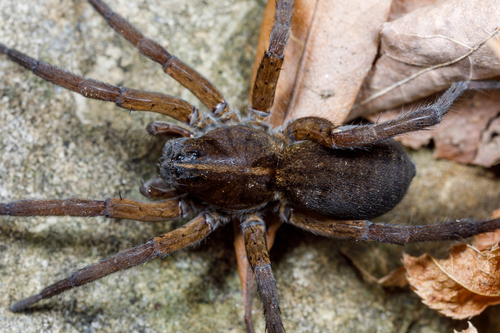
Wetland Giant Wolf Spider
Tigrosa helluo
(c) Meghan Cassidy, some rights reserved (CC BY-SA), uploaded by Meghan Cassidy, CC BY-SA 4.0, via iNaturalist


Side by side
| Wetland Giant Wolf Spider | Rabid Wolf Spider | |
|---|---|---|
| Scientific name | Tigrosa helluo (Walckenaer, 1837) | Rabidosa rabida (Walckenaer, 1837) |
| English name | Wetland Giant Wolf Spider | Rabid Wolf Spider |
| Group | Spiders and other arachnids | Spiders and other arachnids |
| Class | Arachnida Arachnid | Arachnida Arachnid |
| Order | Araneae Spider | Araneae Spider |
| Family | Lycosidae Wolf Spider | Lycosidae Wolf Spider |
| Genus | Tigrosa | Rabidosa |
| Named in | 1837 | 1837 |
| Countries on record | 3 countries | 4 countries |
| GBIF occurrence records | 10,585 records | 18,537 records |
Rows where the two agree are shown in grey.
Where each is found
Both recorded in 3 countries
Only Rabid Wolf Spider (1)
From Catalogue of Life checklists and GBIF occurrence records. A country missing from a list means no record is held, which is not proof of absence.
Checked facts
| Wetland Giant Wolf Spider | Rabid Wolf Spider | |
|---|---|---|
| Appearance | No checked fact yet |
|
| Size | No checked fact yet |
|
| Habitat | No checked fact yet |
|
| Diet | No checked fact yet |
|
| Behaviour | No checked fact yet |
|
| Reproduction | No checked fact yet |
|
| Conservation | No checked fact yet |
|
| Uses | No checked fact yet |
|
| Similar species | No checked fact yet |
|
In brief
Rabid Wolf Spider
Rabidosa rabida inhabits wooded areas, cotton fields, prairies, woodlands, pastures, and other open areas with tall grasses. It has eight eyes arranged in two rows of four, longitudinal stripes on its cephalothorax, and a distinctive pattern of light markings on its abdomen. Full profile
Compare something else
Page built on 25 November 2026 from the data on the two species pages, where every source is listed.
Cite this page
ScientificNames.org. (2026). Wetland Giant Wolf Spider vs Rabid Wolf Spider. Retrieved November 25, 2026, from https://scientificnames.org/compare/wetland-giant-wolf-spider-vs-rabid-wolf-spider
“Wetland Giant Wolf Spider vs Rabid Wolf Spider.” ScientificNames.org, 2026, scientificnames.org/compare/wetland-giant-wolf-spider-vs-rabid-wolf-spider. Accessed 25 Nov. 2026.
ScientificNames.org. “Wetland Giant Wolf Spider vs Rabid Wolf Spider.” Accessed November 25, 2026. https://scientificnames.org/compare/wetland-giant-wolf-spider-vs-rabid-wolf-spider.
@misc{scientificnames_wetland_giant_wolf_spider_vs_rabid_wolf_spider,
  author = {{ScientificNames.org}},
  title = {Wetland Giant Wolf Spider vs Rabid Wolf Spider},
  year = {2026},
  url = {https://scientificnames.org/compare/wetland-giant-wolf-spider-vs-rabid-wolf-spider},
  note = {Accessed 2026-11-25}
}