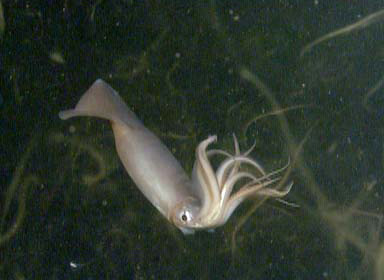
| Appearance | - The species has a typically cylindrical mantle and arrow-shaped fins. English Wikipedia
- The species lacks visceral photophores. English Wikipedia
- Its body is dark purplish brown. English Wikipedia
- Its tentacular club has a short carpal area and four pairs of suckers. English Wikipedia
- The middle manus suckers have rings bearing 13–16 long, pointed teeth. English Wikipedia
- The manus bears 14–18 suckers arranged in four rows. English Wikipedia
- The largest tentacular suckers have rings with 14–17 conical teeth alternating with square plates. English Wikipedia
- The arm sucker rings have large distal teeth alternating with very small teeth. English Wikipedia
- In males, the distal two-fifths of the fourth right arm is hectocotylised. English Wikipedia
- The hectocotylised arm region has thick pedicels instead of suckers, which are almost entirely joined by the ventral protective membrane. English Wikipedia
- The dorsal row of pedicels on the hectocotylised arm is flattened. English Wikipedia
| - The species can rapidly change its body coloration using chromatophores. English Wikipedia
- The species can produce rapid red-and-white flashes across its entire body. English Wikipedia
|
|---|
| Size | | |
|---|
| Habitat | - The species mainly inhabits the benthic upper-slope zone of the South African continental slope. English Wikipedia
- Its principal reported depth range is 300–500 metres. English Wikipedia
| - The species inhabits ocean depths ranging from approximately 200 to 700 metres. English Wikipedia
- The species occupies depths exceeding 250 metres during the day and approaches the surface at night. animaldiversity.org
- The species can tolerate low dissolved oxygen concentrations in deep water by reducing its oxygen consumption. animaldiversity.org
- The species can inhabit hypoxic and anoxic ocean waters. pmc.ncbi.nlm.nih.gov
|
|---|
| Diet | - The species is an opportunistic predator. English Wikipedia
- Its prey includes fish such as Cape hake (Merluccius capensis) in the northern Benguela Current. English Wikipedia
- The species is an important prey item for predatory fishes, sharks and marine mammals. English Wikipedia
| - The species feeds primarily on small fish, crustaceans, other cephalopods, and copepods. English Wikipedia
- Juveniles consume copepods and pelagic shrimp before shifting toward fish and other cephalopods as they grow. animaldiversity.org
- The species consumes very little anchovy off Peru despite the large biomass of this fish in the region. pmc.ncbi.nlm.nih.gov
- The species sometimes consumes other individuals of its own species. English Wikipedia
|
|---|
| Behaviour | - Adult individuals remain near the seabed during daylight. English Wikipedia
- Juveniles avoid surface waters during daylight. English Wikipedia
- Adult individuals move upward through the water column at night but continue to avoid surface waters. English Wikipedia
- Juveniles are most abundant at depths of 60–80 metres during the night. English Wikipedia
- Young individuals normally prefer the epipelagic zone. English Wikipedia
- Individual growth rates vary considerably and are correlated with environmental effects in the northern Benguela Upwelling System. English Wikipedia
- Sub-adult and adult individuals are most abundant during the Southern Hemisphere spring, from October to December. English Wikipedia
| - The species can travel in shoals containing as many as 1,200 individuals. English Wikipedia
- The species can swim at speeds of up to 24 kilometres per hour. English Wikipedia
- The species undertakes daily vertical migrations between deeper daytime waters and shallower nighttime waters. animaldiversity.org
- The species can travel horizontally for up to 100 kilometres over three to four days. animaldiversity.org
- The species has been observed participating in cooperative hunting. English Wikipedia
- The species can use visual signals to interact with other individuals. animaldiversity.org
|
|---|
| Reproduction | - Females are reported to reach sexual maturity at mantle lengths of approximately 300–350 mm according to anatomical studies. English Wikipedia
- Males and females may have different habitat preferences and meet only to spawn. English Wikipedia
- A Namibian population showed a clear predominance of females over males. English Wikipedia
| - Females produce floating egg masses enclosed in a gelatinous protective layer. animaldiversity.org
- A single egg mass can contain approximately 5,000 to 4.1 million eggs. English Wikipedia
- Large females can produce egg masses measuring three to four metres in diameter. English Wikipedia
- Embryonic development lasts approximately six to nine days before hatching. animaldiversity.org
- Spawning is believed to occur throughout the year, with peaks between October and January in the Southern Hemisphere. animaldiversity.org
- Females may produce between three and twenty egg masses during their reproductive cycle. animaldiversity.org
|
|---|
| Distribution | - The species occurs in the southeastern Atlantic Ocean off Southern Africa. English Wikipedia
- Its confirmed reported distribution includes the Benguela Current waters off Angola, Namibia and South Africa. English Wikipedia
- Its reported range extends eastward into the Indian Ocean. English Wikipedia
- The species' exact distribution remains uncertain because of taxonomic confusion with the Antarctic flying squid. English Wikipedia
- Some authorities describe the species as having a circumglobal distribution in the southern oceans. English Wikipedia
| |
|---|
| Conservation | | - The Gulf of California fishery collapse associated with warming waters in 2015 had not recovered at the time described in the source. English Wikipedia
|
|---|
| Uses | - The species is occasionally caught as bycatch in fisheries targeting other species. English Wikipedia
| - The species is commercially harvested for markets in Europe, Russia, China, Japan, Southeast Asia, and the Americas. English Wikipedia
- The species is consumed in Chile in dishes including chupes and paila marina. English Wikipedia
- The species is used to prepare ceviche in Peru. English Wikipedia
|
|---|
| Similar species | - The lesser flying squid (Todaropsis eblanae) shares the species' upper-slope benthic habitat. English Wikipedia
| No checked fact yet |
|---|
| Other | No checked fact yet | - The species is the most important squid worldwide in commercial fisheries. English Wikipedia
|
|---|