Comparison

European Flying Squid vs Humboldt Squid

European Flying Squid (Todarodes sagittatus) and Humboldt Squid (Dosidicus gigas) both belong to the family Ommastrephidae (flying squids) and part ways below it.

European Flying Squid

European Flying Squid

Todarodes sagittatus

Comingio Merculiano in Jatta Giuseppe, Public domain, via Wikimedia Commons

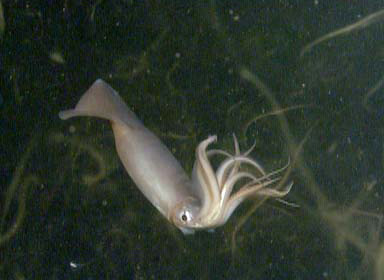
Humboldt Squid

Humboldt Squid

Dosidicus gigas

Image courtesy of NOAA/MBARI 2006, Public domain, via Wikimedia Commons
Side by side

European Flying SquidHumboldt Squid
Scientific nameTodarodes sagittatus (Lamarck, 1798)Dosidicus gigas (A. d'Orbigny, 1835)
English nameEuropean Flying SquidHumboldt Squid
GroupMolluscsMolluscs
ClassCephalopoda CephalopodCephalopoda Cephalopod
OrderOegopsidaOegopsida
FamilyOmmastrephidae Flying SquidsOmmastrephidae Flying Squids
GenusTodarodesDosidicus
Named in17981835
Red List categoryLeast ConcernData Deficient
Environmentmarinemarine
Countries on record15 countries5 countries
GBIF occurrence records3,566 records89,997 records

Rows where the two agree are shown in grey.

Where each is found

Only European Flying Squid (15)

Only Humboldt Squid (5)

From Catalogue of Life checklists and GBIF occurrence records. A country missing from a list means no record is held, which is not proof of absence.

Checked facts

European Flying SquidHumboldt Squid
Appearance
  • The species can rapidly change its body coloration using chromatophores. English Wikipedia
  • The species can produce rapid red-and-white flashes across its entire body. English Wikipedia
Size
Habitat
  • The species inhabits oceanic and neritic waters. English Wikipedia
  • It occurs from the sea surface to depths exceeding 1,000 metres. English Wikipedia
  • Off northwest Africa, it is commonly found at depths of 350–700 metres. English Wikipedia
  • It is occasionally recorded among seabed fauna on the continental shelf and upper continental slope. English Wikipedia
  • Spawning takes place near the seabed at depths of 200–800 metres. English Wikipedia
  • The species inhabits ocean depths ranging from approximately 200 to 700 metres. English Wikipedia
  • The species occupies depths exceeding 250 metres during the day and approaches the surface at night. animaldiversity.org
  • The species can tolerate low dissolved oxygen concentrations in deep water by reducing its oxygen consumption. animaldiversity.org
  • The species can inhabit hypoxic and anoxic ocean waters. pmc.ncbi.nlm.nih.gov
Diet
  • Its prey includes fish, crustaceans and other cephalopods. English Wikipedia
  • Small Atlantic herring and Atlantic cod are major prey species in the northern part of its range. English Wikipedia
  • Blue whiting and Maurolicus muelleri are among its recorded fish prey. English Wikipedia
  • Cannibalism occurs frequently, with conspecifics representing the second most common cephalopod prey. English Wikipedia
  • Lanternfish are the most common and diverse prey recorded in the Macaronesian Islands. English Wikipedia
  • The species feeds primarily on small fish, crustaceans, other cephalopods, and copepods. English Wikipedia
  • Juveniles consume copepods and pelagic shrimp before shifting toward fish and other cephalopods as they grow. animaldiversity.org
  • The species consumes very little anchovy off Peru despite the large biomass of this fish in the region. pmc.ncbi.nlm.nih.gov
  • The species sometimes consumes other individuals of its own species. English Wikipedia
Behaviour
  • The species undertakes migrations associated with feeding and maturation in the North Atlantic. English Wikipedia
  • Large schools appear offshore near southern Iceland, the Faroe Islands, Norway and sometimes Scotland during early summer. English Wikipedia
  • North Atlantic populations move into deeper offshore waters for winter. English Wikipedia
  • Populations off northwestern Africa and in the western Mediterranean are comparatively sedentary. English Wikipedia
  • The species performs daily vertical migrations, generally occupying deeper waters during daylight and approaching the surface at night. English Wikipedia
  • Individuals may occur alone or in small groups before forming large schools during trophic migrations. English Wikipedia
  • Females generally outnumber males in captures. English Wikipedia
  • The species can travel in shoals containing as many as 1,200 individuals. English Wikipedia
  • The species can swim at speeds of up to 24 kilometres per hour. English Wikipedia
  • The species undertakes daily vertical migrations between deeper daytime waters and shallower nighttime waters. animaldiversity.org
  • The species can travel horizontally for up to 100 kilometres over three to four days. animaldiversity.org
  • The species has been observed participating in cooperative hunting. English Wikipedia
  • The species can use visual signals to interact with other individuals. animaldiversity.org
Reproduction
  • Spawning probably occurs continuously throughout the year along the continental slope. English Wikipedia
  • Spawning has seasonal peaks in late winter or early spring in the northeastern Atlantic. English Wikipedia
  • Spawning in the Balearic Sea peaks between September and November. English Wikipedia
  • Females can produce several hundred thousand eggs, depending on their size. English Wikipedia
  • Females reduce their feeding activity before spawning. English Wikipedia
  • Egg laying is intermittent, with successive egg masses containing decreasing numbers of eggs. English Wikipedia
  • Male individuals reach sexual maturity at a smaller size and younger age than females. English Wikipedia
  • Females produce floating egg masses enclosed in a gelatinous protective layer. animaldiversity.org
  • A single egg mass can contain approximately 5,000 to 4.1 million eggs. English Wikipedia
  • Large females can produce egg masses measuring three to four metres in diameter. English Wikipedia
  • Embryonic development lasts approximately six to nine days before hatching. animaldiversity.org
  • Spawning is believed to occur throughout the year, with peaks between October and January in the Southern Hemisphere. animaldiversity.org
  • Females may produce between three and twenty egg masses during their reproductive cycle. animaldiversity.org
Distribution
  • The species occurs in the eastern Atlantic from Greenland and Iceland southward to the Gulf of Guinea. English Wikipedia
  • Its distribution includes the North Sea, Mediterranean Sea and Sea of Marmara. English Wikipedia
Conservation
  • The Gulf of California fishery collapse associated with warming waters in 2015 had not recovered at the time described in the source. English Wikipedia
Uses
  • The species is predominantly caught as bycatch in trawl fisheries but is also harvested using jigging and purse seining. English Wikipedia
  • Its flesh is consumed fresh or boiled and can be preserved by freezing, salting or drying. English Wikipedia
  • The species is used as bait in cod and halibut fisheries. English Wikipedia
  • The species is commercially harvested for markets in Europe, Russia, China, Japan, Southeast Asia, and the Americas. English Wikipedia
  • The species is consumed in Chile in dishes including chupes and paila marina. English Wikipedia
  • The species is used to prepare ceviche in Peru. English Wikipedia
OtherNo checked fact yet
  • The species is the most important squid worldwide in commercial fisheries. English Wikipedia

In brief

European Flying Squid

Todarodes sagittatus inhabits oceanic and neritic waters, from the sea surface to depths exceeding 1,000 metres. It has a dark purplish, elongated muscular body, broad terminal fins and slender arms. Full profile

Humboldt Squid

Dosidicus gigas occurs in the eastern Pacific Ocean from northern California to southern Chile and inhabits ocean depths ranging from approximately 200 to 700 metres. It is distinguished by its ability to rapidly change its body coloration and produce red-and-white flashes across its entire body. Full profile

Compare something else

Page built on 29 November 2026 from the data on the two species pages, where every source is listed.

Cite this page

ScientificNames.org. (2026). European Flying Squid vs Humboldt Squid. Retrieved November 29, 2026, from https://scientificnames.org/compare/european-flying-squid-vs-humboldt-squid