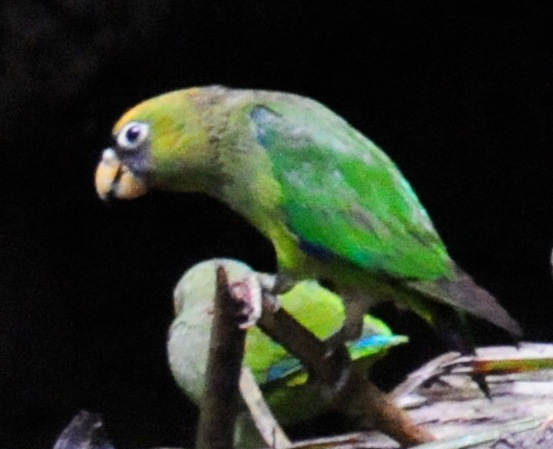
Comparison

Lilac-tailed Parrotlet vs Scarlet-shouldered Parrotlet

Lilac-tailed Parrotlet (Touit batavicus) and Scarlet-shouldered Parrotlet (Touit huetii) both belong to the genus Touit (forest parrotlets) and part ways below it. Both are recorded in 3 countries.

Lilac-tailed Parrotlet

Lilac-tailed Parrotlet

Touit batavicus

Jacques Barraband, Public domain, via Wikimedia Commons

Scarlet-shouldered Parrotlet

Scarlet-shouldered Parrotlet

Touit huetii

Vince Smith from London, United Kingdom, CC BY-SA 2.0, via Wikimedia Commons

Side by side

Lilac-tailed ParrotletScarlet-shouldered Parrotlet
Scientific nameTouit batavicus (Boddaert, 1783)Touit huetii (Temminck, 1830)
English nameLilac-tailed ParrotletScarlet-shouldered Parrotlet
GroupBirdsBirds
ClassAves BirdAves Bird
OrderPsittaciformes ParrotPsittaciformes Parrot
FamilyPsittacidae MacawsPsittacidae Macaws
GenusTouit Forest ParrotletsTouit Forest Parrotlets
Named in17831830
Red List categoryLeast ConcernLeast Concern
Countries on record6 countries7 countries
GBIF occurrence records2,742 records2,784 records

Rows where the two agree are shown in grey.

Where each is found

Both recorded in 3 countries

Only Lilac-tailed Parrotlet (3)

Only Scarlet-shouldered Parrotlet (4)

From Catalogue of Life checklists and GBIF occurrence records. A country missing from a list means no record is held, which is not proof of absence.

Checked facts

Lilac-tailed ParrotletScarlet-shouldered Parrotlet
Appearance
  • The species has a mostly yellow head with green ear coverts, green neck sides, and a dusky scaled nape. English Wikipedia
  • Its back and wings are black, with yellowish-green greater wing coverts edged in green-blue and a red carpal bar. English Wikipedia
  • The species has a purplish-rose tail with a black band near its tip. English Wikipedia
  • Its throat and belly are green, its breast is pale blue, and its underwing coverts are blue. English Wikipedia
  • The species is characterized by black-and-green plumage and a purple tail. ebird.org
Size
Habitat
  • The species inhabits lowland deciduous forests across most of its geographic range. English Wikipedia
  • In Colombia and Venezuela's Coastal Range, the species occurs in cloud forests at elevations between 700 and 1,700 m. English Wikipedia
  • The species uses both undisturbed and disturbed primary and secondary forests. English Wikipedia
  • The species is associated with subtropical or tropical moist natural habitats. inaturalist.org
  • The species is associated with rainforest regions. ebird.org
  • The species inhabits lowland terra firme and várzea forests. English Wikipedia
  • The species occurs mostly below 900 m elevation but has occasionally been recorded at 1,300 m. English Wikipedia
Diet
  • Its diet includes flowers, nectar, buds, berries, seeds, and fruits. English Wikipedia
Behaviour
  • The species is non-migratory but appears to exhibit some nomadic movements. English Wikipedia
  • The species performs most of its foraging during the morning. English Wikipedia
  • Large flocks produce continuous, monotonous, noisy chattering while flying. English Wikipedia
  • When perched, the species produces very nasal calls described as naaee or rrhaaee. English Wikipedia
  • Its most common calls are slightly nasal sounds described as ryee or nee-ryee. English Wikipedia
  • The species is non-migratory but is probably nomadic in Amazonia. English Wikipedia
  • Individuals are seldom recorded remaining in one area for more than a few weeks. English Wikipedia
  • The species is difficult to observe clearly unless a flock visits a clay lick. ebird.org
Reproduction
  • The breeding season of the species has not been determined. English Wikipedia
  • Fledglings have been recorded in December in Suriname and between January and March on Trinidad. English Wikipedia
  • The species nests in cavities, including hollow limbs and cavities excavated in arboreal termite nests. English Wikipedia
  • The clutch contains five or six eggs. English Wikipedia
  • The incubation period, time to fledging, and details of parental care are unknown. English Wikipedia
  • The breeding season apparently includes April in southern Venezuela. English Wikipedia
  • The breeding season apparently extends from September through December in southern Brazil. English Wikipedia
  • Further details of the species' breeding biology are unknown. English Wikipedia
Distribution
  • The species occurs in Colombia, French Guiana, Guyana, Suriname, Trinidad, and Venezuela. English Wikipedia
  • The species occurs in Bolivia, Brazil, Colombia, Ecuador, Guyana, Peru, and Venezuela, with possible occurrence in Suriname. English Wikipedia
  • The species has also been recorded as a vagrant in Trinidad and Tobago. English Wikipedia
  • The species has a discontinuous geographical distribution. English Wikipedia
  • Its range includes northeastern Venezuela, adjacent Guyana, southeastern Colombia, eastern Ecuador, eastern Peru, northern Bolivia, and Brazil's eastern Amazon Basin. English Wikipedia
  • The species is widespread but uncommon across the lowlands of northern South America. ebird.org
Conservation
  • The species is classified as Least Concern by the IUCN. English Wikipedia
  • The species has a large geographical range. English Wikipedia
  • The species' population size is unknown and is believed to be declining. English Wikipedia
  • No immediate threats to the species have been identified. English Wikipedia
  • Although apparently uncommon or rare, the species may be more common than recorded because it is unobtrusive and inhabits remote areas. English Wikipedia
  • The species was most recently assessed for the IUCN Red List in 2021. iucnredlist.org
  • The species is listed as Least Concern on the IUCN Red List. iucnredlist.org
Uses
  • Sources differ regarding the extent to which the species is used in the pet trade. English Wikipedia
No checked fact yet

In brief

Lilac-tailed Parrotlet

Touit batavicus occurs in Colombia, French Guiana, Guyana, Suriname, Trinidad, and Venezuela. It is characterized by black-and-green plumage and a purple tail. Full profile

Scarlet-shouldered Parrotlet

Touit huetii occurs in Bolivia, Brazil, Colombia, Ecuador, Guyana, Peru, and Venezuela, with possible occurrence in Suriname, and has been recorded as a vagrant in Trinidad and Tobago. It has a predominantly green body, red markings on its wings, and sex-specific tail coloration. Full profile

Compare something else

Page built on 29 November 2026 from the data on the two species pages, where every source is listed.

Cite this page

ScientificNames.org. (2026). Lilac-tailed Parrotlet vs Scarlet-shouldered Parrotlet. Retrieved November 29, 2026, from https://scientificnames.org/compare/lilac-tailed-parrotlet-vs-scarlet-shouldered-parrotlet