Species · Birds
Scarlet-shouldered Parrotlet Touit huetii
The scientific name of the Scarlet-shouldered Parrotlet is Touit huetii. It is a species of bird in the family Psittacidae (macaws), order Psittaciformes. The name dates from 1830.
- Scientific name
- Touit huetii (Temminck, 1830)
- Common name
- Scarlet-shouldered Parrotlet
- Genus
- Touit
- Family
- Psittacidae (Macaws)
- Order
- Psittaciformes
- Class
- Aves
- Red List category
- LC Least Concern
- Recorded in
- 7 countries
- Name status
- accepted in the Catalogue of Life
Overview
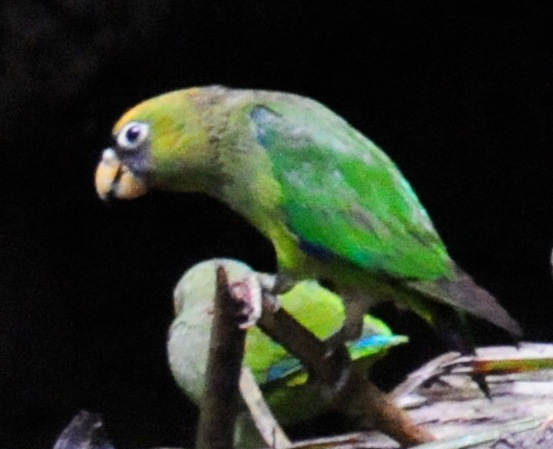
Touit huetii occurs in Bolivia, Brazil, Colombia, Ecuador, Guyana, Peru, and Venezuela, with possible occurrence in Suriname, and has been recorded as a vagrant in Trinidad and Tobago. It has a predominantly green body, red markings on its wings, and sex-specific tail coloration.
Written 26 November 2026 from the sources listed below. Each statement was checked against the passage it cites; statements that could not be supported were removed.
Appearance
The Scarlet-shouldered Parrotlet has a predominantly green body, with darker upperparts. Its face is dark at the front with a white eye ring, while its crown and nape are olive-brown.[1][2][3]
Its upper wing coverts are dark blue, and its primary feathers are black. Its carpal bar, underwing coverts, and axillaries are red.[4][5]
Adult males have green central tail feathers and red outer tail feathers with black tips. Adult females have greenish-yellow tail feathers with black tips, and both sexes have yellow undertail coverts.[6][7][8]
Immature individuals resemble adult females but have green faces.[9]
The species measures 15–16 cm in length and weighs 58–62 g.[10][11]
Habitat
The Scarlet-shouldered Parrotlet inhabits lowland terra firme and várzea forests. It occurs mostly below 900 m elevation but has occasionally been recorded at 1,300 m.[12][13]
Its discontinuous geographical range includes northeastern Venezuela, adjacent Guyana, southeastern Colombia, eastern Ecuador, eastern Peru, northern Bolivia, and Brazil's eastern Amazon Basin.[14][15]
The species is widespread but uncommon across the lowlands of northern South America.[16]
Behaviour
The Scarlet-shouldered Parrotlet is non-migratory but is probably nomadic in Amazonia. Individuals are seldom recorded remaining in one area for more than a few weeks.[17][18]
The species is difficult to observe clearly unless a flock visits a clay lick.[19]
Reproduction and life cycle
The breeding season apparently includes April in southern Venezuela and extends from September through December in southern Brazil.[20][21]
Further details of the species' breeding biology are unknown.[22]
Diet
The species' diet and foraging technique have not been documented.[23]
Conservation
The Scarlet-shouldered Parrotlet is classified as Least Concern on the IUCN Red List. It was most recently assessed in 2021.[24][25][26]
The species has a large geographical range, but its population size is unknown and is believed to be declining. No immediate threats to the species have been identified.[27][28][29]
Although apparently uncommon or rare, the species may be more common than recorded because it is unobtrusive and inhabits remote areas.[30]
Classification of the Scarlet-shouldered Parrotlet
| Kingdom | Animalia |
|---|---|
| Phylum | Chordata |
| Subphylum | Vertebrata |
| Infraphylum | Gnathostomata |
| Parvphylum | Osteichthyes |
| Megaclass | Tetrapoda |
| Class | Aves (Bird) |
| Order | Psittaciformes (Parrot) |
| Family | Psittacidae (Macaws) |
| Genus | Touit (Forest Parrotlets) |
| Species | Touit huetii (Temminck, 1830) |
Where the Scarlet-shouldered Parrotlet is found
Checklists and occurrence records place Touit huetii in 7 countries across South America. GBIF holds 2,784 georeferenced records of it.
Countries
Regions and cities with the most records
- Mato Grosso, Brazil 448
- Orellana Province, Ecuador 442
- Sucumbíos, Ecuador 306
- Madre de Dios, Peru 208
- Pará, Brazil 206
- Guaviare Department, Colombia 184
- Amazonas, Brazil 177
- Loreto, Peru 143
- Meta Department, Colombia 111
- San José del Guaviare, Colombia 107
- Putumayo Department, Colombia 98
- Guainía Department, Colombia 72
- Rondônia, Brazil 48
- Napo, Ecuador 40
- Puerto Asís, Colombia 39
- Vaupés, Colombia 36
- Huánuco Department, Peru 34
- Roraima, Brazil 30
- Novo Airão, Brazil 29
- Tambopata, Peru 28
- Mitú, Colombia 27
- San Martín, Colombia 26
- Boca Suno, Ecuador 23
- Puerto Maldonado, Peru 20
- San Martín Department, Peru 18
- Presidente Figueiredo, Brazil 15
- Bolívar, Venezuela 13
- Caquetá, Colombia 13
- Cauca Department, Colombia 13
- Parauapebas, Brazil 13
- Pastaza Province, Ecuador 13
- Tingo María, Peru 12
- Barima-Waini, Guyana 11
- Amazonas, Venezuela 10
- Monagas, Venezuela 10
- Upper Takutu-Upper Essequibo, Guyana 10
1 more country has a few records outside this range
These countries hold a few records of Touit huetii but lie outside the range the checklists give for it. Such records are often zoo or garden specimens, museum material or vagrants, so the species is not counted as occurring there.
Range as the checklists state it
South America
A number beside a place is its count of GBIF occurrence records. A place without a number comes from a checklist alone. Records show where a species has been observed or collected, which can include escapes and vagrants.
Common names
English
- Scarlet-shouldered Parrotlet
Names in 30 other languages
- Arabic
- ببغاء قرمزي الكتفين
- Catalan
- cotorreta multicolor
- Chinese
- 紫肩鸚哥, 紫肩鹦哥
- Croatian
- modrokrila papigica
- Czech
- papoušek amazonský, papoušík černočelý
- Danish
- Blåvinget Stumppapegøje
- Dutch
- Roodschouderpapegaai
- Esperanto
- nigrafrunta papageto
- Estonian
- mustlaup-väikepapagoi
- Finnish
- punasiipiaranen
- French
- Toui de Huet
- German
- Schwarzstirnpapagei
- Hungarian
- skarlátvállú aprópapagáj, skarlátvállú papagáj
- Italian
- Pappagallino spallescarlatte
- Japanese
- クロビタイイロオインコ
- Lithuanian
- raudonpetė raibauodegė papūga
- Norwegian
- svartpanneparakitt
- Polish
- barwniczka czarnoczelna
- Portuguese
- Periquito-do-encontro-vermelho, apuim-de-asa-vermelha, periquito-d'ombros-vermelhos
- Russian
- Красноплечий туети, Чернолобый пестрохвостый попугай
- Serbian
- Skerletnorameni papagaj
- Slovak
- amazoňan čiernočelý, tui čiernočelý
- Spanish
- Cotorrita alirroja
- Swedish
- rödskuldrad dvärgparakit
- Turkish
- Al Omuzlu Papağan
- Ukrainian
- папуга синьокрилий
- Welsh
- parotan ysgwydd goch
- mrj
- Шим лепкӓн ала пачан попугай
- nav
- Tsídii yáłtiʼí áłtsʼíísí biwos halchíʼígíí
- pnb
- ٹویٹ ہیوٹی
Synonyms
One other scientific name has been used for this species and is now treated as a synonym of Touit huetii.
- Psittacus huetti Temminck, 1830
Related species
-
 Lilac-tailed ParrotletTouit batavicus
-
 Sapphire-rumped ParrotletTouit purpuratus
-
 Blue-fronted ParrotletTouit dilectissimus
-
 Brown-backed ParrotletTouit melanonotus
-
 Golden-tailed ParrotletTouit surdus
- Red-fronted ParrotletTouit costaricensis
-
 Spot-winged ParrotletTouit stictopterus
-
 Spix's MacawCyanopsitta spixii
Compare
Questions and answers
What is the scientific name of the Scarlet-shouldered Parrotlet?
The scientific name of the Scarlet-shouldered Parrotlet is Touit huetii. Written with its author, the full name is Touit huetii (Temminck, 1830).
Which family does the Scarlet-shouldered Parrotlet belong to?
Touit huetii belongs to the family Psittacidae, in the order Psittaciformes and the class Aves.
Where is the Scarlet-shouldered Parrotlet found?
Checklists and occurrence records place Touit huetii in 7 countries, including Brazil, Ecuador, Colombia, Peru, Venezuela and Guyana.
What is the conservation status of the Scarlet-shouldered Parrotlet?
The IUCN Red List category recorded for Touit huetii is Least Concern (LC).
Sources
Passages the profile rests on
- The species has a predominantly green body, with darker coloration on its upperparts. Source passage: “Its body is mostly green, darker above than below.” — English Wikipedia
- Its face is dark at the front and has a white eye ring. Source passage: “The front of its face is dark with a white eye ring” — English Wikipedia
- Its crown and nape are olive-brown. Source passage: “its crown and nape olive-brown.” — English Wikipedia
- Its upper wing coverts are dark blue and its primary feathers are black. Source passage: “Its upper wing coverts are dark blue, its primaries black” — English Wikipedia
- Its carpal bar, underwing coverts, and axillaries are red. Source passage: “its carpal bar, underwing coverts, and axillaries red.” — English Wikipedia
- Adult males have green central tail feathers and red outer tail feathers with black tips. Source passage: “The male's tail has green central feathers and red outer ones with black tips” — English Wikipedia
- Adult females have greenish-yellow tail feathers with black tips. Source passage: “females' tails are all greenish yellow with black tips.” — English Wikipedia
- Both sexes have yellow undertail coverts. Source passage: “Both sexes' under tail coverts are yellow.” — English Wikipedia
- Immature individuals resemble adult females but have green faces. Source passage: “Immature birds are like adult females but with a green face.” — English Wikipedia
- The species measures 15–16 cm in length. Source passage: “is 15 to 16 cm (5.9 to 6.3 in) long” — English Wikipedia
- The species weighs 58–62 g. Source passage: “weighs 58 to 62 g (2.0 to 2.2 oz).” — English Wikipedia
- The species inhabits lowland terra firme and várzea forests. Source passage: “The scarlet-shouldered parrotlet inhabits lowland terra firme and várzea forests.” — English Wikipedia
- The species occurs mostly below 900 m elevation but has occasionally been recorded at 1,300 m. Source passage: “In elevation it mostly occurs below 900 m (3,000 ft) but has occasionally been recorded as high as 1,300 m (4,300 ft).” — English Wikipedia
- The species has a discontinuous geographical distribution. Source passage: “The scarlet-shouldered parrotlet has a disjunct distribution.” — English Wikipedia
- Its range includes northeastern Venezuela, adjacent Guyana, southeastern Colombia, eastern Ecuador, eastern Peru, northern Bolivia, and Brazil's eastern Amazon Basin. Source passage: “It is found in northeastern Venezuela and adjacent Guyana, from southern Venezuela through southeastern Colombia, eastern Ecuador, and eastern Peru into northern Bolivia, and in the eastern Amazon Basin of Brazil.” — English Wikipedia
- The species is widespread but uncommon across the lowlands of northern South America. Source passage: “widespread but uncommon across the lowlands of northern South America.” — ebird.org
- The species is non-migratory but is probably nomadic in Amazonia. Source passage: “The scarlet-shouldered parrotlet is non-migratory but most probably nomadic in Amazonia.” — English Wikipedia
- Individuals are seldom recorded remaining in one area for more than a few weeks. Source passage: “found in one area for more than a few weeks at a time” — English Wikipedia
- The species is difficult to observe clearly unless a flock visits a clay lick. Source passage: “Difficult to see well unless a flock drops into a clay lick” — ebird.org
- The breeding season apparently includes April in southern Venezuela. Source passage: “includes April in southern Venezuela” — English Wikipedia
- The breeding season apparently extends from September through December in southern Brazil. Source passage: “September to December in southern Brazil.” — English Wikipedia
- Further details of the species' breeding biology are unknown. Source passage: “Nothing else is known about its breeding biology.” — English Wikipedia
- The species' diet and foraging technique have not been documented. Source passage: “The scarlet-shouldered parrotlet's foraging technique and diet have not been documented.” — English Wikipedia
- The species is classified as Least Concern by the IUCN. Source passage: “The IUCN has assessed the scarlet-shouldered parrotlet as being of Least Concern.” — English Wikipedia
- The species was most recently assessed for the IUCN Red List in 2021. Source passage: “has most recently been assessed for The IUCN Red List of Threatened Species in 2021.” — iucnredlist.org
- The species is listed as Least Concern on the IUCN Red List. Source passage: “Touit huetii is listed as Least ...” — iucnredlist.org
- The species has a large geographical range. Source passage: “It has a large range” — English Wikipedia
- The species' population size is unknown and is believed to be declining. Source passage: “its population size is not known and is believed to be decreasing.” — English Wikipedia
- No immediate threats to the species have been identified. Source passage: “No immediate threats have been identified.” — English Wikipedia
- Although apparently uncommon or rare, the species may be more common than recorded because it is unobtrusive and inhabits remote areas. Source passage: “Although apparently uncommon to rare, this bird is highly unobtrusive and lives in remote areas, so may be commoner than records indicate” — English Wikipedia
Data
- Catalogue of Life, 2026-10-16 XR cc by
- Global Biodiversity Information Facility CC BY 4.0
- Wikidata CC0
- GeoNames CC BY 4.0
- Wikimedia Commons per image; credit shown with each image
- Within the Catalogue of Life, this name comes from The Integrated Taxonomic Information System cc0
References
- Dickinson, Edward C., ed. (2003). The Howard and Moore Complete Checklist of the Birds of the World, 3rd Edition.
- Gill, Frank, & and Minturn Wright. (2006). Birds of the World: Recommended English Names.
- Dickinson, E. C., and L. Christidis, eds. (2014). The Howard and Moore Complete Checklist of the Birds of the World, 4th Edition, Vol. 2 Passerines.
This species in other databases
Page built on 29 November 2026. See how the catalog is made and all sources and licences.
Cite this page
ScientificNames.org. (2026). Touit huetii (Scarlet-shouldered Parrotlet). Retrieved November 29, 2026, from https://scientificnames.org/species/touit-huetii
“Touit huetii (Scarlet-shouldered Parrotlet).” ScientificNames.org, 2026, scientificnames.org/species/touit-huetii. Accessed 29 Nov. 2026.
ScientificNames.org. “Touit huetii (Scarlet-shouldered Parrotlet).” Accessed November 29, 2026. https://scientificnames.org/species/touit-huetii.
@misc{scientificnames_touit_huetii_scarlet_shouldered_parrotlet,
  author = {{ScientificNames.org}},
  title = {Touit huetii (Scarlet-shouldered Parrotlet)},
  year = {2026},
  url = {https://scientificnames.org/species/touit-huetii},
  note = {Accessed 2026-11-29}
}