Comparison

Threestripe Gourami vs Honey Gourami

Threestripe Gourami (Trichopsis schalleri) and Honey Gourami (Trichogaster chuna) both belong to the family Osphronemidae (gourami) and part ways below it.

Threestripe Gourami

Threestripe Gourami

Trichopsis schalleri

BEDO (Thailand)], CC BY-SA 4.0, via Wikimedia Commons

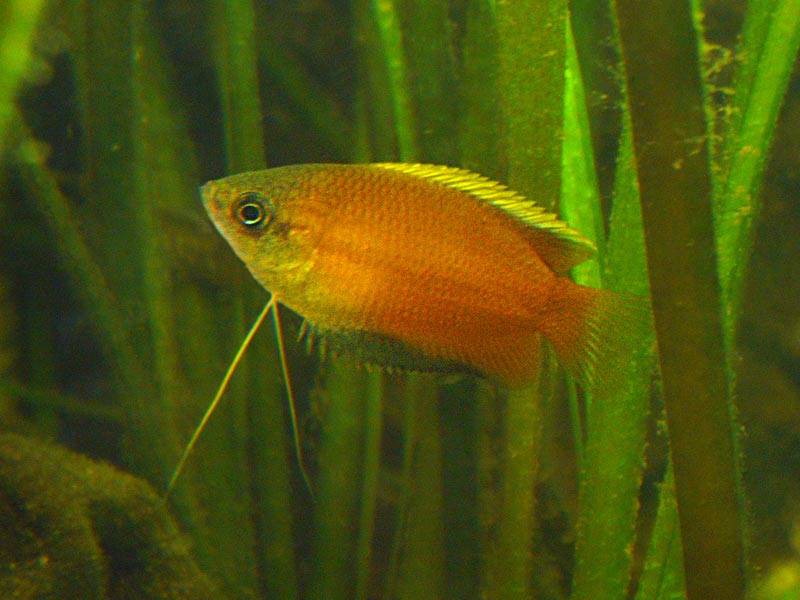
Honey Gourami

Honey Gourami

Trichogaster chuna

Antoondommerholt at Dutch Wikipedia, CC BY-SA 3.0, via Wikimedia Commons

Side by side

Threestripe GouramiHoney Gourami
Scientific nameTrichopsis schalleri Ladiges, 1962Trichogaster chuna (Hamilton, 1822)
English nameThreestripe GouramiHoney Gourami
GroupFishesFishes
ClassTeleostei TeleostTeleostei Teleost
OrderAnabantiformesAnabantiformes
FamilyOsphronemidae GouramiOsphronemidae Gourami
GenusTrichopsis Purring GouramisTrichogaster
Named in19621822
Red List categoryLeast ConcernLeast Concern
Environmentfreshwaterfreshwater
Countries on record3 countries2 countries
GBIF occurrence records203 records67 records

Rows where the two agree are shown in grey.

Where each is found

Only Threestripe Gourami (3)

Only Honey Gourami (2)

From Catalogue of Life checklists and GBIF occurrence records. A country missing from a list means no record is held, which is not proof of absence.

Checked facts

Threestripe GouramiHoney Gourami
Appearance
Size
Habitat
  • The species inhabits still or slow-moving lowland waters. English Wikipedia
  • Its documented habitats include swamp forests and peat swamps. English Wikipedia
  • The species occurs in floodplains, river tributaries, irrigation canals, paddy fields and roadside ditches. English Wikipedia
  • The species appears to prefer still or very slowly flowing water with dense aquatic vegetation or thick vegetation along the shores. English Wikipedia
  • The species inhabits rivers and lakes within its native range. English Wikipedia
  • The species lives in areas with dense vegetation and soft water containing few dissolved minerals. English Wikipedia
  • The species prefers the upper and middle levels of the water column. English Wikipedia
  • In captivity, the species is typically maintained in aquariums with dense vegetation and structural cover. English Wikipedia
DietNo checked fact yet
  • In captivity, early developmental stages initially feed on microscopic food sources before moving to larger prey. English Wikipedia
Behaviour
  • The species can produce audible sounds using a specialised pectoral fin mechanism. English Wikipedia
  • Both sexes can produce short or long bursts of sound. English Wikipedia
  • Sound production occurs mainly during antagonistic interactions or courtship. English Wikipedia
  • The species is generally considered peaceful in community aquariums. English Wikipedia
  • Males may show territorial aggression toward other males in confined aquarium conditions. English Wikipedia
  • Males can establish separate territories and coexist more successfully in larger, well-structured aquariums. English Wikipedia
  • The species can be relatively timid. English Wikipedia
Reproduction
  • Breeding males construct bubble nests among floating plants. English Wikipedia
  • After constructing the bubble nest, the male displays to the female. English Wikipedia
  • During mating, the female positions herself directly beneath the bubble nest and the male wraps his body around her. English Wikipedia
  • The male fertilises the eggs as the female releases them. English Wikipedia
  • The female normally produces approximately ten eggs per mating. English Wikipedia
  • Fertilised eggs float into the bubble nest, and the male retrieves stray eggs and places them in the nest. English Wikipedia
  • Spawning can occur repeatedly until the female has exhausted her supply of eggs. English Wikipedia
  • The male guards the bubble nest after spawning. English Wikipedia
  • The eggs usually hatch after 48 hours. English Wikipedia
  • The orange throat coloration of males becomes more intense during breeding and serves in courtship. English Wikipedia
  • The species reproduces through bubble-nest spawning. English Wikipedia
  • Males construct floating nests from air bubbles and often incorporate plant material. English Wikipedia
  • During spawning, the male embraces the female beneath the nest while eggs are released and fertilized. English Wikipedia
  • The eggs initially sink before the male collects them and places them in the bubble nest. English Wikipedia
  • After spawning, the male alone guards and maintains the nest. English Wikipedia
  • The female typically leaves the nesting area after spawning. English Wikipedia
  • The eggs generally hatch approximately two days after spawning. English Wikipedia
  • The larvae become free-swimming several days after hatching. English Wikipedia
Distribution
  • The species occurs throughout the Mekong basin from Laos through Thailand and Cambodia to the Mekong Delta in Vietnam. English Wikipedia
  • In Thailand, the species also occurs throughout the Chao Phraya river system. English Wikipedia
Uses
  • The species is uncommon in the aquarium trade and is infrequently available. English Wikipedia
  • Wild-caught specimens are normally used for breeding to supply the aquarium trade. English Wikipedia
  • Individuals caught among food fish are discarded. English Wikipedia

In brief

Threestripe Gourami

Trichopsis schalleri inhabits still or slow-moving lowland waters throughout the Mekong basin and the Chao Phraya river system in Thailand. It typically has one or two dark longitudinal stripes, a lanceolate caudal fin and red fin margins with numerous blue spots. Full profile

Honey Gourami

Trichogaster chuna is native to India and Bangladesh, where it inhabits rivers and lakes. Full profile

Compare something else

Page built on 28 November 2026 from the data on the two species pages, where every source is listed.

Cite this page

ScientificNames.org. (2026). Threestripe Gourami vs Honey Gourami. Retrieved November 28, 2026, from https://scientificnames.org/compare/threestripe-gourami-vs-honey-gourami