Species · Fishes
Threestripe Gourami Trichopsis schalleri
The scientific name of the Threestripe Gourami is Trichopsis schalleri. It is a species of fish in the family Osphronemidae (gourami), order Anabantiformes. The name dates from 1962.
- Scientific name
- Trichopsis schalleri Ladiges, 1962
- Common name
- Threestripe Gourami
- Genus
- Trichopsis
- Family
- Osphronemidae (Gourami)
- Order
- Anabantiformes
- Class
- Teleostei
- Red List category
- LC Least Concern
- Environment
- freshwater
- Recorded in
- 3 countries
- Name status
- accepted in the Catalogue of Life

Overview
Trichopsis schalleri inhabits still or slow-moving lowland waters throughout the Mekong basin and the Chao Phraya river system in Thailand. It typically has one or two dark longitudinal stripes, a lanceolate caudal fin and red fin margins with numerous blue spots.
Written 27 November 2026 from the sources listed below. Each statement was checked against the passage it cites; statements that could not be supported were removed.
Appearance
The species typically has one or two dark longitudinal stripes and rarely displays three. It lacks a stripe along the base of its anal fin, and its caudal fin is lanceolate in shape.[1][2][3]
The dorsal, anal and caudal fins have red margins and numerous blue spots. Males have elongated rays in their pelvic, dorsal, anal and caudal fins.[4][5]
The species can reach a total length of 4 centimetres. Males are larger than females, with the largest measured males reaching 5 centimetres in length.[6][7][8]
Similar species
The Threestripe Gourami is intermediate in size between Trichopsis vittata and Trichopsis pumila.[9]
Habitat
The species inhabits still or slow-moving lowland waters. Its documented habitats include swamp forests and peat swamps.[10][11]
It occurs in floodplains, river tributaries, irrigation canals, paddy fields and roadside ditches. It appears to prefer still or very slowly flowing water with dense aquatic vegetation or thick vegetation along the shores.[12][13]
The species occurs throughout the Mekong basin from Laos through Thailand and Cambodia to the Mekong Delta in Vietnam. In Thailand, it also occurs throughout the Chao Phraya river system.[14][15]
Behaviour
The species can produce audible sounds using a specialised pectoral fin mechanism. Both sexes can produce short or long bursts of sound, mainly during antagonistic interactions or courtship.[16][17][18]
Reproduction and life cycle
Breeding males construct bubble nests among floating plants. After constructing the nest, the male displays to the female.[19][20]
During mating, the female positions herself directly beneath the bubble nest and the male wraps his body around her. The male fertilises the eggs as the female releases them, normally producing approximately ten eggs per mating.[21][22][23]
Fertilised eggs float into the bubble nest, and the male retrieves stray eggs and places them in the nest. Spawning can occur repeatedly until the female has exhausted her supply of eggs.[24][25]
The male guards the bubble nest after spawning. The eggs usually hatch after 48 hours.[26][27]
Uses
The species is uncommon in the aquarium trade and is infrequently available. Wild-caught specimens are normally used for breeding to supply the aquarium trade.[28][29]
Individuals caught among food fish are discarded.[30]
Classification of the Threestripe Gourami
| Kingdom | Animalia |
|---|---|
| Phylum | Chordata |
| Subphylum | Vertebrata |
| Infraphylum | Gnathostomata |
| Parvphylum | Osteichthyes |
| Gigaclass | Actinopterygii |
| Superclass | Actinopteri |
| Class | Teleostei (Teleost) |
| Order | Anabantiformes |
| Suborder | Anabantoidei |
| Family | Osphronemidae (Gourami) |
| Subfamily | Macropodusinae |
| Genus | Trichopsis (Purring Gouramis) |
| Species | Trichopsis schalleri Ladiges, 1962 |
Where the Threestripe Gourami is found
Checklists and occurrence records place Trichopsis schalleri in 3 countries. GBIF holds 203 georeferenced records of it.
Countries
Regions and cities with the most records
- Siem Reap, Cambodia 30
- Siem Reap, Cambodia 29
- Ubon Ratchathani, Thailand 20
- Si Sa Ket, Thailand 15
- Bueng Kan, Thailand 14
- Kantharalak, Thailand 14
- Surin, Thailand 13
- Ubon Ratchathani, Thailand 12
- Nong Khai, Thailand 10
- Nong Khai, Thailand 10
- Pakxan, Laos 10
- Warin Chamrap, Thailand 10
- Surin, Thailand 8
- Nakhon Ratchasima, Thailand 7
- Vientiane, Laos 7
- Vientiane Prefecture, Laos 7
- Non Sung, Thailand 6
- Udon Thani, Thailand 5
- Nakhon Phanom, Thailand 4
- Seka, Thailand 4
- Ban Phra, Thailand 3
- Ban Sang, Thailand 3
- Boeng Kak Pir, Cambodia 3
- Chrang Chamreh Muoy, Cambodia 3
- Dangkao, Cambodia 3
- Kampong Cham, Cambodia 3
- Kampong Cham, Cambodia 3
- Khon Kaen, Thailand 3
- Phnom Penh, Cambodia 3
- Phumĭ Âmpĭl Leu, Cambodia 3
- Prachin Buri, Thailand 3
- Savannakhet Province, Laos 3
- Thambon Na Mueang, Thailand 3
- Udon Thani, Thailand 3
A number beside a place is its count of GBIF occurrence records. A place without a number comes from a checklist alone. Records show where a species has been observed or collected, which can include escapes and vagrants.
Common names
English
- Threestripe Gourami
- Mekong Croacking Guaramy
- Schallers Croaking Gourami
Names in 6 other languages
- Czech
- vrčivka Schallerova
- German
- Schallers Knurrender Gurami
- Polish
- Skrzeczyk średni
- Portuguese
- Gourami-do-Mekong
- Thai
- Pla grim Maekong, ปลากริมอีสาน
- Ukrainian
- Гурамі Шаллера
Related species
-
 Pygmy GouramiTrichopsis pumila
-
 Croaking GouramiTrichopsis vittata
-
 Siamese Fighting FishBetta splendens
-
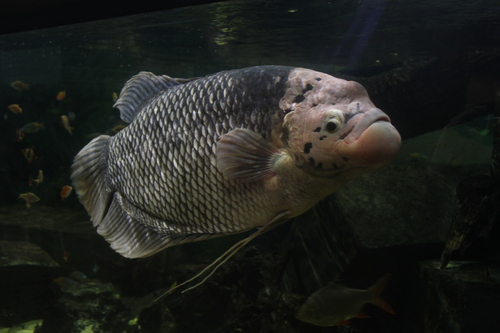 Giant GouramiOsphronemus goramy
-
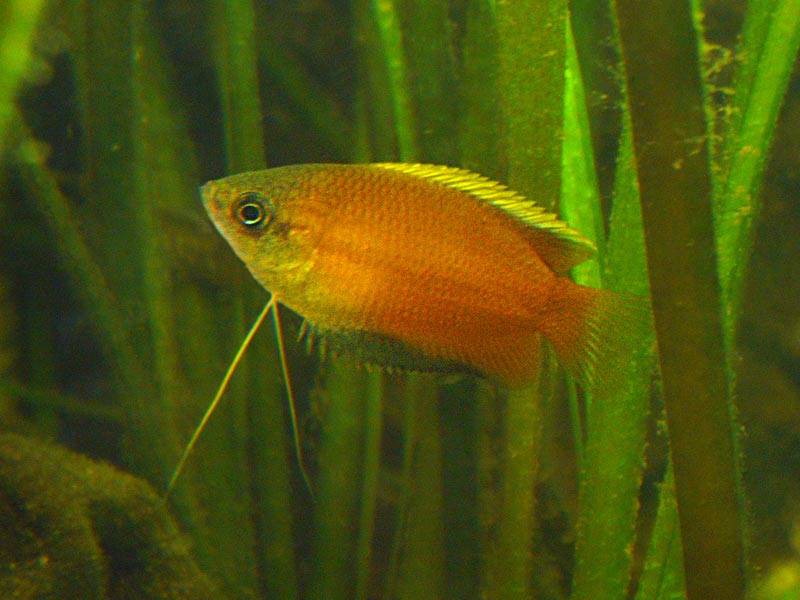 Honey GouramiTrichogaster chuna
-
 Paradise FishMacropodus opercularis
-
 Dwarf GouramiTrichogaster lalius
-
 Three Spot GouramiTrichopodus trichopterus
Compare
Questions and answers
What is the scientific name of the Threestripe Gourami?
The scientific name of the Threestripe Gourami is Trichopsis schalleri. Written with its author, the full name is Trichopsis schalleri Ladiges, 1962.
Which family does the Threestripe Gourami belong to?
Trichopsis schalleri belongs to the family Osphronemidae, in the order Anabantiformes and the class Teleostei.
Where is the Threestripe Gourami found?
Checklists and occurrence records place Trichopsis schalleri in 3 countries: Thailand, Cambodia and Laos.
What is the conservation status of the Threestripe Gourami?
The IUCN Red List category recorded for Trichopsis schalleri is Least Concern (LC).
What other names does the Threestripe Gourami have?
Trichopsis schalleri is also known in English as Mekong Croacking Guaramy and Schallers Croaking Gourami.
Sources
Passages the profile rests on
- The species typically has one or two dark longitudinal stripes and rarely displays three. Source passage: “normally shows one or two, almost never three, dark stripes running the length of its body” — English Wikipedia
- The species lacks a stripe along the base of its anal fin. Source passage: “it lacks any strip along the base of the anal fin.” — English Wikipedia
- Its caudal fin is lanceolate in shape. Source passage: “the caudal fin which is lanceolate in shape.” — English Wikipedia
- The dorsal, anal and caudal fins have red margins and numerous blue spots. Source passage: “The dorsal, anal and caudal fin have red margins and are marked with many blue spots.” — English Wikipedia
- Males have elongated rays in their pelvic, dorsal, anal and caudal fins. Source passage: “Males are larger than the females and have elongated rays in the pelvic, dorsal, anal, and caudal fins.” — English Wikipedia
- The species can reach a total length of 4 centimetres. Source passage: “It can attain a length of 4 centimetres (1.6 in)” — English Wikipedia
- The largest measured males reach 5 centimetres in length. Source passage: “with the largest males measured at 5 centimetres (2.0 in).” — English Wikipedia
- Males are larger than females. Source passage: “Males are larger than the females” — English Wikipedia
- The species is intermediate in size between Trichopsis vittata and Trichopsis pumila. Source passage: “being smaller than the croaking gourami (Trichopsis vittata) and larger than the pygmy gourami (T. pumila).” — English Wikipedia
- The species inhabits still or slow-moving lowland waters. Source passage: “The threestripe gourami occurs in still to slow-moving, lowland waters.” — English Wikipedia
- Its documented habitats include swamp forests and peat swamps. Source passage: “swamp forest, peat swamps, floodplains” — English Wikipedia
- The species occurs in floodplains, river tributaries, irrigation canals, paddy fields and roadside ditches. Source passage: “floodplains, river tributaries, irrigation canals, paddy fields, and roadside ditches.” — English Wikipedia
- The species appears to prefer still or very slowly flowing water with dense aquatic vegetation or thick vegetation along the shores. Source passage: “prefer very slow flowing or still waters where there is a dense growth of aquatic vegetation or thick plant cover along the shores.” — English Wikipedia
- The species occurs throughout the Mekong basin from Laos through Thailand and Cambodia to the Mekong Delta in Vietnam. Source passage: “found throughout the Mekong basin from Laos, through Thailand and Cambodia, including the Tonle Sap to the Mekong Delta in Vietnam.” — English Wikipedia
- In Thailand, the species also occurs throughout the Chao Phraya river system. Source passage: “In Thailand it is also found throughoutin the Chao Praya river system.” — English Wikipedia
- The species can produce audible sounds using a specialised pectoral fin mechanism. Source passage: “make audible sounds using a specialised pectoral mechanism which is unique within the gouramis.” — English Wikipedia
- Both sexes can produce short or long bursts of sound. Source passage: “can produce short or long bursts of sound which are produced by both sexes.” — English Wikipedia
- Sound production occurs mainly during antagonistic interactions or courtship. Source passage: “Sound is mainly produced when the fish are interacting antagonistically or courting.” — English Wikipedia
- Breeding males construct bubble nests among floating plants. Source passage: “The breeding male creates a bubblenest among floating plants” — English Wikipedia
- After constructing the bubble nest, the male displays to the female. Source passage: “when that is complete he will display to the female.” — English Wikipedia
- During mating, the female positions herself directly beneath the bubble nest and the male wraps his body around her. Source passage: “she will move to directly beneath the bubblenestand the male will wrap his body around hers.” — English Wikipedia
- The male fertilises the eggs as the female releases them. Source passage: “As she spawns the male simultaneously fertilises the eggs.” — English Wikipedia
- The female normally produces approximately ten eggs per mating. Source passage: “The female normally produces about ten eggs per mating” — English Wikipedia
- Fertilised eggs float into the bubble nest, and the male retrieves stray eggs and places them in the nest. Source passage: “after fertilisation these float up into the bubblenest with any stray eggs being collected by the male and placed in the nest.” — English Wikipedia
- Spawning can occur repeatedly until the female has exhausted her supply of eggs. Source passage: “Spawning may be repeated several times until the female runs out of eggs.” — English Wikipedia
- The male guards the bubble nest after spawning. Source passage: “After spawning is complete the male guards the nest” — English Wikipedia
- The eggs usually hatch after 48 hours. Source passage: “the eggs usually hatching after 48 hours.” — English Wikipedia
- The species is uncommon in the aquarium trade and is infrequently available. Source passage: “The threestripe gourami is uncommon in the aquarium trade and is said to be infrequently available.” — English Wikipedia
- Wild-caught specimens are normally used for breeding to supply the aquarium trade. Source passage: “Live specimens taken from the wild are normally used for breeding to provide fish for the aquarium trade.” — English Wikipedia
- Individuals caught among food fish are discarded. Source passage: “It is discarded if caught among foodfish.” — English Wikipedia
Data
- Catalogue of Life, 2026-10-16 XR cc by
- Global Biodiversity Information Facility CC BY 4.0
- Wikidata CC0
- GeoNames CC BY 4.0
- Wikimedia Commons per image; credit shown with each image
- Within the Catalogue of Life, this name comes from World Register of Marine Species cc by
References
- Ladiges, W. (1962). Trichopsis schalleri spec. nov., ein neuer Gurami aus Thailand. Die Aquarien- Und Terrarienzeitschrift (DATZ), 15 (4): 101–103. where the name was published
This species in other databases
- Catalogue of Life 7CT2W
- Wikidata Q6417401
- iNaturalist 188585
- WoRMS urn:lsid:marinespecies.org:taxname:1010961
- ITIS 638784
Page built on 27 November 2026. See how the catalog is made and all sources and licences.
Cite this page
ScientificNames.org. (2026). Trichopsis schalleri (Threestripe Gourami). Retrieved November 27, 2026, from https://scientificnames.org/species/trichopsis-schalleri
“Trichopsis schalleri (Threestripe Gourami).” ScientificNames.org, 2026, scientificnames.org/species/trichopsis-schalleri. Accessed 27 Nov. 2026.
ScientificNames.org. “Trichopsis schalleri (Threestripe Gourami).” Accessed November 27, 2026. https://scientificnames.org/species/trichopsis-schalleri.
@misc{scientificnames_trichopsis_schalleri_threestripe_gourami,
  author = {{ScientificNames.org}},
  title = {Trichopsis schalleri (Threestripe Gourami)},
  year = {2026},
  url = {https://scientificnames.org/species/trichopsis-schalleri},
  note = {Accessed 2026-11-27}
}