Comparison
Croaking Gourami vs Giant Gourami
Croaking Gourami (Trichopsis vittata) and Giant Gourami (Osphronemus goramy) both belong to the family Osphronemidae (gourami) and part ways below it. Both are recorded in 7 countries.


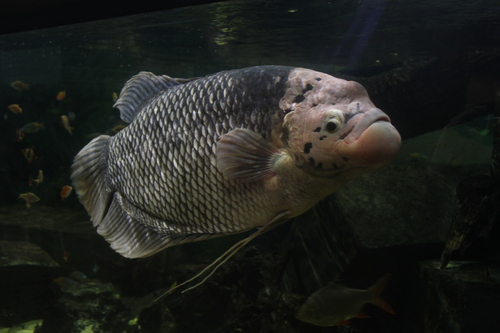
Giant Gourami
Osphronemus goramy
(c) Tim Sheerman-Chase, some rights reserved (CC BY), CC BY 4.0, via iNaturalist
Side by side
| Croaking Gourami | Giant Gourami | |
|---|---|---|
| Scientific name | Trichopsis vittata (Cuvier, 1831) | Osphronemus goramy Lacepède, 1801 |
| English name | Croaking Gourami | Giant Gourami |
| Group | Fishes | Fishes |
| Class | Teleostei Teleost | Teleostei Teleost |
| Order | Anabantiformes | Anabantiformes |
| Family | Osphronemidae Gourami | Osphronemidae Gourami |
| Genus | Trichopsis Purring Gouramis | Osphronemus Kaloi Fishes |
| Named in | 1831 | 1801 |
| Red List category | Least Concern | Least Concern |
| Environment | freshwater | brackish, freshwater |
| Countries on record | 10 countries | 13 countries |
| GBIF occurrence records | 1,216 records | 406 records |
Rows where the two agree are shown in grey.
Where each is found
Both recorded in 7 countries
Only Croaking Gourami (3)
Only Giant Gourami (6)
From Catalogue of Life checklists and GBIF occurrence records. A country missing from a list means no record is held, which is not proof of absence.
Checked facts
| Croaking Gourami | Giant Gourami | |
|---|---|---|
| Appearance |
|
|
| Size |
|
|
| Habitat |
| No checked fact yet |
| Diet |
|
|
| Behaviour |
|
|
| Reproduction |
|
|
| Distribution |
|
|
| Uses |
|
|
| Other |
|
|
In brief
Croaking Gourami
The Croaking Gourami (Trichopsis vittata) is a freshwater labyrinth fish belonging to the family Osphronemidae. It inhabits still freshwater environments, including ponds, canals, and rice paddy fields. It can produce audible grunting or chirping sounds using specialized adaptations of its pectoral fins. Full profile
Giant Gourami
Osphronemus goramy is substantially larger than most other gouramis and can reach a maximum standard length of 80 cm. Full profile
Compare something else
Page built on 28 November 2026 from the data on the two species pages, where every source is listed.
Cite this page
ScientificNames.org. (2026). Croaking Gourami vs Giant Gourami. Retrieved November 28, 2026, from https://scientificnames.org/compare/croaking-gourami-vs-giant-gourami
“Croaking Gourami vs Giant Gourami.” ScientificNames.org, 2026, scientificnames.org/compare/croaking-gourami-vs-giant-gourami. Accessed 28 Nov. 2026.
ScientificNames.org. “Croaking Gourami vs Giant Gourami.” Accessed November 28, 2026. https://scientificnames.org/compare/croaking-gourami-vs-giant-gourami.
@misc{scientificnames_croaking_gourami_vs_giant_gourami,
  author = {{ScientificNames.org}},
  title = {Croaking Gourami vs Giant Gourami},
  year = {2026},
  url = {https://scientificnames.org/compare/croaking-gourami-vs-giant-gourami},
  note = {Accessed 2026-11-28}
}