Species · Fishes
Croaking Gourami Trichopsis vittata
The scientific name of the Croaking Gourami is Trichopsis vittata. It is a species of fish in the family Osphronemidae (gourami), order Anabantiformes. The name dates from 1831.
- Scientific name
- Trichopsis vittata (Cuvier, 1831)
- Common name
- Croaking Gourami
- Genus
- Trichopsis
- Family
- Osphronemidae (Gourami)
- Order
- Anabantiformes
- Class
- Teleostei
- Red List category
- LC Least Concern
- Environment
- freshwater
- Recorded in
- 10 countries
- Name status
- accepted in the Catalogue of Life

Overview
The Croaking Gourami (Trichopsis vittata) is a freshwater labyrinth fish belonging to the family Osphronemidae. It inhabits still freshwater environments, including ponds, canals, and rice paddy fields. It can produce audible grunting or chirping sounds using specialized adaptations of its pectoral fins.
Written 26 November 2026 from the sources listed below. Each statement was checked against the passage it cites; statements that could not be supported were removed.
Uses
The Croaking Gourami is associated with the aquarium trade.[1]
Appearance
The species has highly variable coloration, ranging from pale brown and green to dark purple. Its flanks bear between two and four brown or black stripes or rows of spots.[2][3]
Its median fins have thin iridescent blue edges, and its iris is bright blue or purple.[4][5]
Females are generally paler than males and have a slightly rounded dorsal fin. Males have a pointed dorsal fin, and females have a shorter anal fin than males.[6][7][8]
The species reaches an average length of approximately 5 cm, while some individuals reach 6–7 cm.[9][10]
Habitat
The Croaking Gourami inhabits still freshwater environments, including ponds, canals, and rice paddy fields.[11][12]
It is native to Java, Borneo, Sumatra, Malaya, Thailand, Laos, Cambodia, and Vietnam. Introduced breeding populations occur in Florida, including in drainage ditches.[13][14][15]
The species has spread beyond its native range through the aquarium trade.[16]
Diet
The species is predominantly insectivorous in the wild, consuming insects and insect larvae. Its diet also includes zooplankton, crustaceans, shrimp meat, and plant matter.[17][18][19]
Behaviour
The Croaking Gourami can produce audible grunting or chirping sounds using specialized adaptations of its pectoral fins. Both sexes produce sounds during breeding displays, while males also produce sounds when establishing dominance hierarchies.[20][21][22]
Male confrontations involve circling, fin flaring, aggressive darting, and croaking. Well-matched males may continue these displays for several hours.[23][24]
The species is described as shy and peaceful in community aquaria. Males can become territorial and aggressive toward one another during breeding periods.[25][26]
The species can breathe atmospheric oxygen using a specialized labyrinth organ.[27]
Reproduction and life cycle
Males construct bubble nests from air bubbles and mucus beneath leaves. Spawning takes place beneath the bubble nest.[28][29]
Females respond to male courtship dances by rolling over before the spawning embrace. They release approximately five to ten eggs in each spawning burst.[30][31]
A spawning female may lay approximately 100 eggs, while large females may produce more than 200. The male collects released eggs and transfers them into the bubble nest.[32][33]
The male maintains the bubble nest and cares for the eggs and fry after spawning. The male should be removed when the fry are two to three days old.[34][35]
Classification of the Croaking Gourami
| Kingdom | Animalia |
|---|---|
| Phylum | Chordata |
| Subphylum | Vertebrata |
| Infraphylum | Gnathostomata |
| Parvphylum | Osteichthyes |
| Gigaclass | Actinopterygii |
| Superclass | Actinopteri |
| Class | Teleostei (Teleost) |
| Order | Anabantiformes |
| Suborder | Anabantoidei |
| Family | Osphronemidae (Gourami) |
| Subfamily | Macropodusinae |
| Genus | Trichopsis (Purring Gouramis) |
| Species | Trichopsis vittata (Cuvier, 1831) |
Where the Croaking Gourami is found
Checklists and occurrence records place Trichopsis vittata in 10 countries. GBIF holds 1,216 georeferenced records of it.
Countries
- Bangladesh 49
- Cambodia 125
- India 3
- Indonesia 163
- Laos 49
- Malaysia 75
- Myanmar 38
- Singapore 47
- Thailand 589
- Vietnam 78
Regions and cities with the most records
- Kanchanaburi, Thailand 72
- Siem Reap, Cambodia 58
- Siem Reap, Cambodia 54
- Ang Mo Kio New Town, Singapore 35
- Johor Bahru, Malaysia 35
- Sembawang Estate, Singapore 35
- Sungai Simpang, Singapore 35
- Woodlands, Singapore 35
- Yio Chu Kang, Singapore 35
- Yishun New Town, Singapore 35
- Boon Lay, Singapore 34
- Bukit Panjang New Town, Singapore 34
- Bukit Timah, Singapore 34
- Kampung Pasir Gudang Baru, Malaysia 34
- Marsiling, Singapore 34
- Ubon Ratchathani, Thailand 34
- Yew Tee, Singapore 34
- Anak Bukit, Singapore 33
- Choa Chu Kang New Town, Singapore 33
- Jurong East, Singapore 33
- Jurong Town, Singapore 33
- Jurong West, Singapore 33
- Kampung Larkin Lama, Malaysia 33
- Keat Hong Village, Singapore 33
- Novena, Singapore 33
- Sengkang New Town, Singapore 33
- Teck Whye, Singapore 33
- Queenstown Estate, Singapore 32
- Masai, Malaysia 31
- Taman Permas Jaya, Malaysia 31
- Bandar Seri Alam, Malaysia 30
- Dhaka Division, Bangladesh 30
- Perling, Malaysia 30
- Bangkok, Thailand 29
- Horizon Hills, Malaysia 29
- Huai Khwang, Thailand 29
3 more countries have a few records outside this range
These countries hold a few records of Trichopsis vittata but lie outside the range the checklists give for it. Such records are often zoo or garden specimens, museum material or vagrants, so the species is not counted as occurring there.
A number beside a place is its count of GBIF occurrence records. A place without a number comes from a checklist alone. Records show where a species has been observed or collected, which can include escapes and vagrants.
Common names
English
- Croaking Gourami
- Croaking Guaramy
Names in 9 other languages
- Czech
- vrčivka pruhovaná
- Danish
- Knurrende gurami
- German
- Knurrender Gurami
- Indonesian
- Cupang Sawah
- Polish
- Skrzeczyk pręgowany
- Portuguese
- Gourami-javanês
- Russian
- Ворчащий гурами
- Thai
- Pla Grim Kwai, ปลากริมข้างลาย, ปลากริมควาย
- Ukrainian
- Гурамі-буркун
Synonyms
5 other scientific names have been used for this species and are now treated as synonyms of Trichopsis vittata.
- Ctenops vittatus (Cuvier, 1831)
- Osphromenus vittatus Cuvier, 1831
- Trichopsis harrisi Fowler, 1934
- Trichopsis vittatus (Cuvier, 1831)
- Trichopus striatus Bleeker, 1845
Related species
-
 Pygmy GouramiTrichopsis pumila
-
 Threestripe GouramiTrichopsis schalleri
-
 Siamese Fighting FishBetta splendens
-
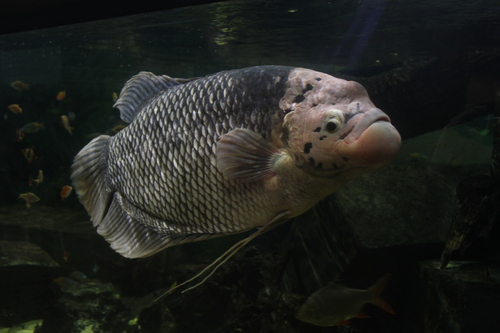 Giant GouramiOsphronemus goramy
-
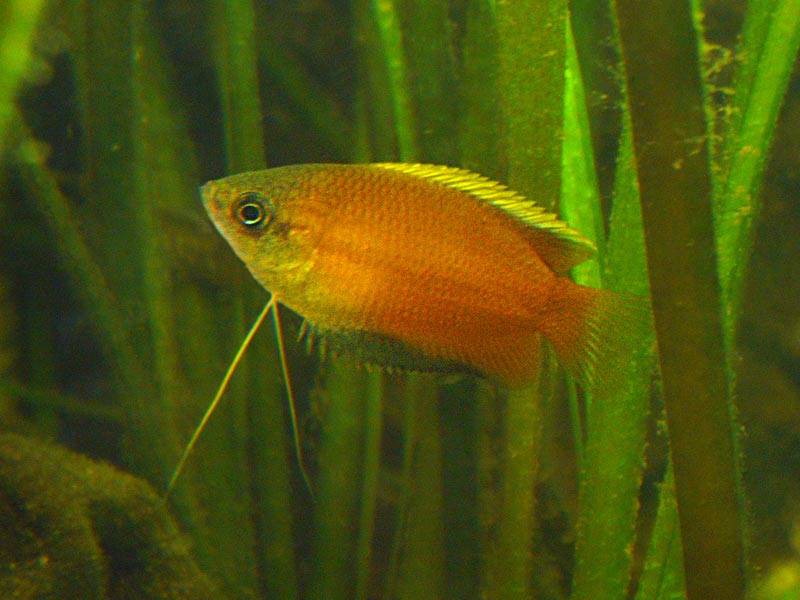 Honey GouramiTrichogaster chuna
-
 Paradise FishMacropodus opercularis
-
 Dwarf GouramiTrichogaster lalius
-
 Three Spot GouramiTrichopodus trichopterus
Compare
Questions and answers
What is the scientific name of the Croaking Gourami?
The scientific name of the Croaking Gourami is Trichopsis vittata. Written with its author, the full name is Trichopsis vittata (Cuvier, 1831).
Which family does the Croaking Gourami belong to?
Trichopsis vittata belongs to the family Osphronemidae, in the order Anabantiformes and the class Teleostei.
Where is the Croaking Gourami found?
Checklists and occurrence records place Trichopsis vittata in 10 countries, including Thailand, Indonesia, Cambodia, Vietnam, Malaysia and Bangladesh.
What is the conservation status of the Croaking Gourami?
The IUCN Red List category recorded for Trichopsis vittata is Least Concern (LC).
What other names does the Croaking Gourami have?
Trichopsis vittata is also known in English as Croaking Guaramy.
Sources
Passages the profile rests on
- The species is associated with the aquarium trade. Source passage: “due to the aquarium trade, the fish has spread” — English Wikipedia
- The species has highly variable coloration, ranging from pale brown and green to dark purple. Source passage: “Coloration is highly variable, ranging from pale brown and green to dark purple with black or red spots on the fins.” — English Wikipedia
- Its flanks bear between two and four brown or black stripes or rows of spots. Source passage: “2 to 4 brown or black stripes or rows of spots are present on the flanks.” — English Wikipedia
- Its median fins have thin iridescent blue edges. Source passage: “Median fins have a thin iridescent blue coloration on their edges” — English Wikipedia
- Its iris is bright blue or purple. Source passage: “the iris is bright blue or purple.” — English Wikipedia
- Females are generally paler than males and have a slightly rounded dorsal fin. Source passage: “Females tend to be paler than males, with a slightly rounded dorsal fin” — English Wikipedia
- Males have a pointed dorsal fin. Source passage: “the dorsal fin of males is instead pointed” — English Wikipedia
- Females have a shorter anal fin than males. Source passage: “and a shorter anal fin.” — English Wikipedia
- The species reaches an average length of approximately 5 cm. Source passage: “The croaking gourami reaches an average size of about 5 cm (2.0 in)” — English Wikipedia
- Some individuals reach lengths of 6–7 cm. Source passage: “some individuals can grow as long as 6 or 7 cm (2.4 or 2.8 in).” — English Wikipedia
- The species inhabits still freshwater environments. Source passage: “The croaking gourami is native to stillwater habitats” — English Wikipedia
- Its native habitats include ponds, canals, and rice paddy fields. Source passage: “including ponds, canals and paddy fields” — English Wikipedia
- An introduced breeding population occurs in drainage ditches in Florida. Source passage: “A breeding population is known to exist in a series of drainage ditches in Florida” — English Wikipedia
- The species is native to Java, Borneo, Sumatra, Malaya, Thailand, Laos, Cambodia, and Vietnam. Source passage: “in Java, Borneo, Sumatra, Malaya, Thailand, Laos, Cambodia, and Vietnam.” — English Wikipedia
- An introduced breeding population is established in Florida. Source passage: “A breeding population is known to exist in a series of drainage ditches in Florida” — English Wikipedia
- The species has spread beyond its native range through the aquarium trade. Source passage: “due to the aquarium trade, the fish has spread to other parts of Southeast Asia (like East Malaysia) and to other parts of the world.” — English Wikipedia
- The species is predominantly insectivorous in the wild. Source passage: “In the wild, the croaking gourami is mostly insectivorous” — English Wikipedia
- Its wild diet includes insects and insect larvae. Source passage: “feeding on insects and insect larvae.” — English Wikipedia
- The species also consumes zooplankton, crustaceans, shrimp meat, and plant matter. Source passage: “other food types, such as zooplankton, crustaceans, shrimp meat and plant matter, are eaten as well.” — English Wikipedia
- The species can produce audible grunting or chirping sounds using specialized adaptations of its pectoral fins. Source passage: “capable of producing an audible grunting or chirping noise, accomplished through the use of specialized adaptations of their pectoral fins.” — English Wikipedia
- Both sexes produce sounds during breeding displays. Source passage: “These noises are produced by both sexes during breeding displays” — English Wikipedia
- Males produce sounds when establishing dominance hierarchies. Source passage: “and during the establishment of dominance hierarchies among males.” — English Wikipedia
- Male confrontations involve circling, fin flaring, aggressive darting, and croaking. Source passage: “each fish circling the other, flaring fins, aggressively darting (though rarely making contact), and producing croaking noises.” — English Wikipedia
- Well-matched males may continue confrontational displays for several hours. Source passage: “Well-matched individuals may continue this behavior for several hours at a time.” — English Wikipedia
- The species is described as shy and peaceful in community aquaria. Source passage: “The croaking gourami is a fairly shy, peaceful fish that does well in most community aquaria” — English Wikipedia
- Males can become territorial and aggressive toward one another during breeding periods. Source passage: “Males can be fairly territorial and aggressive towards each other during breeding periods” — English Wikipedia
- The species can breathe atmospheric oxygen using a specialized labyrinth organ. Source passage: “the croaking gourami can breathe atmospheric oxygen from above the water surface using a specialized labyrinth organ.” — English Wikipedia
- Males construct bubble nests from air bubbles and mucus beneath leaves. Source passage: “creating a small nest from air bubbles and mucus under a leaf.” — English Wikipedia
- Spawning takes place beneath the bubble nest. Source passage: “Spawning occurs under the nest” — English Wikipedia
- Females respond to male courtship dances by rolling over before the spawning embrace. Source passage: “with the female responding to the male's dance by rolling over, followed by the typical gourami embrace.” — English Wikipedia
- Females release approximately five to ten eggs in each spawning burst. Source passage: “About 5 to 10 eggs are released in a quick burst.” — English Wikipedia
- A spawning female may lay approximately 100 eggs, while large females may produce more than 200. Source passage: “until about 100 eggs are laid (some large females may lay more than 200).” — English Wikipedia
- The male collects released eggs and transfers them into the bubble nest. Source passage: “The male will grab the eggs and spit them into the nest” — English Wikipedia
- The male maintains the bubble nest and cares for the eggs and fry after spawning. Source passage: “The male will keep the bubblenest maintained and tend to the eggs and fry” — English Wikipedia
- The male should be removed when the fry are two to three days old. Source passage: “when the fry are 2 to 3 days old, the male should also be removed” — English Wikipedia
Data
- Catalogue of Life, 2026-10-16 XR cc by
- Global Biodiversity Information Facility CC BY 4.0
- Wikidata CC0
- GeoNames CC BY 4.0
- Wikimedia Commons per image; credit shown with each image
- Within the Catalogue of Life, this name comes from World Register of Marine Species cc by
References
- Cuvier and Valenciennes, 1831 where the name was published
This species in other databases
- Catalogue of Life 7CSQW
- Wikidata Q4348592
- iNaturalist 188586
- WoRMS urn:lsid:marinespecies.org:taxname:1022647
- ITIS 553301
Page built on 28 November 2026. See how the catalog is made and all sources and licences.
Cite this page
ScientificNames.org. (2026). Trichopsis vittata (Croaking Gourami). Retrieved November 28, 2026, from https://scientificnames.org/species/trichopsis-vittata
“Trichopsis vittata (Croaking Gourami).” ScientificNames.org, 2026, scientificnames.org/species/trichopsis-vittata. Accessed 28 Nov. 2026.
ScientificNames.org. “Trichopsis vittata (Croaking Gourami).” Accessed November 28, 2026. https://scientificnames.org/species/trichopsis-vittata.
@misc{scientificnames_trichopsis_vittata_croaking_gourami,
  author = {{ScientificNames.org}},
  title = {Trichopsis vittata (Croaking Gourami)},
  year = {2026},
  url = {https://scientificnames.org/species/trichopsis-vittata},
  note = {Accessed 2026-11-28}
}