Comparison

Blue-bellied Parrot vs Grey Parrot

Blue-bellied Parrot (Triclaria malachitacea) and Grey Parrot (Psittacus erithacus) both belong to the family Psittacidae (macaws) and part ways below it.
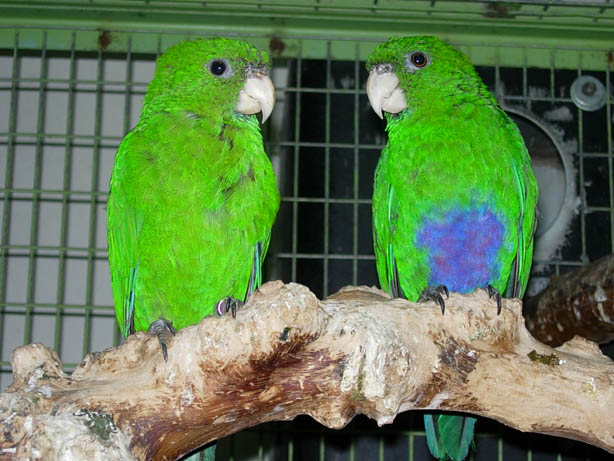
Blue-bellied Parrot

Blue-bellied Parrot

Triclaria malachitacea

TJ Lin, CC BY-SA 2.0, via Wikimedia Commons

Grey Parrot

Grey Parrot

Psittacus erithacus

Florettesokeng, CC BY-SA 4.0, via Wikimedia Commons

Side by side

Blue-bellied ParrotGrey Parrot
Scientific nameTriclaria malachitacea (von Spix, 1824)Psittacus erithacus Linnaeus, 1758
English nameBlue-bellied ParrotGrey Parrot
GroupBirdsBirds
ClassAves BirdAves Bird
OrderPsittaciformes ParrotPsittaciformes Parrot
FamilyPsittacidae MacawsPsittacidae Macaws
GenusTriclariaPsittacus Grey Parrot
Named in18241758
Red List categoryLeast ConcernEndangered
Countries on record2 countries21 countries
GBIF occurrence records3,030 records12,913 records

Rows where the two agree are shown in grey.

Where each is found

Only Blue-bellied Parrot (2)

Only Grey Parrot (21)

From Catalogue of Life checklists and GBIF occurrence records. A country missing from a list means no record is held, which is not proof of absence.

Checked facts

Blue-bellied ParrotGrey Parrot
Appearance
  • The species has predominantly green plumage and a whitish beak. English Wikipedia
  • Adult males have a bluish-purple patch on the belly that females lack. English Wikipedia
  • The species has a long tail, a blue tail tip and bluish underwings. ebird.org
  • The species has a pale bill and a relatively long tail. ebird.org
Size
Habitat
  • The species is generally considered endemic to the humid Atlantic Forest of southeastern Brazil. English Wikipedia
  • The species is now mostly restricted to remnant forest strips on slopes and ridges. English Wikipedia
  • The species occurs at elevations of up to 1,000 m. English Wikipedia
  • The species inhabits both primary and secondary rainforests. pmc.ncbi.nlm.nih.gov
  • The species commonly occurs in moist lowland forests. animaldiversity.org
  • The species also occurs along forest edges, in clearings, gallery forests, mangroves, wooded savannahs, cultivated areas, and gardens. animaldiversity.org
  • Individuals have been recorded at elevations reaching 2,200 m in the eastern parts of their range. animaldiversity.org
  • The species uses natural forest clearings with marshy or muddy soil. pmc.ncbi.nlm.nih.gov
  • Individuals commonly roost in trees above water and may favour river islands. animaldiversity.org
Diet
  • The species feeds on seeds, fruits, flower buds, nectar and some insects. English Wikipedia
Behaviour
  • The species produces whistled calls, and pairs sometimes sing in duets. English Wikipedia
  • The species is typically fairly quiet and can consequently be easily overlooked. English Wikipedia
  • Breeding pairs are highly territorial during the breeding season. English Wikipedia
  • The species is highly social and forms large groups. animaldiversity.org
  • Wild individuals are shy and rarely allow humans to approach them. animaldiversity.org
  • Individuals gather in large, noisy flocks during morning and evening roosting periods. animaldiversity.org
  • During daytime, individuals divide into smaller flocks and travel long distances to forage. animaldiversity.org
  • The species is a partial ground feeder. English Wikipedia
  • Groups visiting forest clearings typically perch in surrounding trees and vocalize before landing to feed, drink, and interact. pmc.ncbi.nlm.nih.gov
  • An average of 40 individuals visited the studied forest clearing each day. pmc.ncbi.nlm.nih.gov
  • Visits to forest clearings become shorter when predators or humans disturb the birds. pmc.ncbi.nlm.nih.gov
  • Wild individuals can imitate sounds heard in their environment. English Wikipedia
Reproduction
Distribution
  • The species occurs in southeastern Brazil, from Espírito Santo south through Rio de Janeiro, São Paulo and Paraná to Santa Catarina and Rio Grande do Sul. datazone.birdlife.org
  • The species is native to equatorial Africa. English Wikipedia
  • Its native range includes Angola, Cameroon, the Congo, Gabon, Ivory Coast, Ghana, Kenya, and Uganda. English Wikipedia
  • The species occurs across the forest belt of central and West Africa, including Príncipe. animaldiversity.org
Conservation
  • Agricultural cultivation of tobacco and bananas has contributed to the removal of much of the species' original forest habitat. English Wikipedia
  • The remaining forest strips occupied by the species cover substantially less than 10% of its original range. English Wikipedia
  • An earlier estimate suggested that 5,000–10,000 individuals survived. English Wikipedia
  • More recent evidence suggests that approximately 10,000 individuals survive in Rio Grande do Sul alone. English Wikipedia
  • Significant populations occur in Rio de Janeiro and São Paulo, although population estimates for these states are unavailable. English Wikipedia
  • The species' population is declining throughout its range because of continuing habitat changes. English Wikipedia
  • The cage-bird trade is not currently considered a major threat because relatively few individuals are captured for local markets. English Wikipedia
  • Fair numbers of the species reached the Netherlands during the 1970s and 1980s. English Wikipedia
  • The species was most recently assessed for the IUCN Red List in 2021. iucnredlist.org
  • The species is classified as Endangered on the IUCN Red List. English Wikipedia
  • Capture for the pet trade and habitat loss are major threats to the species. pmc.ncbi.nlm.nih.gov
  • Grey parrot populations declined by an estimated 50–79% in recent decades. pmc.ncbi.nlm.nih.gov
  • The species received the highest level of CITES protection in October 2016 through Appendix I listing. English Wikipedia
  • Protecting forest clearings from disturbance and capture is recommended as a conservation measure. pmc.ncbi.nlm.nih.gov
UsesNo checked fact yet
  • The species is commonly kept as a companion parrot because of its ability to mimic human speech. English Wikipedia
OtherNo checked fact yet

In brief

Blue-bellied Parrot

Triclaria malachitacea occurs in the humid Atlantic Forest of southeastern Brazil, generally in remnant forest strips on slopes and ridges. It is distinguished by a bluish-purple belly patch in adult males, which females lack, and is the only species in its genus. Full profile

Grey Parrot

Psittacus erithacus inhabits primary and secondary rainforests and commonly occurs in moist lowland forests. Full profile

Compare something else

Page built on 28 November 2026 from the data on the two species pages, where every source is listed.

Cite this page

ScientificNames.org. (2026). Blue-bellied Parrot vs Grey Parrot. Retrieved November 28, 2026, from https://scientificnames.org/compare/blue-bellied-parrot-vs-grey-parrot