Species · Birds
Blue-bellied Parrot Triclaria malachitacea
The scientific name of the Blue-bellied Parrot is Triclaria malachitacea. It is a species of bird in the family Psittacidae (macaws), order Psittaciformes. The name dates from 1824.
- Scientific name
- Triclaria malachitacea (von Spix, 1824)
- Common name
- Blue-bellied Parrot
- Genus
- Triclaria
- Family
- Psittacidae (Macaws)
- Order
- Psittaciformes
- Class
- Aves
- Red List category
- LC Least Concern
- Recorded in
- 2 countries
- Name status
- accepted in the Catalogue of Life
Overview
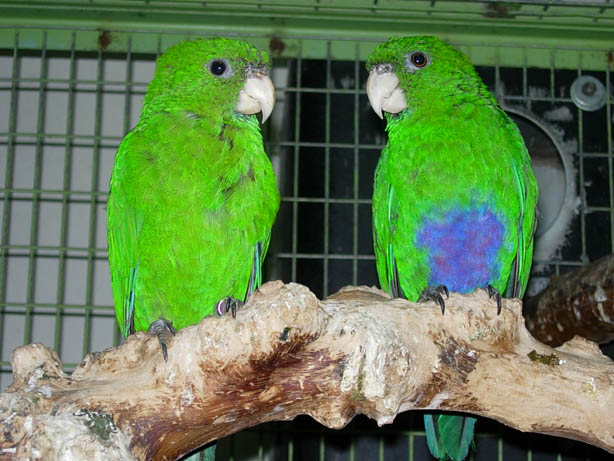
Triclaria malachitacea occurs in the humid Atlantic Forest of southeastern Brazil, generally in remnant forest strips on slopes and ridges. It is distinguished by a bluish-purple belly patch in adult males, which females lack, and is the only species in its genus.
Written 26 November 2026 from the sources listed below. Each statement was checked against the passage it cites; statements that could not be supported were removed.
Appearance
The Blue-bellied Parrot has predominantly green plumage and a pale, whitish bill. It has a relatively long tail with a blue tip and bluish underwings.[1][2][3]
Adult males have a bluish-purple patch on the belly that females lack. The species has an approximate total body length of 28 cm.[4][5]
Habitat
The Blue-bellied Parrot is generally considered endemic to the humid Atlantic Forest of southeastern Brazil. It is now mostly restricted to remnant forest strips on slopes and ridges.[6][7]
The species occurs at elevations of up to 1,000 m.[8]
Diet
The Blue-bellied Parrot feeds on seeds, fruits, flower buds, nectar and some insects.[9]
Behaviour
The species produces whistled calls, and pairs sometimes sing in duets. It is typically fairly quiet and can consequently be easily overlooked.[10][11]
Breeding pairs are highly territorial during the breeding season.[12]
Reproduction and life cycle
The Blue-bellied Parrot nests in cavities of large trees or palms. It generally nests from September through January.[13][14]
In Rio Grande do Sul, the nesting season begins in October rather than September.[15]
Conservation
Agricultural cultivation of tobacco and bananas has contributed to the removal of much of the species' original forest habitat. The remaining forest strips occupied by the species cover substantially less than 10% of its original range.[16][17]
An earlier estimate suggested that 5,000–10,000 individuals survived. More recent evidence suggests that approximately 10,000 individuals survive in Rio Grande do Sul alone.[18][19]
Significant populations occur in Rio de Janeiro and São Paulo, although population estimates for these states are unavailable. The species' population is declining throughout its range because of continuing habitat changes.[20][21]
The cage-bird trade is not currently considered a major threat because relatively few individuals are captured for local markets. Fair numbers of the species reached the Netherlands during the 1970s and 1980s.[22][23]
The species was most recently assessed for the IUCN Red List in 2021.[24]
Classification of the Blue-bellied Parrot
| Kingdom | Animalia |
|---|---|
| Phylum | Chordata |
| Subphylum | Vertebrata |
| Infraphylum | Gnathostomata |
| Parvphylum | Osteichthyes |
| Megaclass | Tetrapoda |
| Class | Aves (Bird) |
| Order | Psittaciformes (Parrot) |
| Family | Psittacidae (Macaws) |
| Genus | Triclaria |
| Species | Triclaria malachitacea (von Spix, 1824) |
Where the Blue-bellied Parrot is found
Checklists and occurrence records place Triclaria malachitacea in 2 countries across South America. GBIF holds 3,030 georeferenced records of it.
Countries
Regions and cities with the most records
- São Paulo, Brazil 1,818
- Guapiara, Brazil 583
- Rio Grande do Sul, Brazil 495
- Santa Catarina, Brazil 378
- Juquitiba, Brazil 346
- São Lourenço da Serra, Brazil 219
- Embu-Guaçu, Brazil 201
- São Francisco de Paula, Brazil 183
- Rio de Janeiro, Brazil 120
- Itapecerica da Serra, Brazil 92
- Santo Amaro da Imperatriz, Brazil 84
- Palhoça, Brazil 81
- Paraná, Brazil 78
- Peruíbe, Brazil 72
- Itariri, Brazil 69
- Ubatuba, Brazil 67
- Cachoeiras de Macacu, Brazil 62
- Mongaguá, Brazil 59
- Dois Irmãos, Brazil 52
- Salesópolis, Brazil 51
- Sapiranga, Brazil 51
- Nova Petrópolis, Brazil 49
- Nova Hartz, Brazil 48
- Itanhaém, Brazil 47
- Campo Bom, Brazil 46
- São Miguel Arcanjo, Brazil 46
- São José, Brazil 44
- São Sebastião, Brazil 43
- Apiaí, Brazil 42
- Caraguatatuba, Brazil 42
- Nova Friburgo, Brazil 41
- Schroeder, Brazil 40
- Arroio do Meio, Brazil 38
- Caxias do Sul, Brazil 38
- Rolante, Brazil 38
- Ivoti, Brazil 36
1 more country has a few records outside this range
These countries hold a few records of Triclaria malachitacea but lie outside the range the checklists give for it. Such records are often zoo or garden specimens, museum material or vagrants, so the species is not counted as occurring there.
Range as the checklists state it
South America
A number beside a place is its count of GBIF occurrence records. A place without a number comes from a checklist alone. Records show where a species has been observed or collected, which can include escapes and vagrants.
Common names
English
- Blue-bellied Parrot
- Purple-bellied Parrot
Names in 30 other languages
- Arabic
- ببغاء أزرق البطن
- Catalan
- Lloret ventreblau, lloret panxablau
- Chinese
- 蓝腹鹦哥, 藍腹鸚哥
- Croatian
- plavotrba papiga
- Czech
- amazoňan modrobřichý
- Danish
- Blåbuget Papegøje
- Dutch
- Paarsbuikparkiet
- Esperanto
- bluventra papago
- Estonian
- laulupapagoi
- Finnish
- sinivatsa-amatsoni
- French
- Crick à ventre bleu
- German
- Blaubauchpapagei, Blaubauchsittich
- Hebrew
- תוכי כחול-בטן
- Hungarian
- malachitpapagáj
- Italian
- Pappagallo panciablu
- Japanese
- アオハラインコ
- Lithuanian
- mėlynpilvė papūga
- Norwegian
- blåbukpapegøye
- Polish
- malachitka
- Portuguese
- Araçaiava, Araçuaiava, papagaio-de-barriga-azul, sabiá-cica
- Russian
- Синебрюхий попугай
- Serbian
- Plavotrbi papagaj (malahita)
- Slovak
- malachitka modrobruchá
- Spanish
- Loro ventriazul
- Swedish
- blåbukig papegoja
- Turkish
- Mavi Karınlı Papağan
- Ukrainian
- папуга синьочеревий
- Welsh
- parot torbiws
- mrj
- Симсӹ мӹшкӹрӓн попугай
- pnb
- نیلے ٹڈوالا طوطا
Synonyms
3 other scientific names have been used for this species and are now treated as synonyms of Triclaria malachitacea.
- Psittacus cyanogaster Shaw, G, 1812
- Psittacus cyanogaster Wied-Neuwied, M, 1820
- Psittacus malachitaceus von Spix, 1824
Related species
-
 Spix's MacawCyanopsitta spixii
-
 Grey ParrotPsittacus erithacus
-
 Scarlet MacawAra macao
-
 Hyacinth MacawAnodorhynchus hyacinthinus
-
 Blue-and-yellow MacawAra ararauna
-
 Sun ConureAratinga solstitialis
-
 Green ParakeetPsittacara holochlorus
-
 Green-cheeked ParakeetPyrrhura molinae
Compare
Questions and answers
What is the scientific name of the Blue-bellied Parrot?
The scientific name of the Blue-bellied Parrot is Triclaria malachitacea. Written with its author, the full name is Triclaria malachitacea (von Spix, 1824).
Which family does the Blue-bellied Parrot belong to?
Triclaria malachitacea belongs to the family Psittacidae, in the order Psittaciformes and the class Aves.
Where is the Blue-bellied Parrot found?
Checklists and occurrence records place Triclaria malachitacea in 2 countries: Brazil and Argentina.
What is the conservation status of the Blue-bellied Parrot?
The IUCN Red List category recorded for Triclaria malachitacea is Least Concern (LC).
What other names does the Blue-bellied Parrot have?
Triclaria malachitacea is also known in English as Purple-bellied Parrot.
What type of habitat do parrots live in?
The Blue-bellied Parrot is generally associated with the humid Atlantic Forest of southeastern Brazil. It is now mostly restricted to remnant forest strips on slopes and ridges.[6][7]
What is the diet of parrots?
The Blue-bellied Parrot feeds on seeds, fruits, flower buds, nectar and some insects.[9]
Sources
Passages the profile rests on
- The species has predominantly green plumage and a whitish beak. Source passage: “It is green overall and the beak is whitish.” — English Wikipedia
- The species has a long tail, a blue tail tip and bluish underwings. Source passage: “Mostly green with a blue tail tip and bluish underwings.” — ebird.org
- The species has a pale bill and a relatively long tail. Source passage: “Fairly large parrot with a long tail and a pale bill.” — ebird.org
- Adult males have a bluish-purple patch on the belly that females lack. Source passage: “Only the male has the bluish-purple patch on the belly for which this species is named.” — English Wikipedia
- The species has an approximate total body length of 28 cm. Source passage: “It is a relatively long-tailed parrot with a total length of c. 28 cm. (11 in).” — English Wikipedia
- The species is generally considered endemic to the humid Atlantic Forest of southeastern Brazil. Source passage: “It is generally considered endemic to the humid Atlantic Forest of southeastern Brazil” — English Wikipedia
- The species is now mostly restricted to remnant forest strips on slopes and ridges. Source passage: “Now mostly restricted to remnant forest strips on slopes and ridges” — English Wikipedia
- The species occurs at elevations of up to 1,000 m. Source passage: “It occurs up to 1000 m. (3300 ft).” — English Wikipedia
- The species feeds on seeds, fruits, flower buds, nectar and some insects. Source passage: “It has been recorded feeding on seeds, fruits, flower buds, nectar and some insects.” — English Wikipedia
- The species produces whistled calls, and pairs sometimes sing in duets. Source passage: “It has a whistled call and pairs will sing in duet” — English Wikipedia
- The species is typically fairly quiet and can consequently be easily overlooked. Source passage: “but it is typically fairly quiet and therefore easily overlooked.” — English Wikipedia
- Breeding pairs are highly territorial during the breeding season. Source passage: “The pair is highly territorial during the breeding season.” — English Wikipedia
- The species nests in cavities of large trees or palms. Source passage: “The nest is placed in the cavity of a large tree or palm.” — English Wikipedia
- The species generally nests from September through January. Source passage: “It nests between September (October in Rio Grande do Sul) and January.” — English Wikipedia
- In Rio Grande do Sul, the nesting season begins in October rather than September. Source passage: “September (October in Rio Grande do Sul) and January.” — English Wikipedia
- Agricultural cultivation of tobacco and bananas has contributed to the removal of much of the species' original forest habitat. Source passage: “Much of the original forest cover in its range has been removed in favour of cultivated crops like tobacco and bananas.” — English Wikipedia
- The remaining forest strips occupied by the species cover substantially less than 10% of its original range. Source passage: “which cover far less than 10% of the original range.” — English Wikipedia
- An earlier estimate suggested that 5,000–10,000 individuals survived. Source passage: “Previously, it was believed that 5,000–10,000 birds survived” — English Wikipedia
- More recent evidence suggests that approximately 10,000 individuals survive in Rio Grande do Sul alone. Source passage: “recent evidence suggests that c. 10,000 survive in the state of Rio Grande do Sul alone.” — English Wikipedia
- Significant populations occur in Rio de Janeiro and São Paulo, although population estimates for these states are unavailable. Source passage: “Significant populations also exists in the states of Rio de Janeiro and São Paulo, but population estimates for these are not available.” — English Wikipedia
- The species' population is declining throughout its range because of continuing habitat changes. Source passage: “numbers are dwindling throughout its range due to further habitat changes.” — English Wikipedia
- The cage-bird trade is not currently considered a major threat because relatively few individuals are captured for local markets. Source passage: “The cage-bird trade is not considered a major threat at this point, as only a small number are captured for the local market” — English Wikipedia
- Fair numbers of the species reached the Netherlands during the 1970s and 1980s. Source passage: “fair numbers reached the Netherlands in the 1970-1980s.” — English Wikipedia
- The species was most recently assessed for the IUCN Red List in 2021. Source passage: “has most recently been assessed for The IUCN Red List of Threatened Species in 2021.” — iucnredlist.org
Data
- Catalogue of Life, 2026-10-16 XR cc by
- Global Biodiversity Information Facility CC BY 4.0
- Wikidata CC0
- GeoNames CC BY 4.0
- Wikimedia Commons per image; credit shown with each image
- Within the Catalogue of Life, this name comes from The Integrated Taxonomic Information System cc0
References
- Gill, Frank, & and Minturn Wright. (2006). Birds of the World: Recommended English Names.
- Dickinson, E. C., and L. Christidis, eds. (2014). The Howard and Moore Complete Checklist of the Birds of the World, 4th Edition, Vol. 2 Passerines.
This species in other databases
Page built on 28 November 2026. See how the catalog is made and all sources and licences.
Cite this page
ScientificNames.org. (2026). Triclaria malachitacea (Blue-bellied Parrot). Retrieved November 28, 2026, from https://scientificnames.org/species/triclaria-malachitacea
“Triclaria malachitacea (Blue-bellied Parrot).” ScientificNames.org, 2026, scientificnames.org/species/triclaria-malachitacea. Accessed 28 Nov. 2026.
ScientificNames.org. “Triclaria malachitacea (Blue-bellied Parrot).” Accessed November 28, 2026. https://scientificnames.org/species/triclaria-malachitacea.
@misc{scientificnames_triclaria_malachitacea_blue_bellied_parrot,
  author = {{ScientificNames.org}},
  title = {Triclaria malachitacea (Blue-bellied Parrot)},
  year = {2026},
  url = {https://scientificnames.org/species/triclaria-malachitacea},
  note = {Accessed 2026-11-28}
}