Comparison

Thick-billed Ground Pigeon vs White-headed Fruit Dove

Thick-billed Ground Pigeon (Trugon terrestris) and White-headed Fruit Dove (Ptilinopus eugeniae) both belong to the subfamily Raphinae and part ways below it. Both are recorded in 1 country.
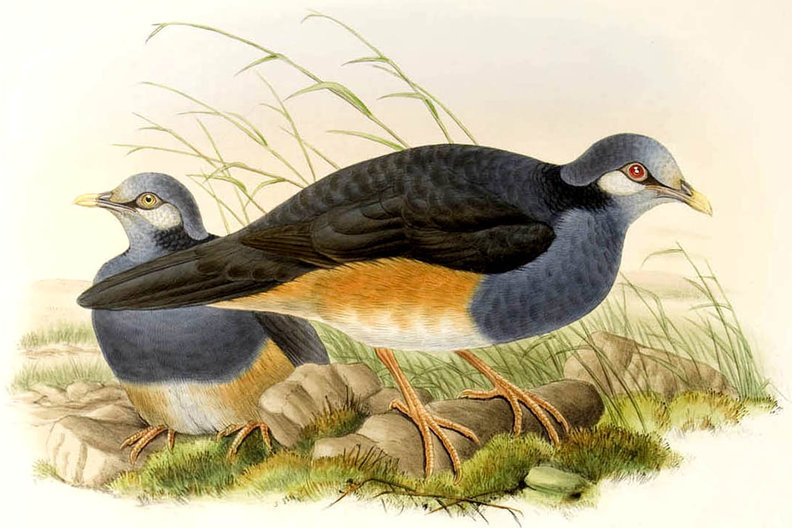
Thick-billed Ground Pigeon

Thick-billed Ground Pigeon

Trugon terrestris

John Gould, Public domain, via Wikimedia Commons

White-headed Fruit Dove

White-headed Fruit Dove

Ptilinopus eugeniae

John Gerrard Keulemans, Public domain, via Wikimedia Commons

Side by side

Thick-billed Ground PigeonWhite-headed Fruit Dove
Scientific nameTrugon terrestris G. R. Gray, 1849Ptilinopus eugeniae (Gould, 1856)
English nameThick-billed Ground PigeonWhite-headed Fruit Dove
GroupBirdsBirds
ClassAves BirdAves Bird
OrderColumbiformes DovesColumbiformes Doves
FamilyColumbidae DovesColumbidae Doves
GenusTrugonPtilinopus Fruit Dove
Named in18491856
Red List categoryLeast ConcernLeast Concern
Countries on record3 countries2 countries
GBIF occurrence records253 records228 records

Rows where the two agree are shown in grey.

Where each is found

Both recorded in 1 country

Only Thick-billed Ground Pigeon (2)

Only White-headed Fruit Dove (1)

From Catalogue of Life checklists and GBIF occurrence records. A country missing from a list means no record is held, which is not proof of absence.

Checked facts

Thick-billed Ground PigeonWhite-headed Fruit Dove
Appearance
  • The species has uniform bluish-grey or brownish-grey upperparts, a grey breast, and an orangey-buff belly. English Wikipedia
  • The species has a broad bill with a pale tip, pale ear coverts, and a short nape crest. English Wikipedia
  • Its underwing coverts have prominent black-and-white streaks, while its tail lacks bands. English Wikipedia
  • The species has pale legs and a long, thick bill with a pale tip. ebird.org
  • Males and females have similar external appearances. English Wikipedia
Size
Habitat
  • The species inhabits moist tropical lowland forests. English Wikipedia
  • Its lowland forest habitat extends to elevations of approximately 650 m. English Wikipedia
  • The species is usually found in primary humid forest but can also use partially cleared areas. English Wikipedia
Diet
  • The species feeds on fruits and seeds that have fallen to the forest floor. English Wikipedia
  • It picks up fruits with its bill and strikes them against the ground to expose their seeds. English Wikipedia
  • Small food items are swallowed whole. English Wikipedia
  • The species sometimes forages at magnificent bird-of-paradise display arenas for regurgitated seeds. English Wikipedia
Behaviour
  • The species is usually observed alone or in pairs. English Wikipedia
  • Small groups may gather at large fruiting trees. English Wikipedia
  • The species forms mixed-species feeding flocks with silver-capped fruit doves and chestnut-bellied imperial pigeons. English Wikipedia
  • The species has a fast, straight flight. English Wikipedia
  • The species often flies over open areas. English Wikipedia
  • The advertising call is a soft two-note phrase given at intervals of 3–6 seconds. English Wikipedia
  • The second note of the advertising call lasts approximately 0.5 seconds and is more strongly emphasised than the first. English Wikipedia
  • The advertising call is occasionally repeated several times. English Wikipedia
Reproduction
  • Breeding appears to occur throughout the year. English Wikipedia
  • Nests have been recorded between February and October. English Wikipedia
  • The species nests in hollows in the ground, potentially concealed among the buttress roots of large trees. English Wikipedia
  • The nest may be unlined, contain a few twigs or leaves, or have a more elaborate structure. English Wikipedia
  • The female lays a single white egg. English Wikipedia
  • Both parents incubate the egg, with the male routinely taking daytime incubation duties. English Wikipedia
  • Fledged chicks remain within their parents' territory for approximately one month. English Wikipedia
Distribution
Conservation
  • The species is classified as Least Concern by the International Union for Conservation of Nature. English Wikipedia
  • The species has a very wide range and is not considered subject to any particular threats. English Wikipedia
  • The species is threatened by deforestation and habitat loss. English Wikipedia
  • The species can adapt to disturbed habitats. English Wikipedia
  • The 2023 IUCN assessment records a continuing decline in mature individuals. iucnredlist.org
  • The 2023 IUCN assessment records a continuing decline in the area, extent or quality of the species' habitat. iucnredlist.org
  • Conservation sites have been identified across part of the species' range. iucnredlist.org
  • The species is not recorded as occurring in any protected area in the 2023 IUCN assessment. iucnredlist.org
Similar species
  • The species' thick bill and white cheek distinguish it from similar pigeons. ebird.org
  • The yellow-bibbed fruit dove can be confused with the white-headed fruit dove. English Wikipedia
  • Male yellow-bibbed fruit doves can be distinguished by their bright yellow breastband. English Wikipedia
  • Female and juvenile yellow-bibbed fruit doves lack the grey shoulder patch and have brighter yellow vents. English Wikipedia
  • The white-headed fruit dove differs from the claret-breasted fruit dove through its white head and upper throat, dark purple breast-patch border and duller green underparts. English Wikipedia

In brief

Thick-billed Ground Pigeon

Trugon terrestris is native to the island of New Guinea, where it inhabits moist tropical lowland forests. It is distinguished by its thick bill with a pale tip and its white cheek. Full profile

White-headed Fruit Dove

Ptilinopus eugeniae is endemic to the Solomon Islands and occurs on Makira, Ugi and Malaupaina. It is distinguished by its snowy-white head and upper throat and rich purplish-red breast patch bordered by dark purple. Full profile

Compare something else

Page built on 28 November 2026 from the data on the two species pages, where every source is listed.

Cite this page

ScientificNames.org. (2026). Thick-billed Ground Pigeon vs White-headed Fruit Dove. Retrieved November 28, 2026, from https://scientificnames.org/compare/thick-billed-ground-pigeon-vs-white-headed-fruit-dove