Species · Birds
Thick-billed Ground Pigeon Trugon terrestris
The scientific name of the Thick-billed Ground Pigeon is Trugon terrestris. It is a species of bird in the family Columbidae (doves), order Columbiformes. The name dates from 1849.
- Scientific name
- Trugon terrestris G. R. Gray, 1849
- Common name
- Thick-billed Ground Pigeon
- Genus
- Trugon
- Family
- Columbidae (Doves)
- Order
- Columbiformes
- Class
- Aves
- Red List category
- LC Least Concern
- Recorded in
- 3 countries
- Name status
- accepted in the Catalogue of Life
Overview
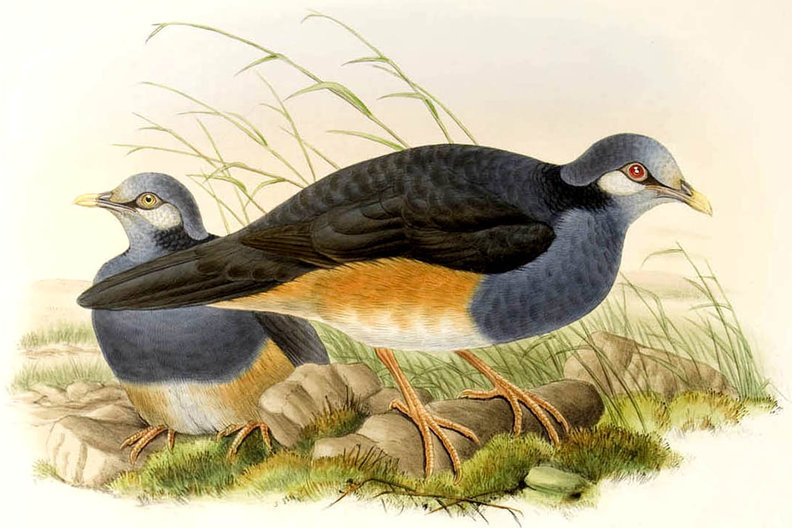
Trugon terrestris is native to the island of New Guinea, where it inhabits moist tropical lowland forests. It is distinguished by its thick bill with a pale tip and its white cheek.
Written 26 November 2026 from the sources listed below. Each statement was checked against the passage it cites; statements that could not be supported were removed.
Similar species
The Thick-billed Ground Pigeon's thick bill and white cheek distinguish it from similar pigeons.[1]
Appearance
The species has uniform bluish-grey or brownish-grey upperparts, a grey breast and an orangey-buff belly. Its underwing coverts have prominent black-and-white streaks, while its tail lacks bands.[2][3]
It has a broad, long and thick bill with a pale tip, pale ear coverts, pale legs and a short nape crest. Males and females have similar external appearances.[4][5][6]
Adults reach approximately 33 cm in length.[7]
Habitat
The species inhabits moist tropical lowland forests, with its habitat extending to elevations of approximately 650 m. It is usually found in primary humid forest but can also use partially cleared areas.[8][9][10]
Diet
The species feeds on fruits and seeds that have fallen to the forest floor. It picks up fruits with its bill and strikes them against the ground to expose their seeds, while small food items are swallowed whole.[11][12][13]
It sometimes forages at magnificent bird-of-paradise display arenas for regurgitated seeds.[14]
Behaviour
The species generally forages alone but occasionally occurs in pairs. It is generally shy and spends most of its time on the ground.[15][16]
When disturbed, it usually runs into the undergrowth. When threatened, it launches into the air with vigorous, rapid wingbeats.[17][18]
It frequently flicks its tail downwards while walking and roosts at night on low branches.[19][20]
Reproduction and life cycle
Breeding appears to occur throughout the year, and nests have been recorded between February and October. The species nests in hollows in the ground, potentially concealed among the buttress roots of large trees.[21][22][23]
The nest may be unlined, contain a few twigs or leaves, or have a more elaborate structure. The female lays a single white egg.[24][25]
Both parents incubate the egg, with the male routinely taking daytime incubation duties. Fledged chicks remain within their parents' territory for approximately one month.[26][27]
Conservation
It is classified as Least Concern by the International Union for Conservation of Nature. Its very wide range and the absence of any particular threats are consistent with this classification.[28][29]
Classification of the Thick-billed Ground Pigeon
| Kingdom | Animalia |
|---|---|
| Phylum | Chordata |
| Subphylum | Vertebrata |
| Infraphylum | Gnathostomata |
| Parvphylum | Osteichthyes |
| Megaclass | Tetrapoda |
| Class | Aves (Bird) |
| Order | Columbiformes (Doves) |
| Family | Columbidae (Doves) |
| Subfamily | Raphinae |
| Genus | Trugon |
| Species | Trugon terrestris G. R. Gray, 1849 |
Where the Thick-billed Ground Pigeon is found
Checklists and occurrence records place Trugon terrestris in 3 countries across Oceania. GBIF holds 253 georeferenced records of it.
Countries
Regions and cities with the most records
- Western Province, Papua New Guinea 43
- Central Province, Papua New Guinea 20
- Gulf Province, Papua New Guinea 6
- Madang Province, Papua New Guinea 5
- Fakfak, Indonesia 3
Range as the checklists state it
Australia
A number beside a place is its count of GBIF occurrence records. A place without a number comes from a checklist alone. Records show where a species has been observed or collected, which can include escapes and vagrants.
Common names
English
- Thick-billed Ground Pigeon
- Thick-billed Ground-Pigeon
- Grey Ground Pigeon
- Jungle Pigeon
- Slaty Ground Pigeon
Names in 28 other languages
- Arabic
- حمام الأرض سميك المنقار
- Catalan
- colom perdiu
- Chinese
- 厚嘴地鳩, 厚嘴地鸠
- Croatian
- pozemni golub
- Czech
- holub břidlicový
- Danish
- Øredue
- Dutch
- Grijze Grondduif
- Esperanto
- Dikbeka grundokolombo, dikbeka kolombo
- Estonian
- habetuvi
- Finnish
- isopyykyyhky
- French
- Trugon terrestre
- German
- Dickschnabelerdtaube, Erdtaube, Neuguinea-Erdtaube
- Hungarian
- földi galamb
- Indonesian
- Delimukan puyuh
- Italian
- Piccione terragnolo
- Japanese
- ハシブトバト
- Lithuanian
- storasnapis balandis
- Norwegian
- gladiatordue
- Polish
- papuasek
- Portuguese
- pombo-de-bico-grosso
- Russian
- Толстоклювый голубь
- Serbian
- Debelokljuni papuanski golub
- Slovak
- trugón zemný
- Spanish
- Paloma perdiz picogorda
- Swedish
- gladiatorduva, tjocknäbbad markduva
- Turkish
- Yer Güvercini
- Ukrainian
- тругон
- Welsh
- colomen ddaear bigbraff
Subspecies and varieties
- Trugon terrestris leucopareia subspecies
- Trugon terrestris mayri subspecies
- Trugon terrestris terrestris subspecies
Related species
-
 White-headed Fruit DovePtilinopus eugeniae
-
 Rock DoveColumba livia
-
 Mourning DoveZenaida macroura
-
 Nicobar PigeonCaloenas nicobarica
-
 Eurasian Collared DoveStreptopelia decaocto
-
 Common Wood PigeonColumba palumbus
-
 Spotted DoveSpilopelia chinensis
-
 European Turtle DoveStreptopelia turtur
Compare
Questions and answers
What is the scientific name of the Thick-billed Ground Pigeon?
The scientific name of the Thick-billed Ground Pigeon is Trugon terrestris. Written with its author, the full name is Trugon terrestris G. R. Gray, 1849.
Which family does the Thick-billed Ground Pigeon belong to?
Trugon terrestris belongs to the family Columbidae, in the order Columbiformes and the class Aves.
Where is the Thick-billed Ground Pigeon found?
Checklists and occurrence records place Trugon terrestris in 3 countries: Indonesia, Papua New Guinea and Australia.
What is the conservation status of the Thick-billed Ground Pigeon?
The IUCN Red List category recorded for Trugon terrestris is Least Concern (LC).
What other names does the Thick-billed Ground Pigeon have?
Trugon terrestris is also known in English as Thick-billed Ground-Pigeon, Grey Ground Pigeon, Jungle Pigeon and Slaty Ground Pigeon.
Sources
Passages the profile rests on
- The species' thick bill and white cheek distinguish it from similar pigeons. Source passage: “Thick bill and white cheek differentiate it from any” — ebird.org
- The species has uniform bluish-grey or brownish-grey upperparts, a grey breast, and an orangey-buff belly. Source passage: “The upper parts are a uniform bluish-grey or brownish-grey, the breast is grey and the belly orangey-buff.” — English Wikipedia
- Its underwing coverts have prominent black-and-white streaks, while its tail lacks bands. Source passage: “The underwing coverts are boldly streaked in black and white but the tail is unbanded.” — English Wikipedia
- The species has a broad bill with a pale tip, pale ear coverts, and a short nape crest. Source passage: “The beak is broad with a pale tip, the ear coverts are pale and there is a short crest on the nape.” — English Wikipedia
- The species has pale legs and a long, thick bill with a pale tip. Source passage: “Pale legs and a long, thick, pale-tipped bill.” — ebird.org
- Males and females have similar external appearances. Source passage: “the sexes are similar in appearance.” — English Wikipedia
- Adults reach approximately 33 cm in length. Source passage: “This robust species grows to a length of 33 cm (13 in);” — English Wikipedia
- The species inhabits moist tropical lowland forests. Source passage: “its natural habitat is moist tropical lowland forest.” — English Wikipedia
- Its lowland forest habitat extends to elevations of approximately 650 m. Source passage: “Its habitat is lowland forest at altitudes up to about 650 m (2,000 ft).” — English Wikipedia
- The species is usually found in primary humid forest but can also use partially cleared areas. Source passage: “Although usually found in primary humid forest, it seems to be able to make use of partially cleared areas.” — English Wikipedia
- The species feeds on fruits and seeds that have fallen to the forest floor. Source passage: “It feeds on fruits and seeds that have fallen to the ground.” — English Wikipedia
- It picks up fruits with its bill and strikes them against the ground to expose their seeds. Source passage: “It picks up fruit with its beak and hammers it on the ground to split it, exposing and eating the seeds.” — English Wikipedia
- Small food items are swallowed whole. Source passage: “Small items are swallowed whole.” — English Wikipedia
- The species sometimes forages at magnificent bird-of-paradise display arenas for regurgitated seeds. Source passage: “It sometimes visits the display arenas of the magnificent bird-of-paradise in order to forage for regurgitated seeds.” — English Wikipedia
- The species generally forages alone but occasionally occurs in pairs. Source passage: “The thick-billed ground pigeon usually forages alone, but is sometimes seen in pairs.” — English Wikipedia
- The species is generally shy and spends most of its time on the ground. Source passage: “It is generally shy, staying mainly on the ground” — English Wikipedia
- When disturbed, the species usually runs into the undergrowth. Source passage: “running away into the undergrowth when disturbed,” — English Wikipedia
- When threatened, the species launches into the air with vigorous, rapid wingbeats. Source passage: “but launching itself vigorously into the air with rapidly beating wings when it feels threatened.” — English Wikipedia
- The species frequently flicks its tail downwards while walking. Source passage: “It flicks its tail downwards frequently as it walks.” — English Wikipedia
- The species roosts at night on low branches. Source passage: “This bird roosts at night on low branches.” — English Wikipedia
- Breeding appears to occur throughout the year. Source passage: “Breeding seems to take place at any time of year,” — English Wikipedia
- Nests have been recorded between February and October. Source passage: “with nests having been found between February and October.” — English Wikipedia
- The species nests in hollows in the ground, potentially concealed among the buttress roots of large trees. Source passage: “The nest is a hollow in the ground, perhaps concealed between the buttress roots of a large tree.” — English Wikipedia
- The nest may be unlined, contain a few twigs or leaves, or have a more elaborate structure. Source passage: “It may be unlined or may incorporate a few twigs or leaves, or may be rather more elaborate.” — English Wikipedia
- The female lays a single white egg. Source passage: “A single white egg is laid” — English Wikipedia
- Both parents incubate the egg, with the male routinely taking daytime incubation duties. Source passage: “and is incubated by both parents, the male routinely sitting during the daytime.” — English Wikipedia
- Fledged chicks remain within their parents' territory for approximately one month. Source passage: “The fledged chick stays in its parents' territory for about a month.” — English Wikipedia
- The species is classified as Least Concern by the International Union for Conservation of Nature. Source passage: “the International Union for Conservation of Nature has assessed its conservation status as being of "least concern".” — English Wikipedia
- The species has a very wide range and is not considered subject to any particular threats. Source passage: “It has a very wide range and does not seem to be subject to any particular threats,” — English Wikipedia
Data
- Catalogue of Life, 2026-10-16 XR cc by
- Global Biodiversity Information Facility CC BY 4.0
- Wikidata CC0
- GeoNames CC BY 4.0
- Wikimedia Commons per image; credit shown with each image
- Within the Catalogue of Life, this name comes from The Integrated Taxonomic Information System cc0
References
- Gill, Frank, & and Minturn Wright. (2006). Birds of the World: Recommended English Names.
This species in other databases
Page built on 27 November 2026. See how the catalog is made and all sources and licences.
Cite this page
ScientificNames.org. (2026). Trugon terrestris (Thick-billed Ground Pigeon). Retrieved November 27, 2026, from https://scientificnames.org/species/trugon-terrestris
“Trugon terrestris (Thick-billed Ground Pigeon).” ScientificNames.org, 2026, scientificnames.org/species/trugon-terrestris. Accessed 27 Nov. 2026.
ScientificNames.org. “Trugon terrestris (Thick-billed Ground Pigeon).” Accessed November 27, 2026. https://scientificnames.org/species/trugon-terrestris.
@misc{scientificnames_trugon_terrestris_thick_billed_ground_pigeon,
  author = {{ScientificNames.org}},
  title = {Trugon terrestris (Thick-billed Ground Pigeon)},
  year = {2026},
  url = {https://scientificnames.org/species/trugon-terrestris},
  note = {Accessed 2026-11-27}
}