Comparison

Thick-billed Ground Pigeon vs Mourning Dove

Thick-billed Ground Pigeon (Trugon terrestris) and Mourning Dove (Zenaida macroura) both belong to the family Columbidae (doves) and part ways below it.
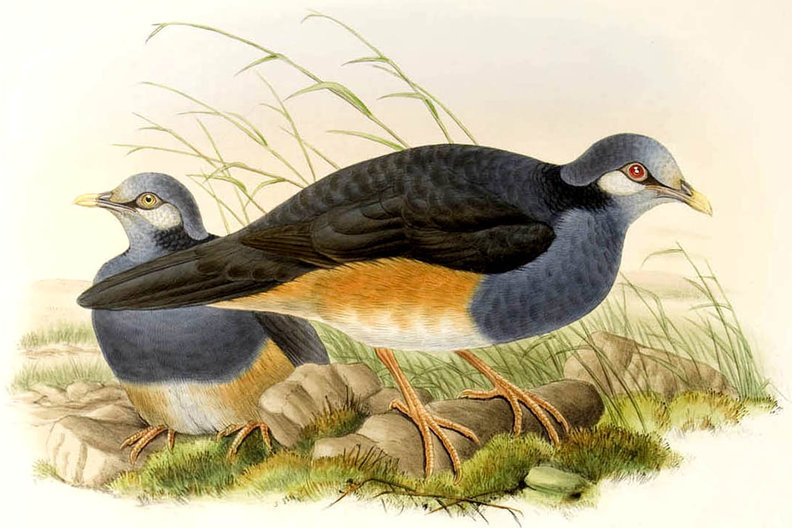
Thick-billed Ground Pigeon

Thick-billed Ground Pigeon

Trugon terrestris

John Gould, Public domain, via Wikimedia Commons

Mourning Dove

Mourning Dove

Zenaida macroura

Rhododendrites, CC BY-SA 4.0, via Wikimedia Commons

Side by side

Thick-billed Ground PigeonMourning Dove
Scientific nameTrugon terrestris G. R. Gray, 1849Zenaida macroura (Linnaeus, 1758)
English nameThick-billed Ground PigeonMourning Dove
GroupBirdsBirds
ClassAves BirdAves Bird
OrderColumbiformes DovesColumbiformes Doves
FamilyColumbidae DovesColumbidae Doves
GenusTrugonZenaida Zenaida Doves
Named in18491758
Red List categoryLeast ConcernLeast Concern
EnvironmentNot recordedterrestrial
Countries on record3 countries23 countries
GBIF occurrence records253 records28,842,435 records

Rows where the two agree are shown in grey.

Where each is found

Only Thick-billed Ground Pigeon (3)

Only Mourning Dove (23)

From Catalogue of Life checklists and GBIF occurrence records. A country missing from a list means no record is held, which is not proof of absence.

Checked facts

Thick-billed Ground PigeonMourning Dove
Appearance
  • The species has uniform bluish-grey or brownish-grey upperparts, a grey breast, and an orangey-buff belly. English Wikipedia
  • The species has a broad bill with a pale tip, pale ear coverts, and a short nape crest. English Wikipedia
  • Its underwing coverts have prominent black-and-white streaks, while its tail lacks bands. English Wikipedia
  • The species has pale legs and a long, thick bill with a pale tip. ebird.org
  • Males and females have similar external appearances. English Wikipedia
  • The Mourning Dove has predominantly light gray-brown upperparts and lighter, pinkish underparts. English Wikipedia
  • The Mourning Dove has black spots on its wings and white outer tail feathers. English Wikipedia
  • The species has a distinctive crescent-shaped patch of dark feathers below each eye. English Wikipedia
  • Adult males have purple-pink patches on the sides of their necks and a bluish-gray crown. English Wikipedia
  • Females are generally browner and slightly smaller than males. English Wikipedia
  • Juvenile Mourning Doves have darker plumage with a scaly appearance. English Wikipedia
  • The species has a relatively small head and a long, pointed tail. animaldiversity.org
  • Mourning Doves have a small black bill and red legs and feet. animaldiversity.org
Size
Habitat
  • The species inhabits moist tropical lowland forests. English Wikipedia
  • Its lowland forest habitat extends to elevations of approximately 650 m. English Wikipedia
  • The species is usually found in primary humid forest but can also use partially cleared areas. English Wikipedia
  • Mourning Doves inhabit urban areas, farms, prairies, grasslands, and lightly wooded areas. English Wikipedia
  • The species avoids swamps and dense forests. English Wikipedia
  • Mourning Doves are especially common in open woodlands and forest edges near grasslands and fields. animaldiversity.org
  • Agricultural and suburban environments provide particularly abundant habitat for Mourning Doves. animaldiversity.org
Diet
  • The species feeds on fruits and seeds that have fallen to the forest floor. English Wikipedia
  • It picks up fruits with its bill and strikes them against the ground to expose their seeds. English Wikipedia
  • Small food items are swallowed whole. English Wikipedia
  • The species sometimes forages at magnificent bird-of-paradise display arenas for regurgitated seeds. English Wikipedia
  • Seeds constitute more than 99% of the Mourning Dove's diet. English Wikipedia
  • Mourning Doves commonly consume agricultural grains including corn, millet, rye, barley, and oats. animaldiversity.org
Behaviour
  • Mourning Doves generally forage on the ground by walking rather than hopping. English Wikipedia
  • Mourning Doves swallow fine gravel or sand to assist digestion. English Wikipedia
  • Mourning Doves produce a whistling sound with their wings during flight, particularly during take-off and landing. English Wikipedia
  • Mourning Doves are swift and direct fliers. animaldiversity.org
  • Adult Mourning Doves sometimes distract predators from their nests by pretending to have an injured wing. animaldiversity.org
Reproduction
  • Breeding appears to occur throughout the year. English Wikipedia
  • Nests have been recorded between February and October. English Wikipedia
  • The species nests in hollows in the ground, potentially concealed among the buttress roots of large trees. English Wikipedia
  • The nest may be unlined, contain a few twigs or leaves, or have a more elaborate structure. English Wikipedia
  • The female lays a single white egg. English Wikipedia
  • Both parents incubate the egg, with the male routinely taking daytime incubation duties. English Wikipedia
  • Fledged chicks remain within their parents' territory for approximately one month. English Wikipedia
  • Mourning Doves are generally monogamous and form strong pair bonds. English Wikipedia
  • A typical Mourning Dove clutch contains two white eggs. English Wikipedia
  • Both male and female Mourning Doves participate in incubating their eggs. English Wikipedia
  • Mourning Dove eggs generally hatch after approximately two weeks of incubation. English Wikipedia
  • Both parents feed newly hatched squabs crop milk during their first three to four days. English Wikipedia
  • Young Mourning Doves generally leave the nest approximately 11–15 days after hatching. English Wikipedia
  • In warm regions, a Mourning Dove pair can raise as many as six broods in one year. English Wikipedia
  • Young Mourning Doves can become capable of breeding at approximately 85 days old. animaldiversity.org
Distribution
  • Mourning Doves occur from southern Canada through the United States to Panama. animaldiversity.org
Conservation
  • The species is classified as Least Concern by the International Union for Conservation of Nature. English Wikipedia
  • The species has a very wide range and is not considered subject to any particular threats. English Wikipedia
  • Mourning Doves are currently classified as widespread and abundant rather than threatened. animaldiversity.org
UsesNo checked fact yet
  • Mourning Doves are hunted recreationally as game birds in North America. animaldiversity.org
  • Mourning Doves are hunted for both sport and meat in the United States. English Wikipedia
Similar species
  • The species' thick bill and white cheek distinguish it from similar pigeons. ebird.org
  • The Mourning Dove is closely related to the Eared Dove and Socorro Dove. English Wikipedia
Name originNo checked fact yet

In brief

Thick-billed Ground Pigeon

Trugon terrestris is native to the island of New Guinea, where it inhabits moist tropical lowland forests. It is distinguished by its thick bill with a pale tip and its white cheek. Full profile

Mourning Dove

Zenaida macroura occurs from southern Canada through the United States to Panama. It has a distinctive crescent-shaped patch of dark feathers below each eye. Full profile

Compare something else

Page built on 28 November 2026 from the data on the two species pages, where every source is listed.

Cite this page

ScientificNames.org. (2026). Thick-billed Ground Pigeon vs Mourning Dove. Retrieved November 28, 2026, from https://scientificnames.org/compare/thick-billed-ground-pigeon-vs-mourning-dove